Agenore Fabbri: colour lithograph with seated figure and abstract signs
Limited edition 33/75, 1970s: when Tuscan sculpture meets lyrical abstraction on paper
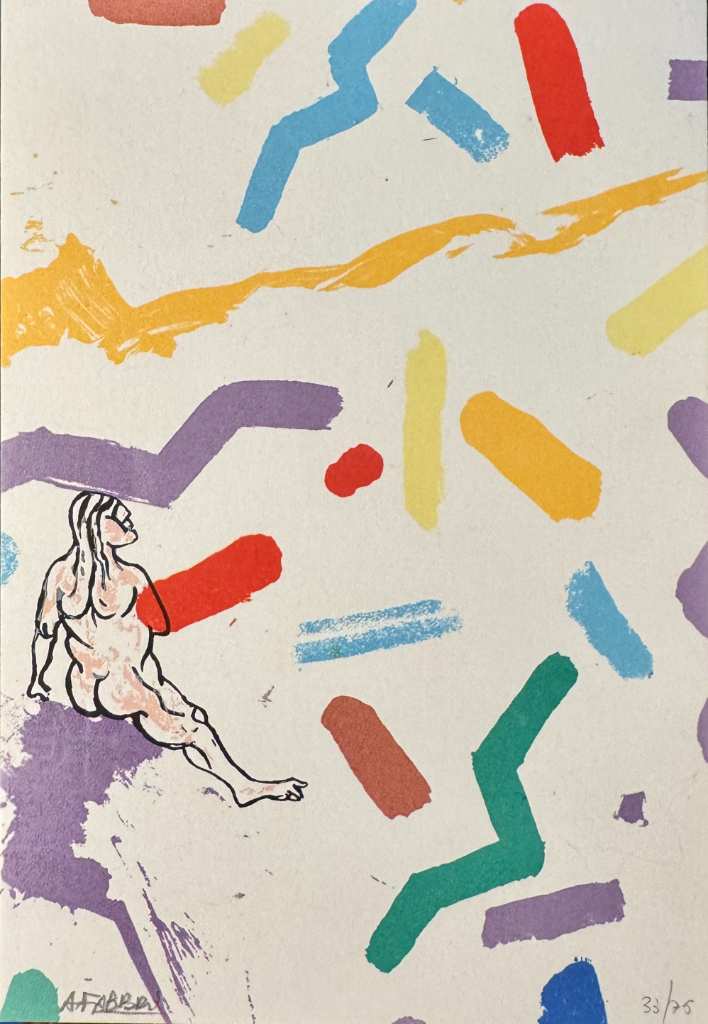
A seated human figure emerges from the chromatic field like a silent apparition. Essential black line, barely suggested contours, and around it a whirl of abstract signs – yellow, red, blue, violet, green – floating on the pale surface of the paper. This colour lithograph, signed in pencil and numbered 33/75, documents a crucial moment in the graphic production of Agenore Fabbri (Barba, Pistoia 1911 – Savona 1998), when the Tuscan sculptor translated into two dimensions the expressive tensions that animated his three-dimensional works. Created between approximately 1970 and 1980, the work testifies to the uninterrupted dialogue between figuration and abstraction that characterised the artist's entire creative trajectory.
Bibliographic notes
Agenore Fabbri belongs to that generation of Italian sculptors who, trained in the 1930s, traversed the post-war period redefining the national plastic language. A pupil of Libero Andreotti at the Florence Academy, Fabbri developed a formal vocabulary that combined the lesson of Tuscan tradition with the demands of European expressionism. His graphic production, less known than his sculpture but equally significant, concentrated mainly between the 1960s and 1980s, a period when the artist collaborated with specialist printers for limited editions destined for the collectors' market. The lithographs of this period, like the present example, reflect the same expressive urgency as the sculptures: essential human figures, often seated or crouching, immersed in chromatic fields that oscillate between lyrical abstraction and figurative memory. The edition of 75 numbered examples places this work in the medium-high range of Fabbri's graphic production, which rarely exceeded one hundred copies per edition. The combination of pencil signature and limited numbering follows the editorial conventions established by Italian artist-printmakers in the post-war decades.
Provenance and condition
Example 33/75 presents good general conditions, with fresh colours that maintain the original vibrancy of the print. The margins remain intact, without tears or losses, and the paper shows no signs of foxing or significant yellowing. The artist's pencil signature, placed lower right according to the editorial custom of the period, appears clear and legible. The numbering 33/75, positioned lower left, confirms the intermediate position of the example within the edition, generally considered neutral with respect to collectible value (low numbers and higher ones tend to be more sought after). No restoration interventions or traces of previous aggressive framing are recorded. The absence of documentation on specific provenance does not constitute a critical element for graphic works of this period, often acquired directly from galleries or art fairs without formal certifications. The overall conservation suggests adequate custody over time, probably in a controlled domestic environment. The paper support, characteristic of quality lithographic editions of the 1970s, maintains good structural integrity without brittleness or significant discolouration.
Market value
The BookOracle valuation of €350-550 reflects the current market positioning for Agenore Fabbri's colour lithographs in limited edition. Analysis of the main Italian auction houses – Wannenes, Pandolfini, Il Ponte – and specialist online platforms such as Catawiki reveals consistent but non-speculative interest in the artist's graphic production. Lithographs from the 1970s, particularly those combining figure and abstraction like the present example, occupy the lower-medium range of the Fabbri market, dominated by bronze and ceramic sculptures that achieve significantly higher prices. The rarity score of 55/100 (Discrete index) confirms the availability on the market of analogous graphic works, whilst recognising the specificity of each numbered example. The edition of 75 copies, neither too large nor extremely limited, guarantees a balance between collectible accessibility and future appreciation potential. Recent comparables suggest stability in quotations, with occasional peaks for examples in exceptional condition or with documented provenance from notable collections. The price range positions this lithograph as an accessible entry point for collectors interested in post-war Italian graphic art.
Why it matters
This lithograph represents a privileged point of access to Agenore Fabbri's creative universe for collectors interested in Italian twentieth-century graphics. The work condenses in accessible format the expressive tensions that animated the artist's research: the dialogue between body and space, the formal synthesis that reduces the human figure to a few essential strokes, the use of colour as emotional field rather than descriptive tool. For those who know Fabbri primarily through his sculptures, this lithograph offers a complementary perspective, revealing how the artist's plastic thinking translated into two-dimensional terms without losing intensity. From a historical-artistic viewpoint, the work testifies to the vitality of artist's graphics in the 1970s, when many Italian sculptors – from Marino Marini to Giacomo Manzù – devoted themselves to printmaking as an autonomous expressive medium. For the contemporary collectors' market, it represents an opportunity to acquire at contained price an artist whose historical relevance is consolidated, with revaluation margins linked to the critical rediscovery of post-war Italian sculpture. The combination of autograph signature, limited numbering and adequate conservative conditions makes this example an ideal candidate for thematic collections dedicated to Tuscan graphics or Italian lyrical abstraction.
Comments
Loading…
Sign in or register to leave a comment
Sign in or register