Michel Seuphor on Capogrossi: the first monograph on the Informale master
Edizioni del Cavallino, 1954: foundational document of Italian sign abstraction with original artist dust jacket
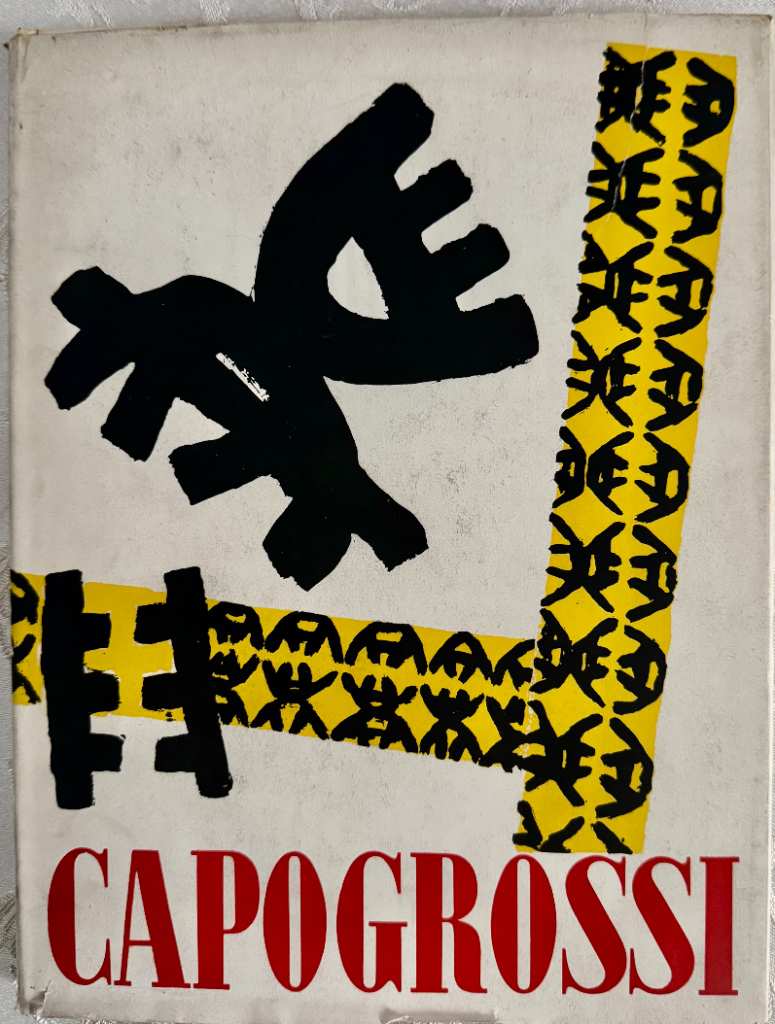
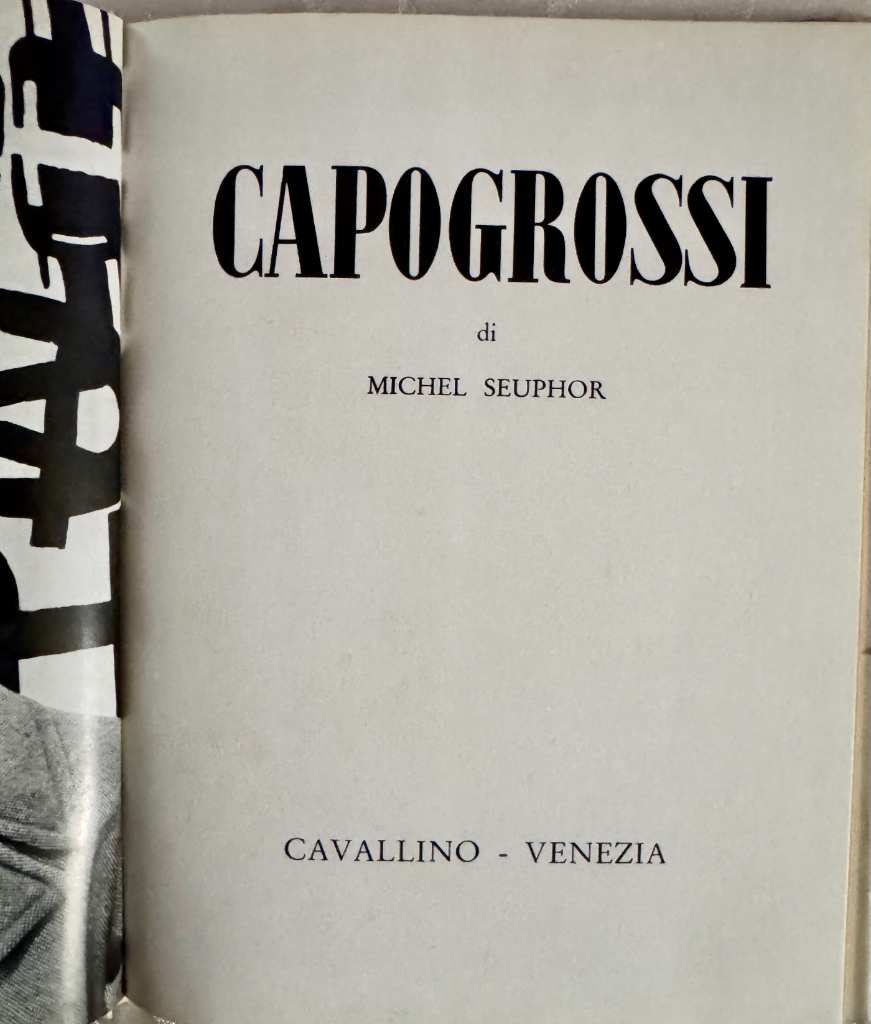
Within the publishing landscape of the Italian post-war avant-garde, few publications can claim the historical weight and bibliographic rarity of this first monograph dedicated to Giuseppe Capogrossi. Printed in 1954 by Edizioni del Cavallino in Venice, the work marks the moment when the visual language of the Roman master – with his unmistakable 'forks' – received its first international critical consecration through the pen of Michel Seuphor, historian of abstract art and privileged witness to the European avant-gardes.
Bibliographic notes
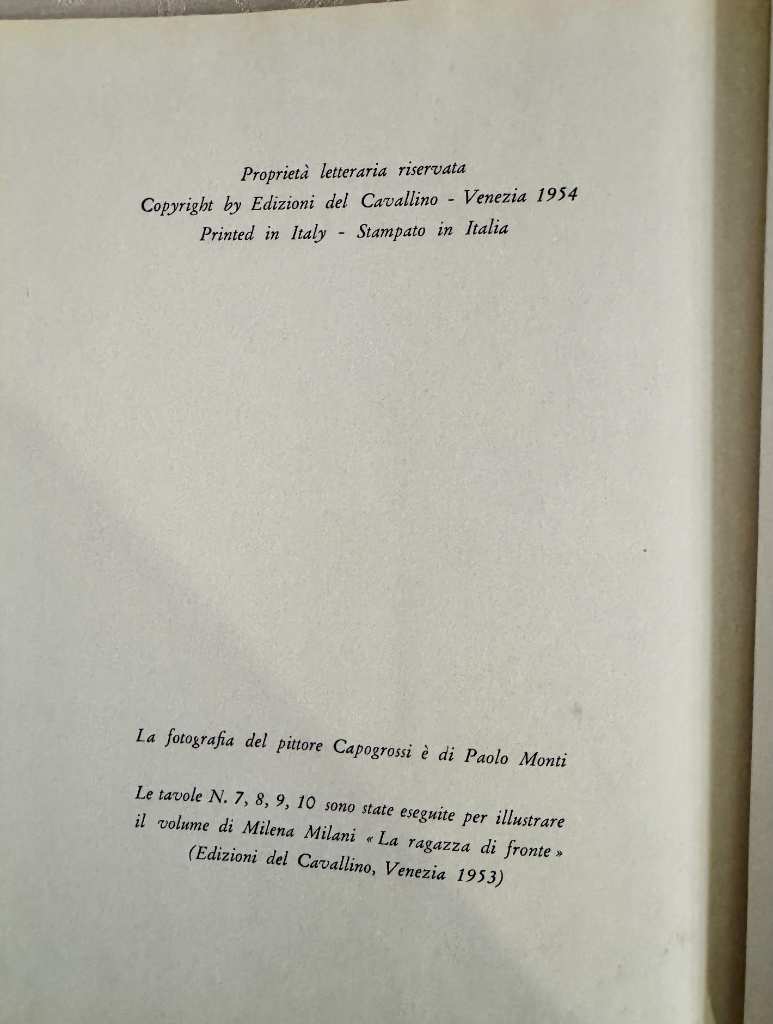
The volume presents itself in quarto format, bound in publisher's boards with illustrated dust jacket. The latter constitutes an element of particular distinction: designed by Capogrossi himself, it bears the fork-signs that from 1949 became the obsessive and generative nucleus of his pictorial research. The publication includes reproductions of works in black and white, according to the typographic standards of the period, and a photograph of the artist by Paolo Monti, master of Italian art photography. Seuphor's text – the Belgian critic naturalised French and author of the fundamental 'Dictionnaire de la peinture abstraite' (1957) – offers a penetrating reading of Capogrossi's abstract turn, which occurred in 1949 in conjunction with the foundation of Gruppo Origine alongside Burri, Colla and Ballocco.
Edizioni del Cavallino represents a crucial chapter in the history of contemporary Italian art. Founded by Carlo Cardazzo, a visionary gallerist who transformed Venice into a laboratory of artistic experimentation, they published between 1942 and 1972 a series of monographs and catalogues documenting the entire trajectory of Italian Informel and Spatialism. This first edition on Capogrossi belongs to a catalogue that includes volumes on Vedova, Fontana, Tancredi and other protagonists of the artistic scene of the time.
Provenance & condition
The copy under valuation presents itself in conditions consistent with the age and editorial nature of the volume. The presence of the original dust jacket – an element often lost or damaged in art books of this period – constitutes a determining factor for the quotation. Cavallino publications, printed in limited runs and destined primarily for collectors, gallerists and institutions, circulated in restricted circles and suffered the typical wear of consultation volumes. Copies in excellent condition, with intact dust jacket and without blooming or foxing, today achieve valuations significantly above average.
Paolo Monti's photograph adds a further level of documentary interest. Monti, active between the 1950s and 1980s, was the reference photographer for Italian artists, architects and cultural institutions, and his images today constitute primary iconographic sources for twentieth-century art history.
Market value
The BookOracle valuation places this copy in a market range between €180 and €350, with a discrete rarity index (58/100). This estimate reflects several concurrent factors: the historical-artistic relevance of the publication, the presence of the original dust jacket, the state of conservation, and sustained demand from collectors specialising in Italian Informel and post-war artist editions.
The international antiquarian market registers variable quotations for this monograph. Copies lacking dust jacket or with evident damage fall within the lower range of the valuation fork, whilst copies in excellent condition, from artists' libraries or with autograph dedications, may exceed the upper limit of the estimate. Auctions specialising in twentieth-century art books have seen in recent years renewed interest in Edizioni del Cavallino publications, in parallel with the critical and commercial revaluation of Italian Informel.
Recent comparables on the European antiquarian market show a price range oscillating between €150 for copies in fair condition and €400-500 for exceptional copies. The presence of autograph dedications by Capogrossi or Seuphor can significantly increase value, taking the quotation beyond €600.
Why it matters
This monograph represents a foundational document for understanding Italian post-war abstraction. Capogrossi, after a long figurative phase, made in 1949 a radical turn towards a sign language reduced to the essential: the fork motif, repeated, varied, orchestrated in infinite combinations, becomes the alphabet of an art that refuses representation to explore the pure possibilities of the sign. Seuphor, direct witness to the historical avant-gardes and theorist of abstraction, offers in this volume one of the first critical interpretations of this research, placing it within the European context of abstract art.
For the art book collector, this edition constitutes an indispensable piece for reconstructing the publishing history of the Italian avant-garde. Edizioni del Cavallino, with their essential graphics and quality of reproductions, represent a model of art publishing that anticipates the formal solutions of the 1960s and 1970s. The dust jacket designed by Capogrossi transforms the volume itself into a work of applied art, according to a conception that merges criticism, publishing and artistic practice.
At a moment of renewed interest in Informel and post-war avant-gardes, this monograph offers the collector the opportunity to acquire a historical document at a still accessible quotation, likely destined to grow with the consolidation of Capogrossi's critical fortune and that of his generation.
Comments
Loading…
Sign in or register to leave a comment
Sign in or register