Claude Berge, Sculptures Multipètres (1962): mathematics meets surrealism
A rare plaquette documenting the encounter between graph theory and objet trouvé, prefaced by Philippe Soupault
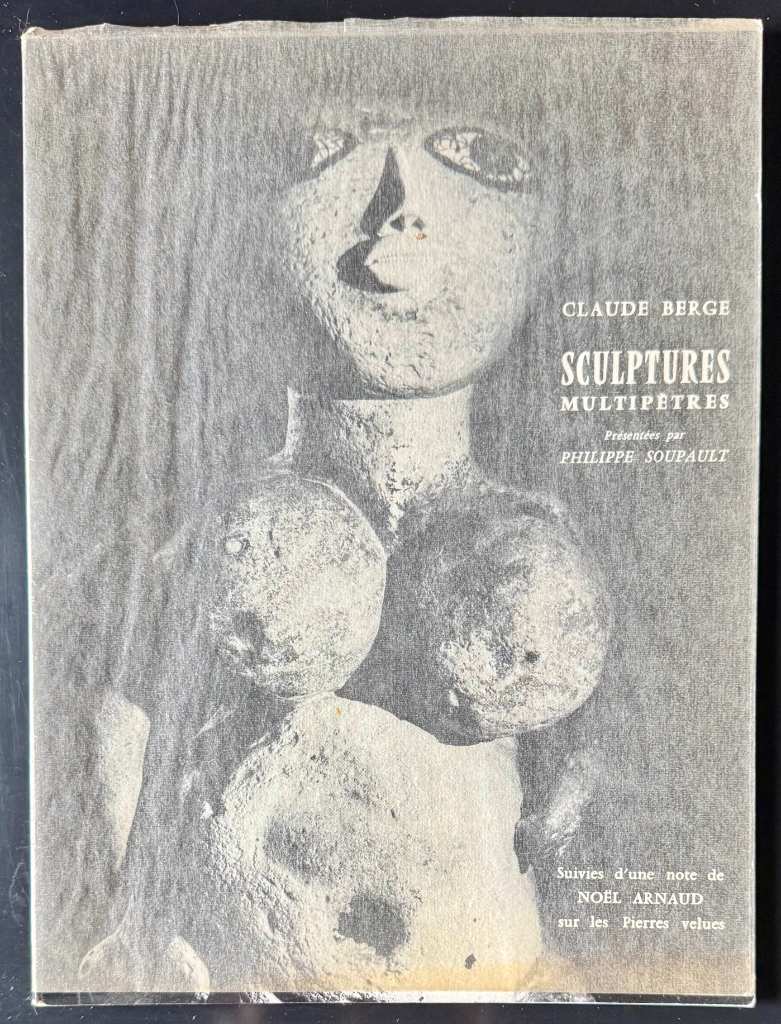
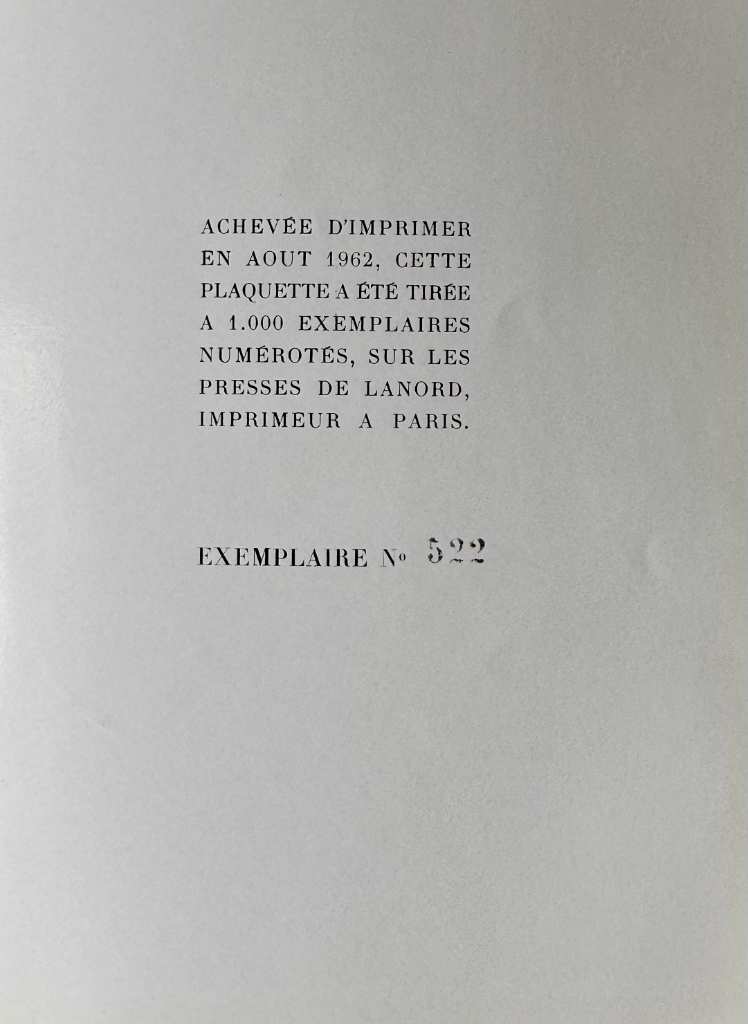
In August 1962, Presses de Lanord in Paris published a singular work: Sculptures Multipètres, signed by Claude Berge and presented by the Surrealist poet Philippe Soupault. The copy examined here, number 522 of a limited edition of one thousand numbered copies, constitutes a fascinating document of the encounter between mathematical rigour and Surrealist freedom, between science and the art of assemblage. Berge, destined to become one of the founding fathers of graph theory, reveals himself here as a sculptor of stones, a collector of natural forms that the human hand recomposes into precarious and poetic equilibria.
Bibliographic notes
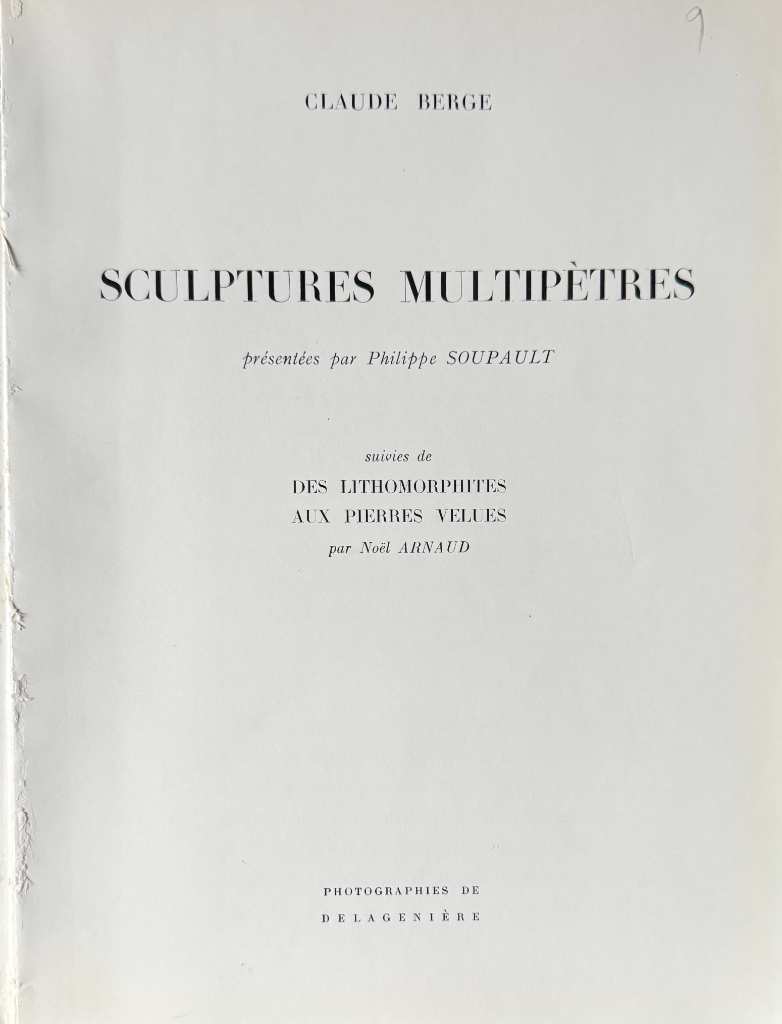
The plaquette is presented in quarto format, bound in illustrated publisher's wrappers featuring a black-and-white photograph of one of the author's sculptures, the work of photographer Delagenière. The volume includes a presentation by Philippe Soupault — a leading figure of the Surrealist movement, co-founder of the journal Littérature with André Breton — and an essay by Noël Arnaud entitled Des Lithomorphites aux Pierres velues (From Lithomorphites to Hairy Stones). Arnaud, a writer and member of Oulipo (Ouvroir de littérature potentielle), shared with Berge an interest in formal structures and creative constraints. The edition, printed in one thousand numbered copies, was never reprinted: this is therefore the first and only edition, a circumstance that enhances its bibliographic value. Delagenière's photographs document the "multipètres sculptures", assemblages of natural stones that Berge composed according to principles of balance and form, inscribing themselves in the tradition of the objet trouvé dear to Surrealism.
Provenance and condition
Copy number 522 presents itself in good general condition, with the normal patina of age that characterises publisher's wrappers from the 1960s. The illustrated cover retains its structural integrity, whilst showing the signs of time: slight marginal oxidation and a light browning of the paper support, physiological phenomena for a volume over sixty years old. No losses, tears or restoration interventions are noted. The absence of bookplates, stamps or manuscript annotations suggests that the volume has not passed through institutional collections, but has remained in private hands. The manuscript numbering (522/1000) is clear and well preserved. Overall, this is a copy from a private library, carefully kept but not subjected to museum conditions: a state that the market defines as "good" or "very good" according to Anglo-Saxon standards, entirely adequate for an artist's book of this period and typology.
Market value
The BookOracle valuation places this copy in the €95-150 range, with a "Discrete" rarity index (55/100). The price reflects several concurrent factors. On one hand, the limited print run (one thousand copies) and the absence of reprints confer a certain bibliographic scarcity upon the volume; on the other, the market niche — collectors of Surrealist editions, French artist's books from the 1960s, works connected to Oulipo — remains relatively circumscribed. The presence of Philippe Soupault as preface writer adds an element of historical-literary interest, whilst Claude Berge's name attracts the attention of bibliophiles interested in the history of mathematics and science. Consultations on AbeBooks and Maremagnum confirm the relative rarity of the title: copies offered for sale are sporadic, with prices ranging between €80 and €180 depending on condition and the presence of dedications or particular features. No recent auction passages at major international houses are recorded, a circumstance indicating a predominantly antiquarian market, with direct transactions between specialist bookshops and private collectors.
Why it matters
Sculptures Multipètres represents a cultural crossroads of considerable interest. Claude Berge (1926-2002) is remembered today primarily for his contribution to graph theory — particularly for the Berge conjecture on perfect graphs, proved only in 2002 — but his intellectual formation took place in the post-war Parisian milieu, in contact with artists, poets and writers. His friendship with Raymond Queneau led him to frequent Oulipo, where mathematics became an instrument of literary creation. The "multipètres sculptures" — the neologism plays on mètre (metre) and pierre (stone), evoking multiple measures and lithic compositions — embody this dual vocation: formal rigour and combinatorial freedom, calculation and chance, structure and surprise. Soupault's preface, by a poet who had explored automatic writing and the verbal unconscious, legitimises these stone compositions as authentic Surrealist objets trouvés, whilst Arnaud's essay inscribes them in a genealogy running from "lithomorphs" to "hairy stones", playing with fantastic taxonomy and pseudo-scientific nomenclature. For the collector, this volume thus offers rare testimony to a moment when art, literature and science intertwined in a fertile manner, anticipating subsequent research into conceptual art and visual poetry. Its presence in a private library signals an interest in border zones, in books that escape rigid classifications and that document, with discretion and intelligence, the intellectual adventures of the French twentieth century.
Comments
Loading…
Sign in or register to leave a comment
Sign in or register