Dada Zurich: the revolutionary 1920 manifesto that brought avant-garde to Italy
The exceptionally rare first Italian edition edited by Tristan Tzara, a graphic and literary testament to the movement that subverted European art
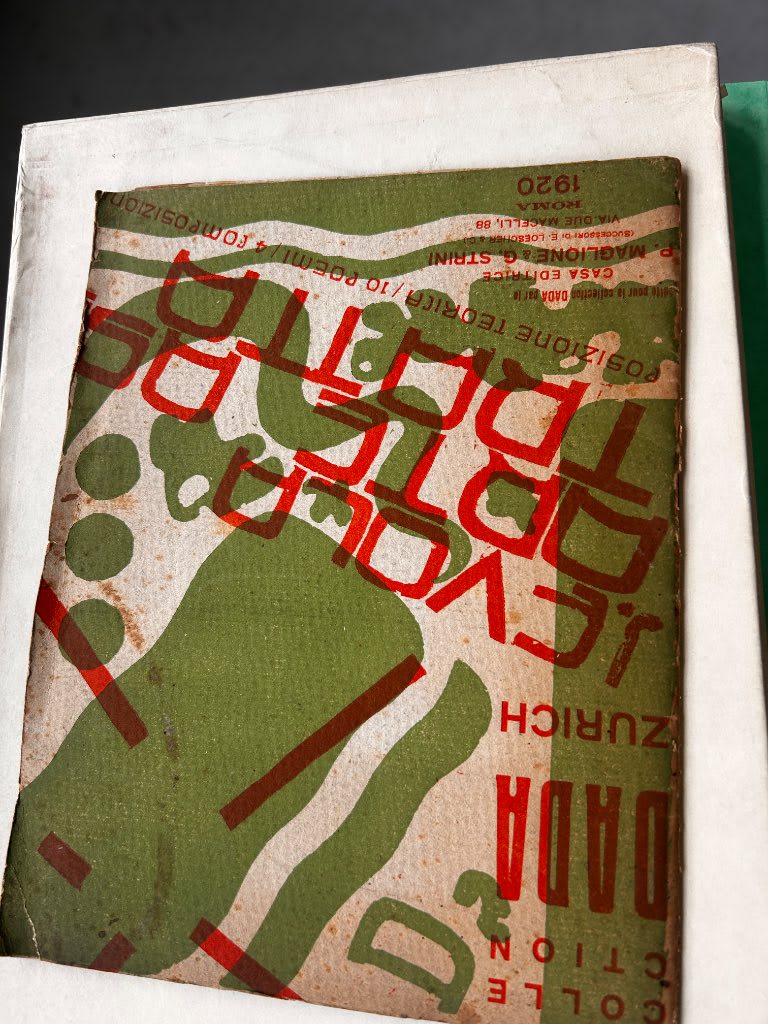
Among the avant-garde publications of the immediate post-war period, few documents possess the disruptive force of this Dadaist fascicle that appeared in Rome in 1920. Published by Maglione & Strini, "Dada Zurich - Collection Dada" represents one of the very first attempts to transplant onto Italian soil the iconoclastic gospel born in Zurich cafés during the Great War. The typographic cover, with its overlapping letters in green and red, constitutes a visual manifesto of the revolutionary aesthetic that Tristan Tzara and his associates were spreading across Europe.
Bibliographic notes
Edited by Tristan Tzara, the Romanian-French poet and central figure of the Dada movement, this fascicle collects theoretical and poetic texts from the Zurich nucleus that had given birth to the movement at the Cabaret Voltaire in 1916. The 1920 Roman edition occupies a crucial moment: whilst Dada was expanding from Zurich towards Berlin, Paris and New York, Italy remained relatively unexplored territory for these radical experimentations. The editorial choice by Maglione & Strini testifies to significant cultural openness in a country where Marinetti's Futurism still dominated avant-garde discourse.
The constructivist graphics of the cover merit particular attention: the compositional dynamism, bold use of colour and typographic superimposition anticipate solutions that would become canonical in modernist design of the 1920s and 1930s. Every visual element challenges the publishing conventions of the era, transforming the cover itself into a conceptual artwork embodying the movement's anti-aesthetic principles.
Provenance & condition
The copy presents in original wrappers, a format respecting the ephemeral and anti-monumental nature of Dadaist publications. The visible signs of use are perfectly consistent with a document over a century old, testifying to a life lived rather than sterile preservation. The presence of a modern protective case ensures future preservation of this fragile paper artefact.
The extreme rarity of this publication derives from multiple factors: the limited print run typical of avant-garde editions, the perishable nature of the medium, and above all the scarce diffusion that the Dada movement initially enjoyed in Italy. Whilst Parisian or Berlin publications of the movement benefited from wider distribution circuits, Italian editions remained confined to restricted circles of intellectuals and artists. Many copies were lost or destroyed, rendering each survival a significant bibliographic event.
Market value
The valuation of €3,750-6,000 reflects the extraordinary rarity of this document, certified by a 92/100 index in the "Super Rare" category. The international market for Dadaist publications has registered growing interest over the past two decades, with original editions achieving increasingly elevated prices at major auction houses.
Italian Dadaist publications, due to their scarcity, tend to exceed in relative value their more common French or German counterparts. A copy in comparable condition of "391", Francis Picabia's magazine, was sold by Christie's for approximately €4,200 in 2019, whilst fascicles of the Zurich "Dada" magazine reached €5,500 at Swann Galleries. The present Roman edition, for its uniqueness within the Italian context, positions itself in the upper range of this market segment.
The presence of the protective case adds conservative value, an element increasingly appreciated by institutional collectors. Specialised libraries and modern art museums represent the principal potential purchasers for documents of this historical relevance.
Why it matters
This fascicle transcends its monetary value to assume the dimension of a primary cultural document. It represents the moment when Italy, though dominated by Futurism and its nationalist drifts, opened itself to international currents of the avant-garde. The choice to publish Tzara in Rome in 1920 testifies to the existence of transnational intellectual networks that survived the fracture of war.
For scholars of the historical avant-gardes, this publication offers irreplaceable research material on the Italian reception of Dadaism. The theoretical texts contained illuminate the movement's diffusion strategies, whilst the graphic realisation documents the transfer of visual competencies between different European centres of the avant-garde.
In an era when the art market constantly re-evaluates the contribution of the historical avant-gardes, possessing such a rare document means safeguarding an authentic fragment of that cultural revolution which redefined the boundaries of art in the twentieth century. Its presence in a private or institutional collection constitutes a reference point for understanding how radical ideas circulated in post-war Europe, challenging national borders and consolidated aesthetic conventions.
Comments
Loading…
Sign in or register to leave a comment
Sign in or register