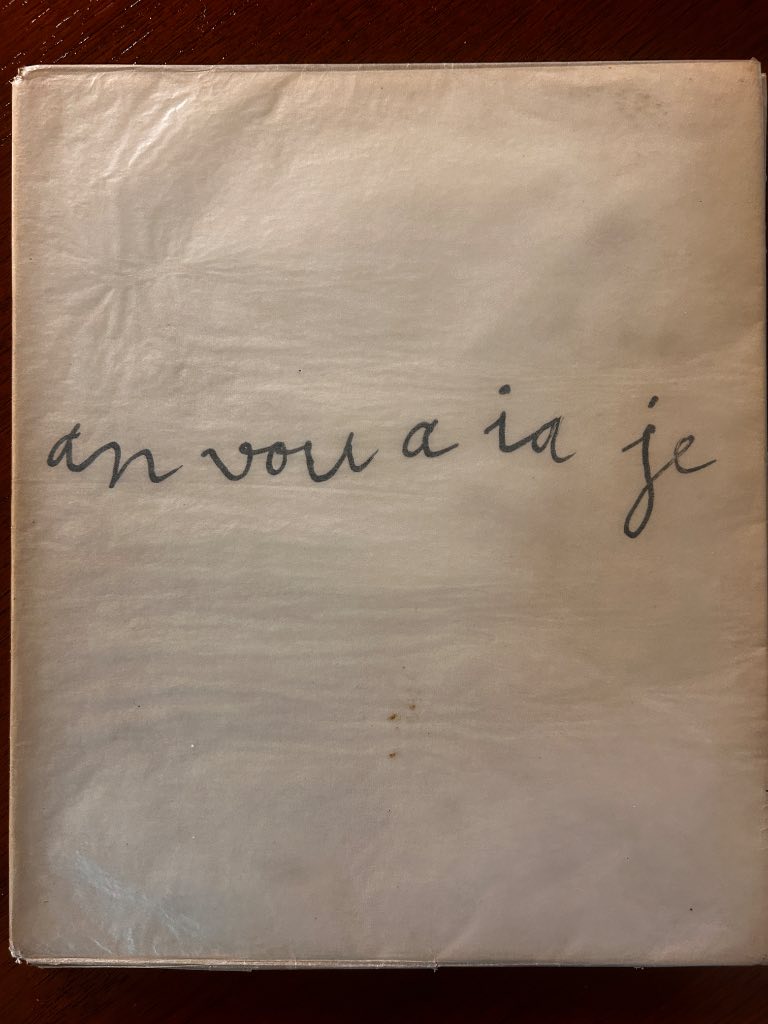
Anvouaiaje par in ninbesil avec de zimaje by Jean Dubuffet (1950)
Exceptionally rare livre d'artiste in pataphonie with 9 signed original lithographs, edition of only 23 copies
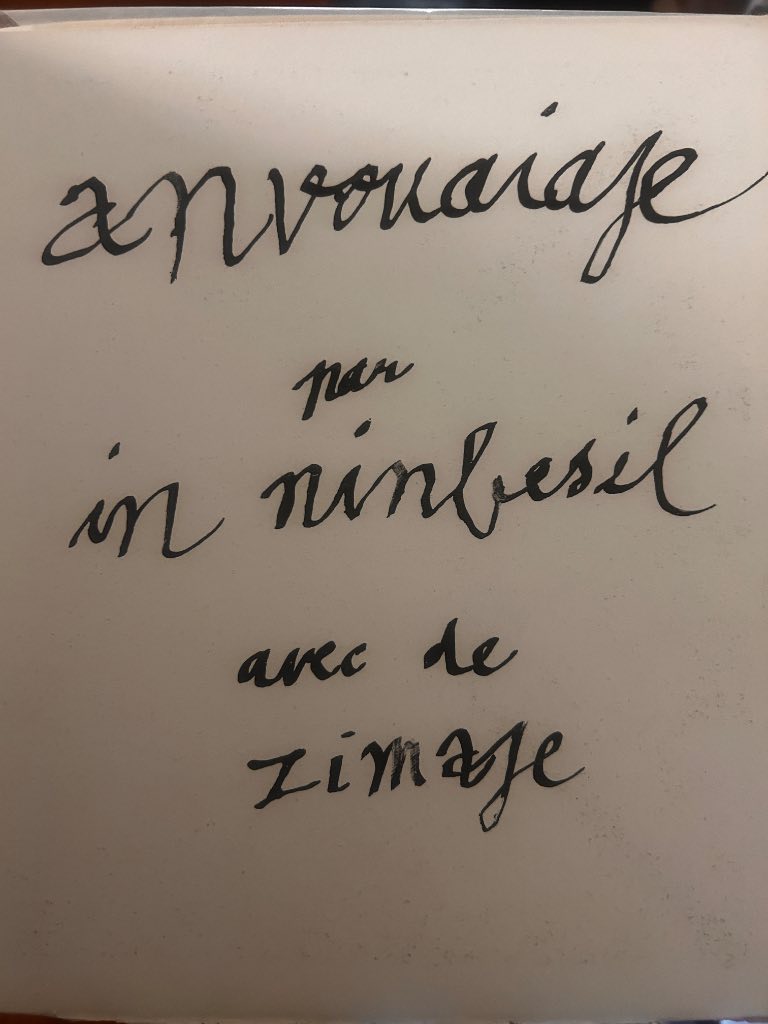
In the landscape of French post-war livres d'artiste, few works embody the rupture with academic tradition as radically as this 1950 volume by Jean Dubuffet. Anvouaiaje par in ninbesil avec de zimaje represents an unprecedented linguistic and visual experiment: a text written entirely in pataphonie — the phonetic system invented by the artist — accompanied by nine signed original lithographs, produced in an edition of merely twenty-three copies on handmade paper.
The work belongs to the most fertile moment of Dubuffet's production as artist-publisher, when the inventor of Art Brut sought to subvert every cultural convention through a completely autonomous visual and verbal language. The autograph dedication on the first page — "à Monsieur Ninbesil avec de l'image" — constitutes a further element of bibliographic uniqueness, transforming this copy into direct testimony of the relationship between artist and recipient.
Bibliographic notes
The publication belongs to the experimental phase of Dubuffet's editorial production, when the artist employed pataphonie as an instrument of rebellion against academic language and official culture. The title itself — roughly translatable as "Journey of an imbecile with images" — reveals the corrosive irony and anti-intellectual attitude that characterised Dubuffet's thinking during those years.
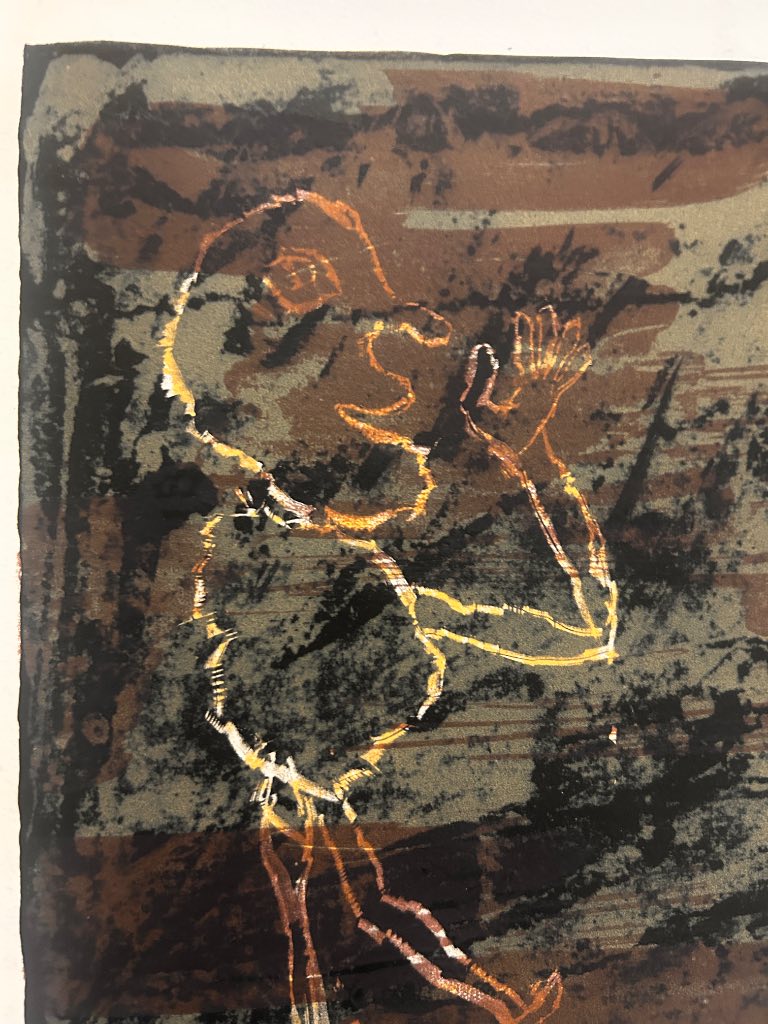
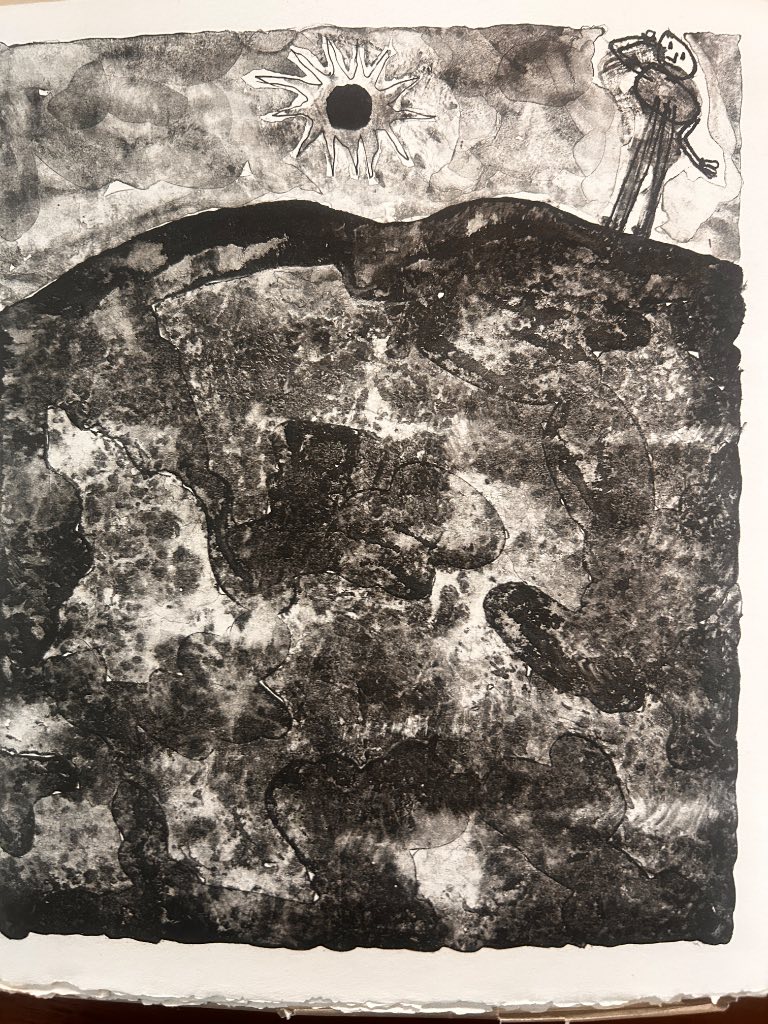
The nine signed original lithographs display the artist's characteristic informal technique: stylised anthropomorphic figures emerge from dense materic textures, realised with that immediate gesturality which anticipated European informal research by several years. The choice of lithography as medium allowed Dubuffet to maintain the spontaneity of graphic mark-making, avoiding the technical refinement of traditional engravings.
The edition of twenty-three copies places this work among the artist's rarest publications. The handmade paper, chemically untreated, confers upon the volume that raw materiality coherent with Art Brut aesthetics. Each copy constitutes effectively an artist's multiple, where the serial component does not compromise the object's uniqueness.
Provenance & condition
The autograph dedication "à Monsieur Ninbesil avec de l'image" on the first page represents a significant provenance element, although the identity of the original recipient requires further archival research. The dedicatory formula ironically reprises elements from the title, suggesting a personal relationship between artist and collector.
The state of preservation proves generally good, with marginal foxing perfectly compatible with the use of chemically untreated handmade paper. This type of chromatic alteration, far from constituting a defect, testifies to the authenticity of materials employed and coherence with Dubuffet's aesthetic choices, which privileged "poor" and non-industrial supports.
The lithographs maintain the original freshness of pigments, without significant fading or oxidation. The artist's autograph signatures remain perfectly legible, a crucial element for authenticating graphic works of the period. The original binding, presumably artisanal, preserves structural integrity despite the seventy years elapsed since publication.
Market value
The valuation of €18,000-28,000 reflects the work's extraordinary bibliographic rarity and historical-artistic significance. With a rarity score of 92/100 and "super" classification in the rarity index, this volume belongs to the category of museum-quality livres d'artiste, destined for institutional or private collections of the highest level.
Market references consulted — Artprice for Dubuffet lithographs of the 1950s and Christie's Paris for a 1951 portfolio — confirm the solidity of the estimate. Signed original lithographs from this period achieve individual quotations between €2,000 and €5,000, but the presence of nine examples in such a rare editorial context exponentially multiplies overall value.
The severely limited edition constitutes the primary value driver: twenty-three copies represent virtually nil market availability, considering that many are probably preserved in museum institutions or inaccessible private collections. The autograph dedication adds a premium estimated between 15% and 25% compared to a non-dedicated copy.
The market for French post-war livres d'artiste has shown consistent growth in recent years, with particular interest in works anticipating subsequent movements such as Fluxus and concrete poetry. This Dubuffet volume represents a fundamental precedent for both currents, an element strengthening its desirability among international collectors.
Why it matters
Anvouaiaje par in ninbesil avec de zimaje is not simply a rare book: it is a three-dimensional artistic manifesto, where invented language, informal images and raw materiality converge in an object defying every traditional categorisation. The work anticipates by at least a decade Fluxus experimentation with nonsense language and concrete poetry, positioning Dubuffet as unrecognised precursor of movements that would dominate the 1960s.
Pataphonie — the invented linguistic system rejecting conventional syntax and semantics — represents the verbal equivalent of Art Brut: an attempt to create pure expression, uncontaminated by cultural conventions. In this sense, the volume constitutes unique testimony to Dubuffet's thinking at the moment of his maximum theoretical radicality.
For collectors of livres d'artiste, this work offers the opportunity to acquire a fundamental piece of twentieth-century publishing history, an object belonging simultaneously to the history of art, experimental literature and avant-garde typography. Its extreme rarity guarantees that every market appearance constitutes a bibliographic event of international significance.
Comments
Loading…
Sign in or register to leave a comment
Sign in or register