Gianfranco Donegà in Stockholm: 1963 exhibition catalogue
A refined exhibition document from Konstsalongen Samlaren witnessing the international reach of Italian Informalism in Scandinavia
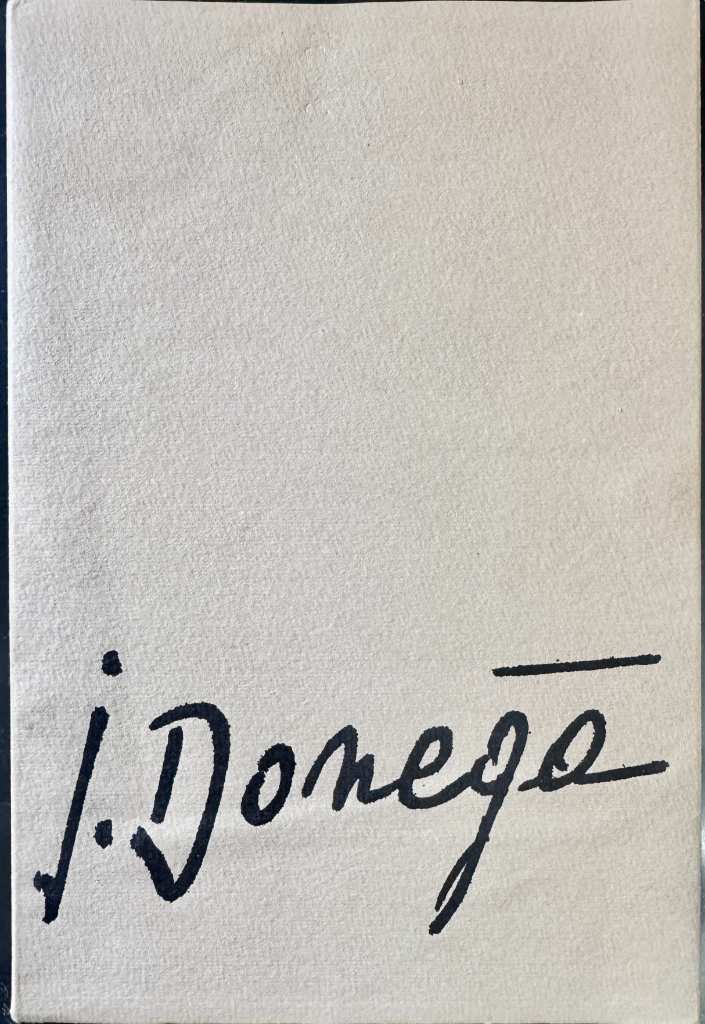
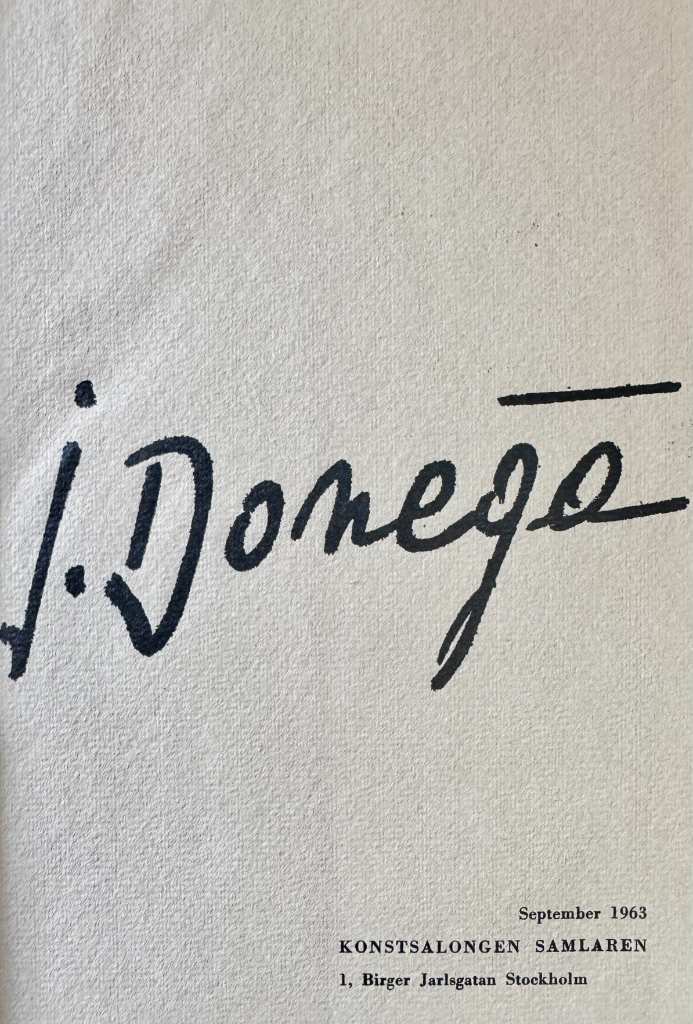
In September 1963, as Italian Informalism enjoyed growing international recognition, Konstsalongen Samlaren in Stockholm dedicated a solo exhibition to Gianfranco Donegà. The catalogue documenting this event now stands as valuable testimony to Italo-Scandinavian artistic relations during a crucial decade for European abstract art. Published as an elegant paperback with a laid-paper cover bearing the artist's stylised signature in black, the volume offers a privileged vantage point on the circulation of Informalist research beyond Italian borders.
Bibliographic notes
The catalogue presents itself in paperback format with a quality laid-paper cover, an editorial choice reflecting the typographic attention characteristic of Scandinavian art publications of the period. Donegà's stylised signature dominates the cover in black, a graphic element conferring immediate visual impact to the document. The edition, produced by Konstsalongen Samlaren — a Stockholm gallery active in promoting contemporary European art — belongs to the Nordic tradition of sober yet refined exhibition publications. This is not an extended monographic volume but rather an agile instrument accompanying the exhibition, a typology customary for solo shows in private galleries of the era. The 1963 first edition remains the only documented one, a circumstance common for catalogues of temporary exhibitions in non-museum spaces.
Provenance & condition
The copy bears no specific provenance indications, a frequent element in publications of this kind that were rarely signed or inscribed except on particular occasions. The state of preservation reflects the sixty years elapsed since publication: the laid paper of the cover, though elegant, tends to show signs of use compatible with its age. The paperback binding, an economical yet dignified technique, may present slight weakening at the spine or hinges, typical of volumes handled during exhibition events. The absence of serious structural defects or losses — tears, extensive staining, pronounced foxing — places the copy in fair condition, adequate for a historical-artistic consultation document. The internal paper, presumably of good weight according to Scandinavian standards, should have resisted time better than the exposed cover.
Market value
The valuation stands between €25 and €60, a range consistent with the market for solo exhibition catalogues of second-generation Italian Informalist artists. The positioning reflects several factors: Gianfranco Donegà (Schio 1930 – Milan 2018), though a recognised figure of Lombard Informalism trained at the Brera Academy and active between Milan and Paris, does not reach the quotations of first-tier masters of Spatialism such as Fontana or Burri. Catalogues from private Scandinavian gallery exhibitions of the 1960s, however interesting from a historical-documentary standpoint, circulated in limited but not exceptionally rare print runs, and specific demand remains confined to niche collectors. The rarity score of 55/100 ("Fair" index) confirms intermediate availability: not common, but neither unobtainable for those frequenting the specialised market. Analogous catalogues of contemporary Informalist artists in Northern European exhibitions fall within similar ranges, except in cases of particular critical relevance or presence of original graphic works.
Why it matters
The catalogue's importance transcends its monetary value and resides in its documentary significance. The 1963 Stockholm exhibition testifies to the penetration of Italian Informalism in Scandinavia, a geographical area traditionally attentive to abstraction but more inclined towards Nordic declinations (CoBrA, Finnish geometric abstraction). Konstsalongen Samlaren's choice to dedicate space to Donegà signals interest in the Italian variant of gestural and material painting, characterised by Mediterranean chromatics and a relationship with Milanese Spatialism. For scholars of Italo-Scandinavian artistic relations, the catalogue constitutes a primary source documenting alternative exhibition circuits to major institutions, highlighting the role of private galleries in the international diffusion of post-war Italian art. For collectors of Informalist art, it represents a useful piece in reconstructing the critical fortune of an artist who, though not rising to movement icon status, coherently embodied its material and sign-based research across a biographical arc spanning half a century.
Comments
Loading…
Sign in or register to leave a comment
Sign in or register