Giuseppe Capogrossi and D'Ars Agency: a Milanese bulletin from 1963
When Italian Arte Informale became chronicle: the 1963 issue No. 2 with original cover by the master of abstraction
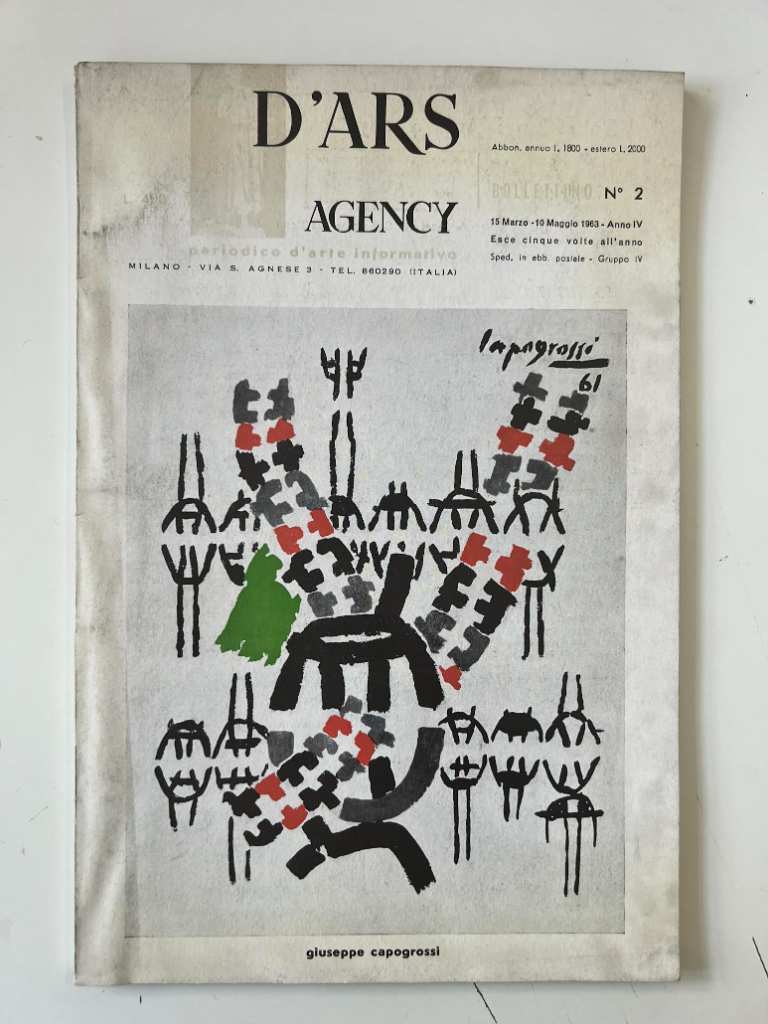
Within the Milanese publishing landscape of the early 1960s, few periodicals documented the ferment of Italian contemporary art with the clarity of D'Ars Agency. Issue number 2 of year IV, published between 15 March and 10 May 1963, stands out for a cover that is both document and artwork: a composition signed and dated 1961 by Giuseppe Capogrossi, undisputed master of European abstraction and co-founder of Gruppo Origine.
Bibliographic notes
D'Ars Agency was born in Milan in 1960 as an information and promotion tool for contemporary art, at a time when the Lombard city was establishing itself as the epicentre of Italian artistic debate. The periodical aimed to bridge the gap between galleries, collectors and the educated public, offering updates on exhibitions, movements and protagonists of the national and international art scene. The bulletin format, agile and informative, allowed widespread distribution among professionals and enthusiasts. The choice to entrust covers to leading artists transformed each issue into a small artist's multiple, elevating the periodical beyond its merely informative function. Giuseppe Capogrossi (Rome, 1900-1972) was at the time a figure of absolute prominence: after traditional academic training, he had made a radical turn towards abstraction in the 1950s, developing a visual alphabet of archetypal signs repeated obsessively. Co-founder in 1951 of Gruppo Origine alongside Alberto Burri, Ettore Colla and Mario Ballocco, Capogrossi had exhibited at the Venice Biennale and in important European galleries, establishing himself as one of the protagonists of Italian Arte Informale.
Provenance and condition
The copy under examination comes from an Italian private collection and presents itself in generally good condition, with the natural patina of time that characterises periodical publications from the 1960s. The cover, the element of greatest value, displays the celebrated Capogrossian 'signs': fork-shaped forms in black, red and green on a light background, arranged according to the serial and rhythmic logic that constitutes the core of the artist's poetics. The signature and 1961 dating attest that the composition was created two years before the bulletin's publication, probably granted by the artist or the gallery representing him. The internal pages preserve their structural integrity, with minimal signs of use compatible with the age and ephemeral nature of the paper support. No tears, losses or restoration interventions are noted. The metal staple binding, typical of periodicals of the era, is intact. Given that this is editorial material intended for consultation rather than archival preservation, the survival in decent condition of a copy over sixty years old represents in itself an element of interest for collectors and scholars.
Market value
The BookOracle valuation places this bulletin in the €35-55 range, with a discrete rarity index (45/100). The market for Italian art periodicals from the 1960s is segmented and specialist: prices depend on the publication's reputation, the presence of contributions or illustrations by established artists, condition and the completeness of any series. D'Ars Agency, whilst being a niche publication, benefits from growing interest in historical documentation of Arte Informale and in artist's multiples avant la lettre. The presence of Capogrossi's cover constitutes the element of greatest value: works on paper by the Roman artist, even in small format or editioned, achieve significant prices in the art market. However, as this is an editorial reproduction rather than an original signed and numbered work, the value remains contained. Comparables available on specialist platforms such as Maremagnum, AbeBooks and Catawiki confirm this price range for Italian art periodicals from the 1960s with covers illustrated by known artists. Copies of more celebrated titles or in exceptional condition may exceed €100, whilst issues without particular iconographic interest settle below €30. The discrete rarity reflects limited but not exceptional availability: D'Ars Agency had a circumscribed distribution, but not so restricted as to render every issue unobtainable.
Why it matters
Beyond its monetary value, this bulletin represents precious testimony to a crucial moment for Italian art. 1963 was a year of consolidation for abstract informalism, already moving towards a phase of critical reflection and historicisation. Capogrossi, at the apex of his artistic maturity, continued to decline his vocabulary of signs with almost obsessive rigour, demonstrating that repetition could generate infinite variations. D'Ars Agency's choice to entrust him with the cover testifies to the institutional recognition he enjoyed, but also to the periodical's desire to position itself as a qualified interlocutor in artistic debate. For collectors and scholars, this type of ephemeral material offers an irreplaceable cross-section of the circulation of ideas, the dynamics of the art market and the role of specialist publications in constructing the canon. In an era when artistic information travelled primarily through print, bulletins like D'Ars Agency were instruments for taste formation and orientation for buyers and enthusiasts. Preserving and valorising these documents means safeguarding the memory of an art system now vanished, but whose traces continue to illuminate the present.
Comments
Loading…
Sign in or register to leave a comment
Sign in or register