Henri Michaux's Meidosems: Visionary Lithographs from 1948
First edition of Michaux's lithographic masterwork, copy 51 of 250 on pur fil Johannot, with twelve original lithographs
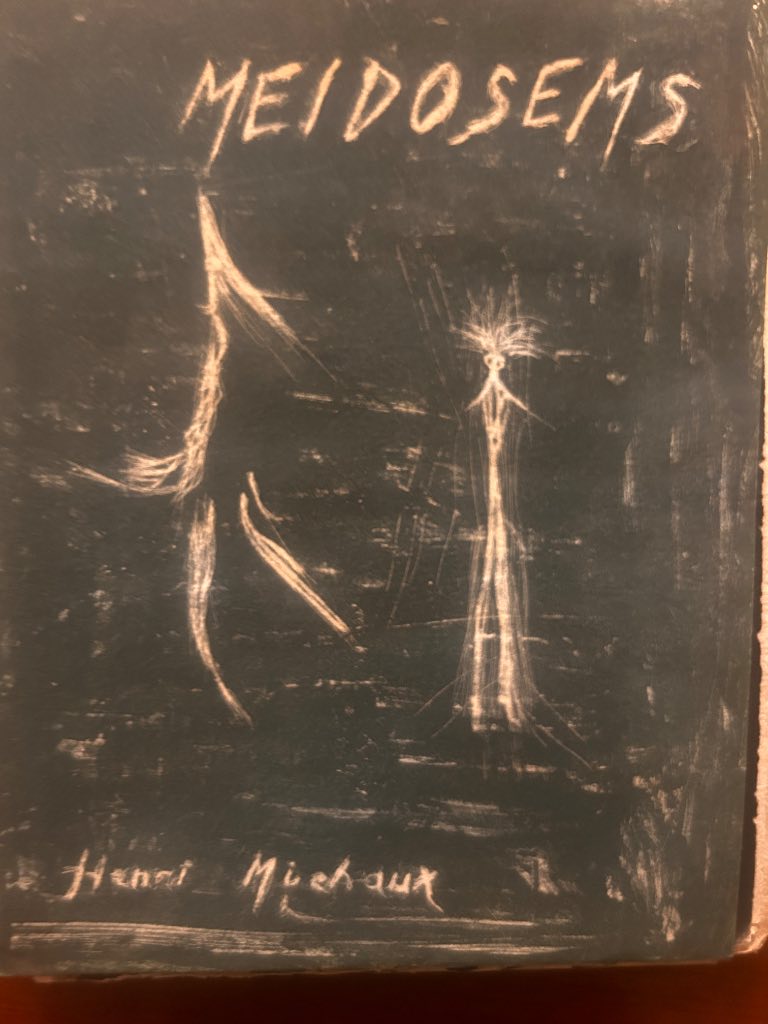
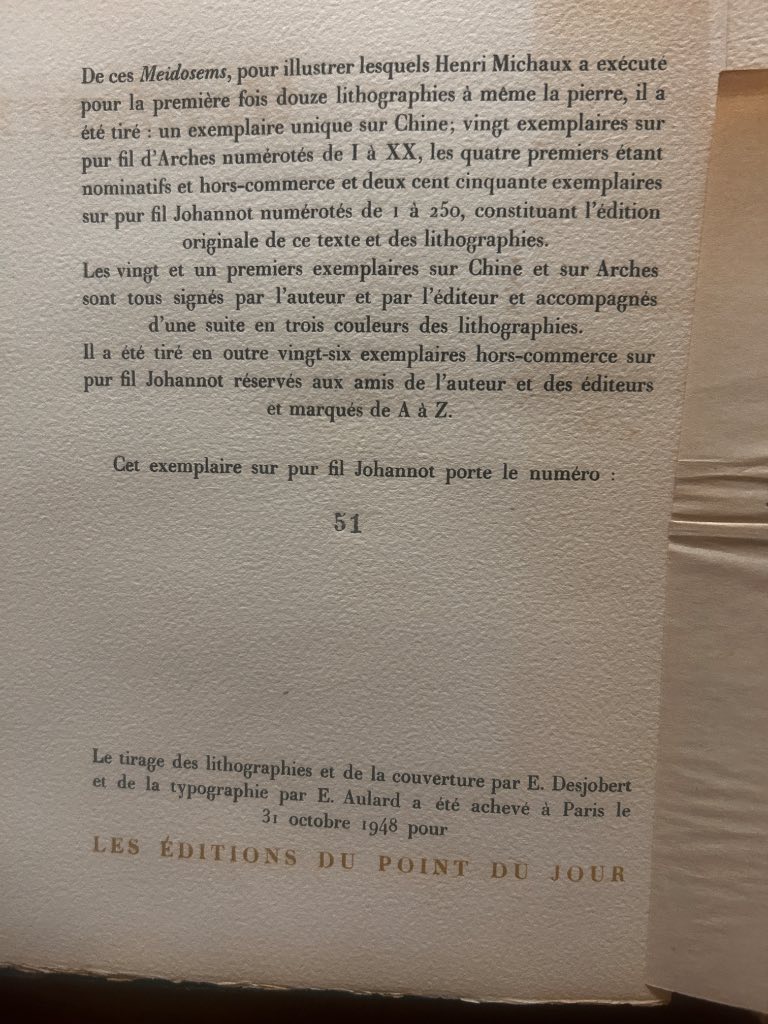
In the landscape of post-war French livres d'artiste, few works embody with equal visionary force the encounter between poetry and image as Henri Michaux's Meidosems, published in 1948 by Les Éditions du Point du Jour. This copy, number 51 from an edition of 250 on pur fil Johannot paper (from a total of 297 copies), represents the Belgian-French author's first venture into the lithographic medium, an adventure that would redefine the boundaries of his artistic practice.
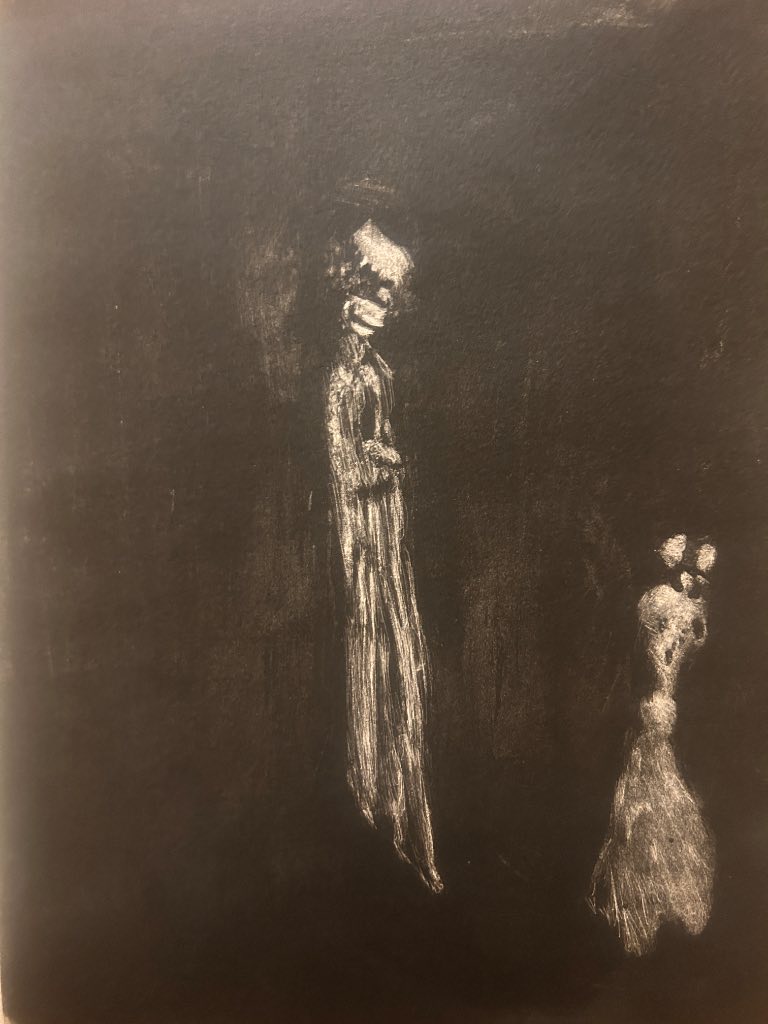
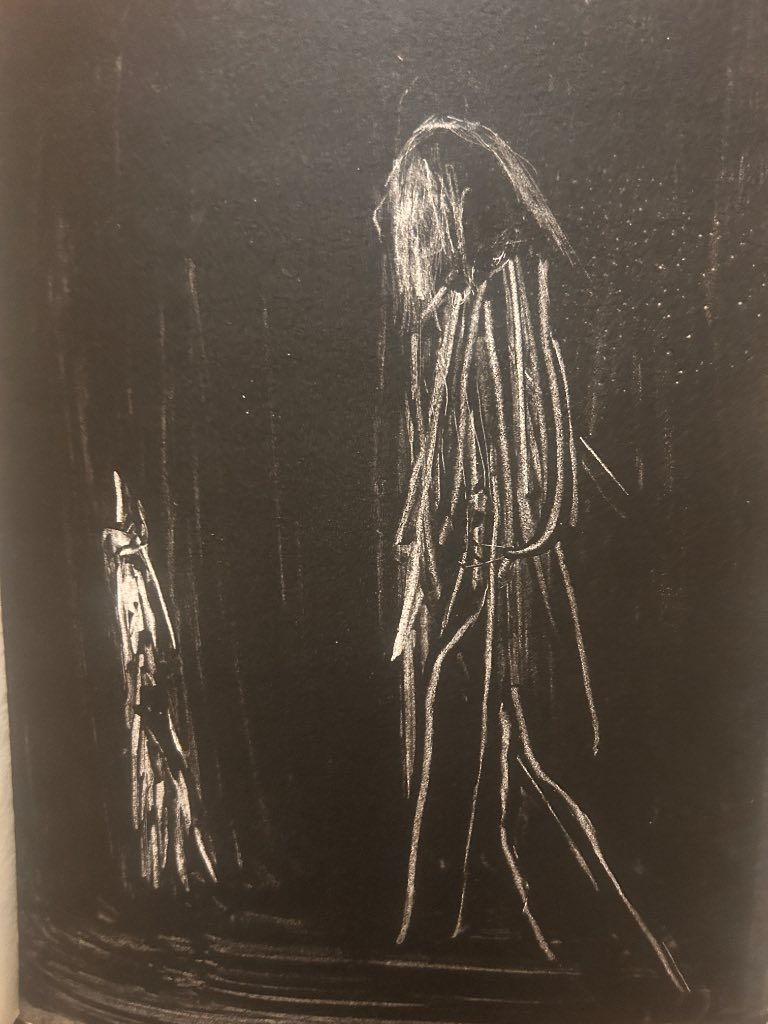
The Meidosems are fantastical creatures inhabiting a parallel universe of Michaux's imagination, spectral beings rendered through the elongated, characteristic forms that would become the hallmark of his visual production. The twelve original lithographs, drawn directly on stone by the artist and printed by E. Desjobert, possess an extraordinary nocturnal quality: white figures emerging from deep black grounds like apparitions, testimony to an aesthetic of the invisible that anticipates Michaux's subsequent experiments with altered states of consciousness.
Bibliographic notes
The first edition of Meidosems was published in quarto format with original lithographed wrappers designed by Michaux himself. The total edition of 297 copies divides into several categories: 250 numbered copies on pur fil Johannot paper (such as the present example), 40 copies on Arches paper with an additional suite, and 7 hors commerce copies. Typography was handled by E. Aulard, whilst the lithographs were printed by E. Desjobert, trusted printer to numerous artists of the École de Paris.
The choice of lithography as medium was far from casual. Michaux sought a technique permitting maximum expressive immediacy, a direct relationship between gesture and image that the lithographic stone offered uniquely. The volume's twelve plates show the Meidosems in various configurations: solitary, paired, in procession, always characterised by that phantasmal quality rendering them simultaneously present and elusive.
The work appears at a crucial moment in Michaux's career, when the artist was expanding his practice beyond the boundaries of written poetry. 1948 marks the beginning of a decade of intense visual experimentation that would culminate in the celebrated Mescaline Drawings of the 1950s.
Provenance & condition
This copy presents in good general condition, with characteristic wear to the lithographed wrappers testifying to the inherent fragility of this editorial solution. The original wrappers, a distinctive element of the edition, show signs of handling consistent with the volume's age, yet maintain their structural integrity and the legibility of Michaux's design.
The interior lithographs preserve their tonal depth, a crucial element for appreciating the dramatic contrast between white figures and black grounds that characterises the work's aesthetic. The pur fil Johannot paper, chosen for its absorption qualities and texture, has maintained its original consistency without evident foxing or yellowing, a factor contributing significantly to the copy's value.
The numbering "51" places this copy in the first half of the Johannot edition, a position some collectors consider preferable to higher numbers. The absence of authorial dedications or annotations is typical for this edition, where Michaux maintained a rigorously impersonal approach to distribution.
Market value
The valuation of €1,800–2,800 for this copy reflects the consolidated position of Meidosems in the twentieth-century artist's book market. The work represents a relatively accessible entry point into Michaux's bibliographic universe, an artist whose market standing has experienced steady growth over the past two decades.
Recent auctions at Christie's and Sotheby's Paris have recorded variable results for Meidosems, with copies in excellent condition reaching the upper estimate range, whilst examples with more evident defects have settled at the lower end. The presence of all lithographs in good condition is naturally determinant for final value.
Listings from leading specialist dealers on AbeBooks show a price range confirming the proposed valuation, with comparable copies offered between €1,600 and €3,200, depending on condition and documented provenance. The work's relative scarcity on the market—complete copies appear with limited frequency—supports price stability.
The rarity score of 72/100 assigned by BookOracle places Meidosems in the "high" category, reflecting both the limited edition and the work's historical-artistic importance. For Michaux collectors, this volume often represents the first significant acquisition, before moving towards the even rarer editions of the 1950s.
Why it matters
Meidosems occupies a pivotal position in Henri Michaux's bibliography for multiple reasons. Firstly, it marks the artist's lithographic debut, opening a chapter that would prove fundamental to his creative evolution. The techniques and aesthetic developed in these twelve plates—extreme contrast, spectral figure, emergence from blackness—would become constants of his visual production.
Secondly, the work testifies to the moment when Michaux begins conceiving text and image as equal elements of a unified vision. The Meidosems are not illustrations of a pre-existing text, but entities existing simultaneously in verbal and visual dimensions, anticipating the research into synaesthesia that would characterise his mescaline experiments.
From the perspective of livre d'artiste history, Meidosems represents a paradigmatic example of post-war Parisian production, when a new generation of publishers—such as Les Éditions du Point du Jour—sought to renew the illustrated book tradition through more integrated collaborations between poets and artists.
For the contemporary collector, owning a copy of Meidosems means safeguarding a fragment of that extraordinary creative season, a work that continues to interrogate the boundaries between writing and image, between the visible and invisible, between the known world and the unexplored territories of imagination.
Comments
Loading…
Sign in or register to leave a comment
Sign in or register