Kant in Milena Milani's Library: An Annotated 1932 Edition
The first Italian edition of the Groundwork of the Metaphysics of Morals with manuscript notes attributed to the writer and artist
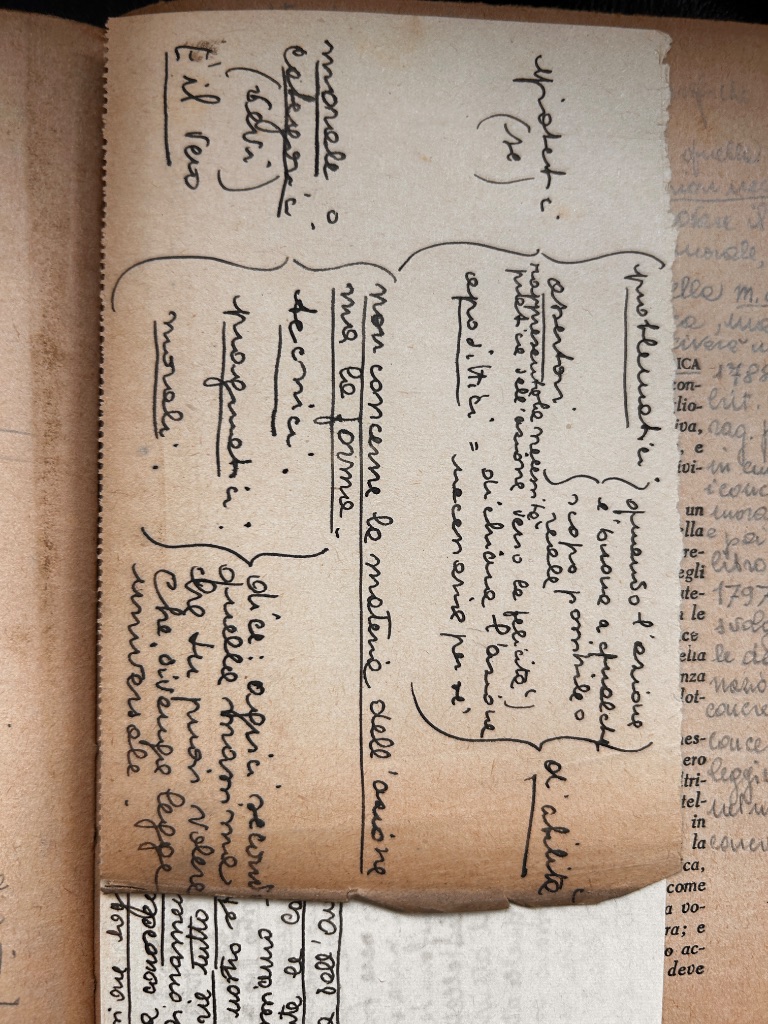
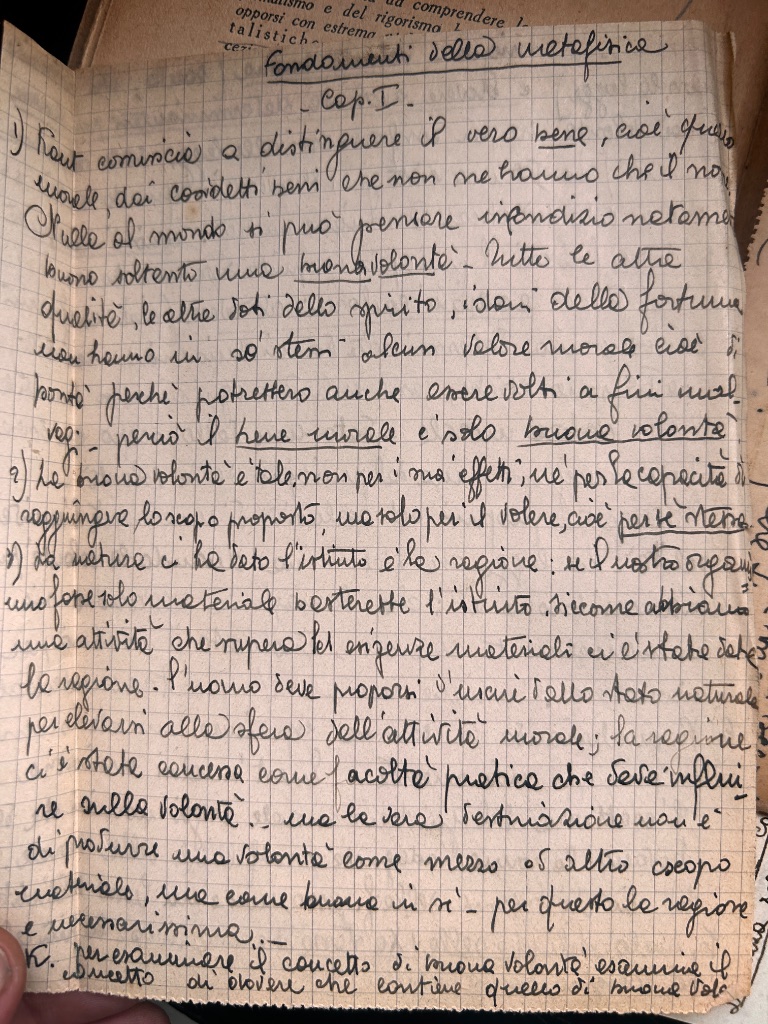
A copy of the first Italian edition of Immanuel Kant's Groundwork of the Metaphysics of Morals, published by Vallecchi in 1932, bears eloquent traces of an exceptional reader. The manuscript annotations in pen, inscribed on interleaved squared sheets and in the margins of the text, are attributed by the owner to Milena Milani (1917-2013), a multifaceted figure in twentieth-century Italian culture: writer, visual artist, art critic and life companion of Carlo Cardazzo, the gallerist who introduced Art Informel to Italy. This volume testifies not only to the dissemination of Kantian thought in interwar Italy, but also to the study methods and philosophical interests of an intellectual who would later weave aesthetics, ethics and civic engagement throughout her work.
Bibliographic notes
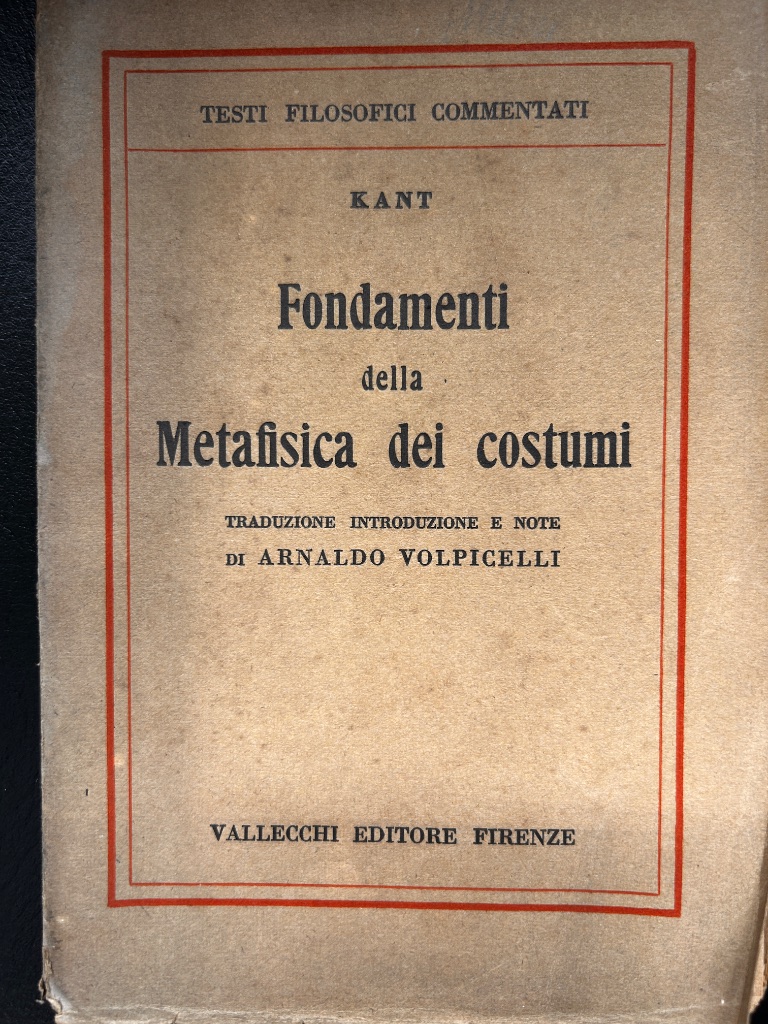
The translation by Arnaldo Volpicelli (1892-1968), a philosopher and educationalist of neo-idealist formation, placed the Groundwork in the series 'Testi Filosofici Commentati' directed by Guido Calogero for Vallecchi Editore. Published in Florence in 1932, this edition represents the first systematic attempt to make accessible to the Italian public the 1785 work in which Kant formulates the celebrated categorical imperative and outlines the principles of his deontological ethics. The octavo volume retains the original publisher's wrappers with impressed red border, characteristic of the series, and is distinguished by the critical apparatus prepared by the translator: a historical-philosophical introduction and explanatory notes contextualising the text within the tradition of Kantian criticism. The Volpicelli edition preceded by over a decade the more widely circulated translations of the post-war period and circulated primarily in academic circles and amongst lay intellectuals engaged in the ethical-political debate of the 1930s.
Provenance & condition
The copy presents extensive manuscript annotations in pen on interleaved squared sheets and in the text margins. According to the owner's attribution, the notes belong to Milena Milani, who at the time of publication was fifteen years old and would embark on literary and artistic studies in the immediately following years. The annotations testify to a systematic study of Kantian ethics: references recur to the 'good will' (guter Wille), practical reason and moral duty, central concepts of the Grundlegung. The handwriting, orderly and considered, suggests not casual reading but part of a formative journey. The attribution to Milani, though not documented by bookplates or explicit signatures, gains plausibility when considered in the context of her intellectual formation: the writer would later demonstrate, in novels and critical essays, an ethical sensibility and argumentative rigour consistent with youthful engagement with Kantian thought. The state of preservation is fair: the wrappers show wear to edges and spine, with small losses; foxing affects several leaves, more pronounced on the interleaved sheets. The body of the text remains intact and the annotations, though faded in places, are legible. The whole retains bibliographic dignity and documentary value.
Market value
The BookOracle valuation places the copy in the €150-300 range, with a fair rarity index (52/100). The price reflects several concurrent factors. On one hand, first Italian editions of philosophical classics from the 1930s, especially in specialist series, maintain a stable market amongst bibliophiles and scholars: comparable copies from the Vallecchi series in similar condition typically fall between €100 and €200. On the other, the presence of manuscript annotations can constitute an element of appreciation or depreciation depending on the verifiability of provenance. In this specific case, the attribution to Milena Milani, a significant figure in twentieth-century culture but not among the foremost names in Italian philosophy, adds documentary interest justifying the upper limit of the estimate, provided future research confirms the autography. Copies with certain and documented provenances from leading intellectuals (Croce, Gentile, Banfi) achieve substantially higher quotations, in the order of €500-1,000. The fair condition and foxing limit appeal to more demanding collectors, whilst the absence of autograph dedications or stamps from historic libraries reduces value compared to copies with institutional provenance. The reference market is that of modern philosophy books with authorial annotations, a niche but lively segment frequented by scholars of cultural history and collectors interested in the reception of European thought in Italy.
Why it matters
This copy of Kant's Groundwork stands at the intersection of publishing history, history of philosophy and intellectual biography. The Volpicelli translation represents a significant moment in the dissemination of Kantian criticism in Fascist Italy, when philosophical debate was dominated by Gentilian idealism but spaces remained for lay ethical reflection. The annotations attributed to Milena Milani, if confirmed, would offer an unprecedented glimpse into the youthful formation of a figure who would later interweave literature, visual art and civic engagement: the engagement with Kant in formative years would illuminate the ethical coherence running through her novels, from the denunciation of women's condition to the critique of bourgeois conformism. Even absent attributive certainty, the volume documents the reading and annotation practices of an era: the interleaved squared sheets, the fountain pen, the study method by key concepts reveal an approach to philosophical text now rare, replaced by digital highlighting and fragmentary notes. For scholars of Kantian reception in Italy, the copy constitutes material testimony to how the Groundwork was read and meditated upon outside academia, in a season when the ethics of duty could represent a silent alternative to regime rhetoric. For collectors, it is a borderline document: not rare enough to aspire to international auctions, not common enough to pass unnoticed. Its strength lies in the layering of stories it carries: that of Kant, that of Volpicelli, that of Milani, that of an Italy reading philosophy in wrappers.
Comments
Loading…
Sign in or register to leave a comment
Sign in or register