Buon Fine e Miglior Principio: Pivano & Sottsass, 1953
A hand-painted New Year's greeting documents the convergence of American literature and Italian design in the postwar era
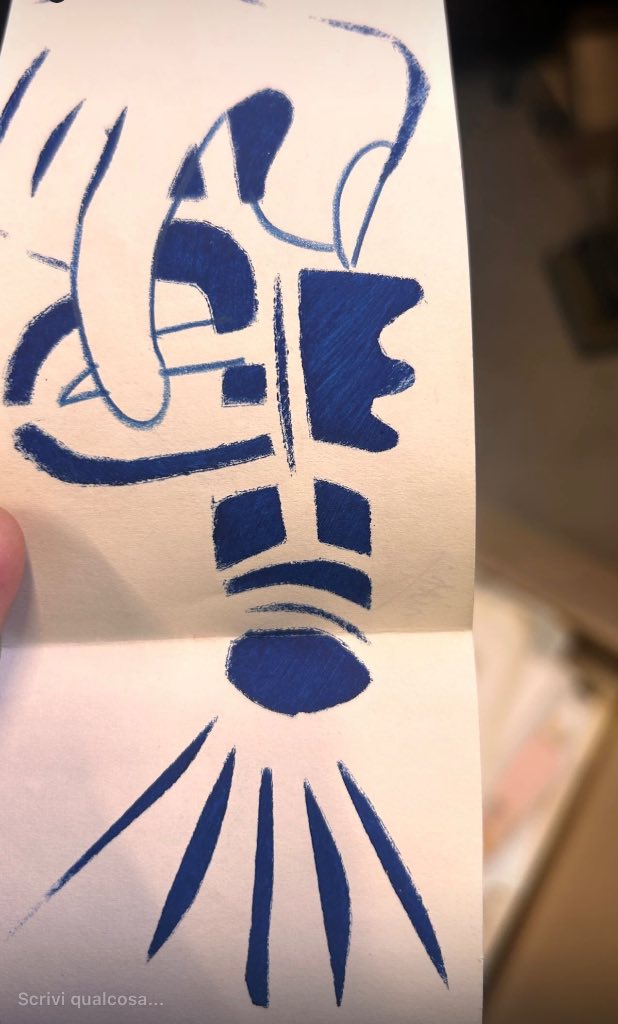
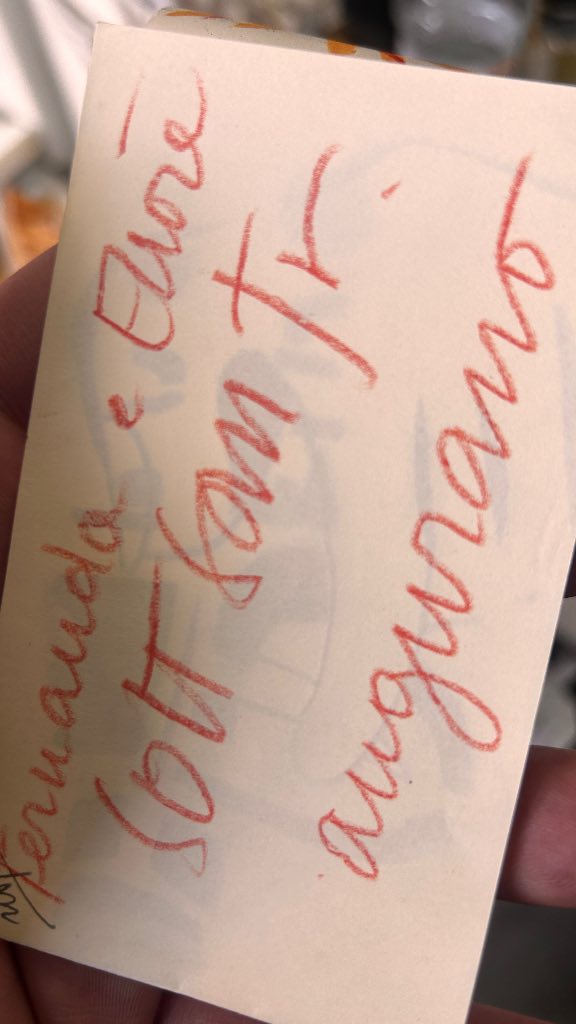
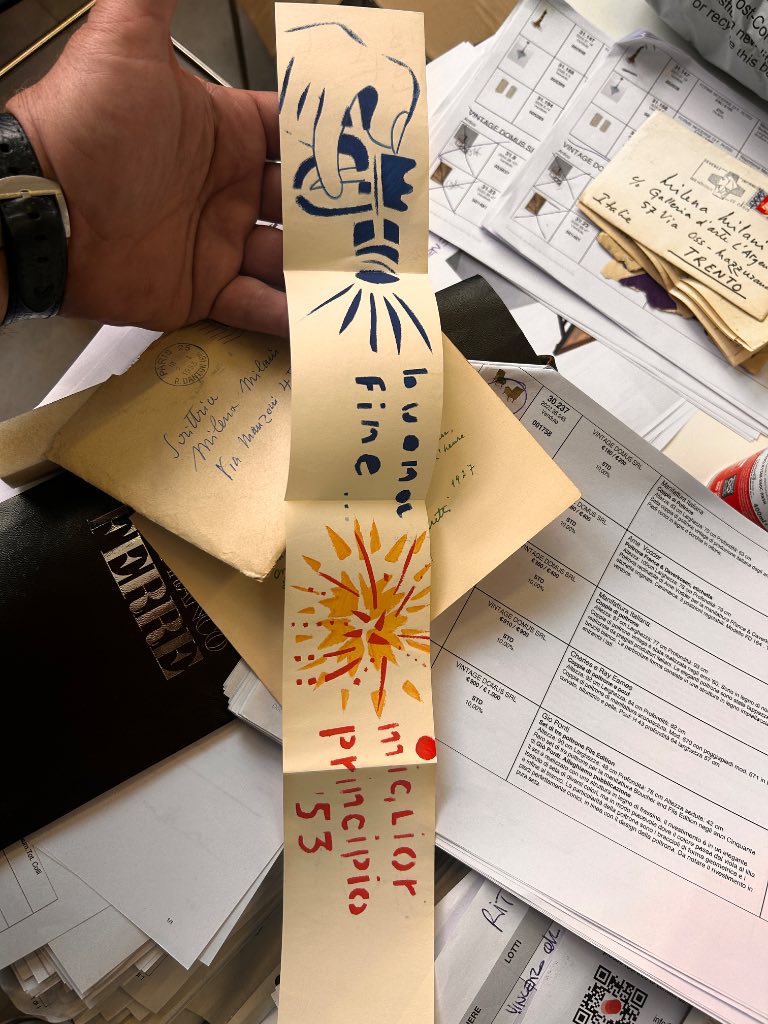
When Fernanda Pivano and Ettore Sottsass Jr. dispatched this New Year's greeting to the Milena tailoring house on Via Manzoni in Milan in January 1953, neither had yet achieved the global renown that would define their legacies. Yet this accordion-fold leporello, with its hand-painted gouache illustrations by Sottsass and Pivano's autograph dedication in red crayon, captures a pivotal moment: the dawn of a creative partnership that would redraw the boundaries between literary culture and visual innovation in postwar Italy.
Bibliographic notes
The leporello format, an Oriental binding technique adopted by European avant-garde artists, suits perfectly the ephemeral and intimate nature of this object. Sottsass's illustrations—a stylised blue hand holding a torch and an orange-yellow starburst explosion—anticipate the graphic vocabulary the architect-designer would develop over subsequent decades, culminating in the Memphis movement of the 1980s. The bold chromatic choices and essential geometry already reveal the influence of Bauhaus and American abstraction that Sottsass was absorbing during those years. Pivano's handwritten dedication adds a rare biographical dimension: these greetings were not intended for public circulation but represented private gestures within the Milanese intellectual circle. The absence of a declared print run and the artisanal nature of execution suggest a unique edition or extremely limited issue, probably not exceeding ten copies.
Provenance & condition
The recipient's address—the Milena tailoring house on Via Manzoni, artery of Milanese luxury—situates the object within the social fabric of the Lombard cultural elite. Via Manzoni, steps from La Scala and Brera, was the drawing room of reconstructive Milan, where intellectuals, artists and enlightened entrepreneurs converged. The choice to honour a tailoring house is not accidental: in 1953 Italian fashion was emerging as an international creative force, and the connections between design, architecture and haute couture were intense. The state of preservation appears remarkable for an object born ephemeral. The gouache colours retain vibrancy and saturation; the leporello paper, though subject to natural ageing, shows no losses or evident restoration. The autograph dedication in red crayon, particularly vulnerable to abrasion, remains legible and intact. The absence of structural damage to the accordion fold—a critical point in this format—testifies to careful conservation, probably in a controlled environment.
Market value
The BookOracle valuation of €1,800–3,500 reflects the extreme rarity of private works by the Pivano-Sottsass couple and the growing collecting interest in twentieth-century Italian authored ephemera. The market for Sottsass graphic works has surged following the Metropolitan Museum retrospective in 2017: preparatory drawings and unrealised projects have reached quotations between €5,000 and €15,000 at Cambi Casa d'Aste and Wright Chicago. However, the private and non-commercial nature of this greeting places it in a distinct niche. Wannenes Genova hammered an autograph letter from Pivano to Hemingway at €2,800 in 2021, establishing a precedent for the translator's epistolary documents. The differentiating element here is the double autography—literary and visual—and the early dating, anterior to the consecration of both figures. Collectors of twentieth-century Italian design, bibliophiles specialising in the Beat Generation, and museum institutions dedicated to the reconstructive period represent the most receptive market segments. The upper band of the estimate (€3,500) is justified in the presence of period photographic documentation or collateral correspondence that further contextualises the object.
Why it matters
This New Year's greeting transcends its original function to become a historical document of an unrepeatable era. In 1953 Fernanda Pivano had already translated Hemingway and was preparing the Italian versions of Faulkner and Steinbeck that would open Italy to American literature; Sottsass, fresh from his experience with George Nelson in the United States, was elaborating that synthesis between American functionalism and Mediterranean sensibility that would characterise Italian design. Their partnership—a marriage lasting until 1958—was a forge of contaminations: Pivano brought the voices of American counterculture, Sottsass translated those voices into visual form. This leporello is tangible testimony to that dialogue. For collectors, it represents a rare opportunity: to acquire an authentic fragment of the private life of two figures who shaped the Italian cultural imaginary of the second half of the twentieth century. For scholars, it offers an unpublished tessera in reconstructing Milanese intellectual networks and the mechanisms of symbolic exchange between literature and visual arts. In a market increasingly oriented towards documented provenance and biographical narrative, objects like this—intimate, autograph, historically situated—acquire exponential value.
Comments
Loading…
Sign in or register to leave a comment
Sign in or register