Eugenio Vaquer, Il Procuratore (1955): autograph dedication to Milena Milani
First Bompiani edition with author's dedication to the writer at the centre of the 1966 obscenity trial
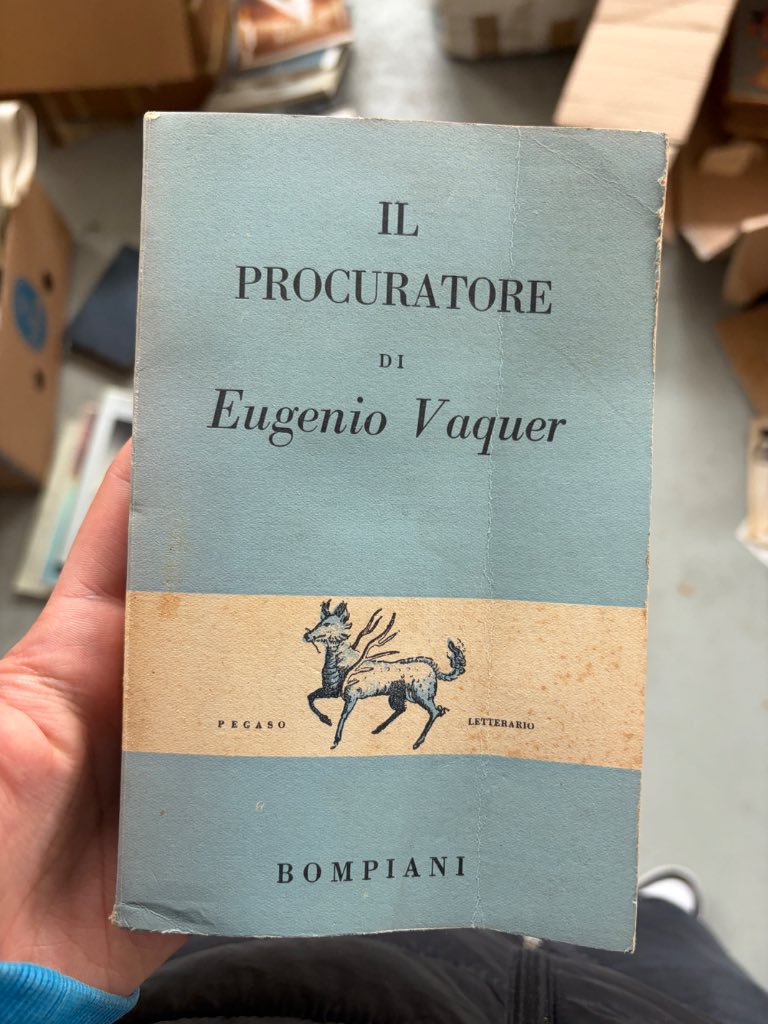
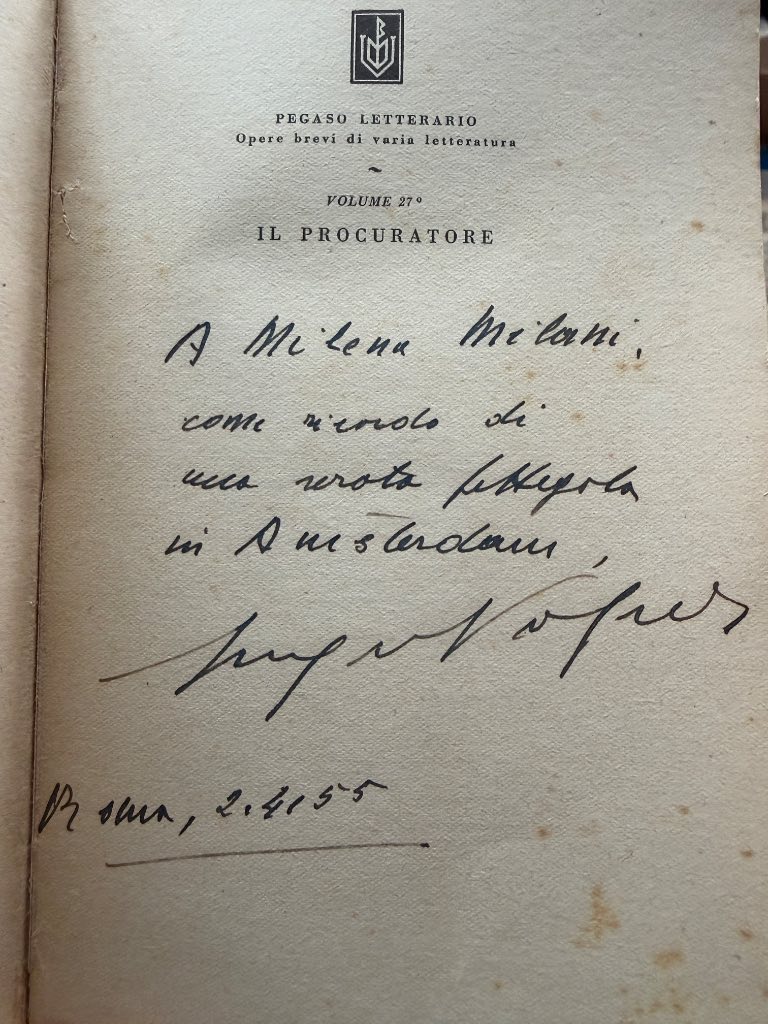
A copy of the first edition of Il Procuratore (Milan, Bompiani, 1955) bears on its front endpaper an autograph dedication from Eugenio Vaquer to Milena Milani, dated Rome, 2 April 1955. The inscription reads: 'A Milena Milani, come ricordo di una serata letteraria in Amsterdam' ('To Milena Milani, as a memento of a literary evening in Amsterdam'). The dedication transforms a volume of courtroom fiction into a document of the intellectual networks that crisscrossed post-war Italy, when writers, magistrates and journalists met in editorial offices, salons and European conferences.
Vaquer, a Roman magistrate active in forensic fiction, published Il Procuratore in the Pegaso Letterario series, Bompiani's imprint dedicated to contemporary narrative. The volume, in sextodecimo format, features the illustrated publisher's wrappers with the winged Pegasus on an ochre band, the distinctive graphic identity of the series. The recipient, Milena Milani (1917-2013), would become one of the most controversial voices in Italian literature: in 1966 her novel La ragazza di nome Giulio provoked an obscenity trial that shook public opinion and marked a crucial moment in the battle for freedom of expression.
Bibliographic notes
Il Procuratore appeared in 1955 as volume 27 of the Pegaso Letterario series, directed by Bompiani with the aim of promoting contemporary Italian authors alongside the Milanese publisher's classics. Eugenio Vaquer (1910-1989) built a parallel career between magistracy and literature, publishing novels and stories drawn from his experience in courtrooms. His fiction belongs to the strand of Italian legal fiction, less well known than its Anglo-Saxon equivalents but significant for its representation of the legal system in republican Italy.
The Pegaso Letterario series adopted a recognisable graphic style: covers with illustrations on coloured backgrounds, often ochre or blue, and the symbol of the winged horse. This copy preserves the original wrappers, with normal wear: creases to edges, foxing to the ochre band, interior yellowed but sound. The autograph dedication occupies the front endpaper, written in black ink with clear handwriting and precisely dated.
The reference to a 'literary evening in Amsterdam' suggests both authors' participation in a cultural event in the Netherlands, probably a conference or editorial presentation. The 1950s saw an intense revival of European intellectual exchanges after the war, with Italian writers invited to festivals and international gatherings.
Provenance & condition
The provenance from Milena Milani confers on the volume an interest that transcends the bibliographic value of the edition. Milani, born in Treviso and relocated to Milan, was a writer, art critic and prominent figure in Milanese and Roman cultural salons. Her literary output, inaugurated with Il vento che non si placa (1950), explored themes of sexual freedom and social criticism that anticipated the feminist battles of the 1960s and 1970s.
The trial for La ragazza di nome Giulio (1964) made her famous beyond literary circles: accused of obscenity for her explicit representation of female sexuality, Milani was acquitted on appeal in a verdict that marked a turning point in Italian jurisprudence on freedom of expression. Vaquer's dedication, from a magistrate and writer to a colleague who would end up on trial for her works, assumes in retrospect an involuntary irony.
The state of preservation is consistent with a reading copy kept in a private library for nearly seventy years. The wrappers show signs of handling: creases to corners, minor abrasions to spine, diffuse foxing to the ochre band of the cover. The interior displays uniform yellowing of the paper, typical of economical editions from the 1950s, but the binding remains solid and the pages intact. The autograph dedication is perfectly legible, without smudges or erasures.
Market value
The BookOracle valuation places the copy in the €55-90 range, with a discrete rarity index (45/100). The market for Italian first editions from the post-war period remains selective: collectors favour authors of the first rank (Moravia, Pavese, Calvino) or fine editions with original illustrations. Vaquer, though respectable as a narrator, does not belong to the major canon, and Il Procuratore does not figure among the most sought-after titles in the Pegaso Letterario series.
The dedication to Milena Milani constitutes the element of greatest commercial interest. Provenance associations from recognised literary figures increase the value of otherwise common volumes, especially when the dedication documents personal relationships or specific events. In the Italian antiquarian market, autograph dedications to celebrated recipients can double or triple the base price, depending on the fame of both signatory and recipient.
Searches on Maremagnum, AbeBooks and among ILAB/LILA members have not identified copies of Il Procuratore with dedications to Milani or other notable recipients. Common editions of the Pegaso Letterario series circulate at €15-30, whilst autograph dedications by Vaquer are rare on the market. The combination of first edition, autograph dedication and provenance from a controversial figure such as Milani justifies positioning in the medium-high range for a second-tier author.
The reference market includes collectors of twentieth-century Italian literature, scholars of Milena Milani and women's fiction, bibliophiles interested in autograph dedications and documented provenances. The €55-90 price range reflects a balance between the limited intrinsic value of the edition and the historical-literary interest of the dedication.
Why it matters
This copy of Il Procuratore documents a moment in Italian intellectual networks during the 1950s, when writers of different generations and orientations met in formal and informal contexts. The dedication to Milena Milani, a young writer at the beginning of her career, from an older magistrate-narrator, testifies to the relationships of exchange and recognition that characterised the literary world of the period.
The mention of Amsterdam suggests the European dimension of these encounters: post-war Italy sought to reinsert itself into international cultural circuits after Fascist and wartime isolation. Conferences, festivals and editorial presentations abroad offered opportunities for visibility and dialogue for Italian authors.
The figure of Milena Milani, recipient of the dedication, adds a further layer of meaning. Her evolution from writer of psychological novels to protagonist of battles for freedom of expression makes this volume an involuntary document of the tensions that would traverse Italian society in the 1960s. The dedication from a magistrate to a writer who would end up on trial for obscenity constitutes a historical irony that enriches the documentary value of the copy.
For collectors of twentieth-century Italian literature, this volume represents an opportunity to acquire a piece of literary history at an accessible price, testimony to an era when the boundaries between genres, professions and generations were more fluid than they appear today.
Comments
Loading…
Sign in or register to leave a comment
Sign in or register