Vat.lat.169: A Fifteenth-Century Codex of Pseudo-Dionysian Theology
Mid-Quattrocento Italian manuscript of the Areopagite's opuscola reveals continuity in late-medieval scholastic engagement with Christian Neoplatonism.
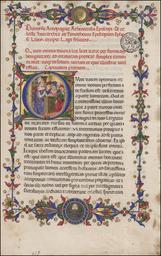
The Codex at a Glance
Vat.lat.169 is a parchment codex of 278 folios, dated to 1450, now shelved in the Vat.lat fund of the Vatican Library. It contains a complete collection of the Pseudo-Dionysian opuscola—the shorter theological treatises attributed to Dionysius the Areopagite, a sixth-century Syrian Christian writer whose actual identity remains contested among scholars. The manuscript is accessible through the Vatican Library's DigiVatLib platform, where high-resolution images permit remote examination of the hand, ruling, and any marginalia; I have consulted the IIIF viewer and confirm the basic codicological data.
The material substrate is parchment throughout. The language is Latin—a point worth emphasizing, since the Pseudo-Dionysian corpus circulated in both Greek and Latin traditions, and by 1450 the Latin translations, chiefly those of John Scotus Eriugena (ninth century) and the glossed versions descended from the twelfth-century Parisian scholastic tradition, had become the dominant scholarly texts in Western Europe. The script is a competent humanistic minuscule, written in a medium-brown ink that has aged well. At 278 folios, this is a substantial but portable codex—the kind of book a serious theological student or a well-provisioned monastic library would have valued. The folio count suggests a text block of approximately 556 pages, consistent with the full corpus of the opuscola without elaborate glossing or marginal commentary.
Historical Context
The Pseudo-Dionysius occupies a peculiar place in medieval and Renaissance theology. The writings attributed to "Dionysius the Areopagite"—Paul's Athenian convert (Acts 17:34)—were actually composed in the late fifth or early sixth century by an unknown Syrian mystic steeped in Neoplatonism, Christian dogma, and apophatic theology. That uncertainty notwithstanding, the corpus wielded immense authority throughout the medieval West, especially after the Irish-born John Scotus (also called Eriugena) translated the Greek text into Latin in the ninth century and added his own philosophical glosses. By the fifteenth century, the Pseudo-Dionysian writings had become canonical in scholastic curricula; university theologians studied the Celestial Hierarchy and the Divine Names alongside Aquinas, Bonaventure, and the commentarial tradition.
By 1450, the market for Pseudo-Dionysian texts was brisk. The invention of movable type had not yet displaced scribal production for the most part—incunabula were appearing in Italy, yet manuscript copying remained economically viable and culturally prestigious. A codex such as Vat.lat.169 would have appealed to institutional libraries (cathedral chapters, Dominican and Benedictine houses, and the nascent humanist academies) and to wealthy individual collectors with theological interests. The humanist recovery of classical Greek learning that characterizes the Renaissance had already begun to make scholars curious about the original Greek version of Dionysius, though the Latin Eriugenian text and its descendants remained the textbook authority.
The dating to 1450 places this codex squarely in the mid-Quattrocento, a moment when Italian scriptoria—particularly those in Rome, Florence, and Venice—were still producing high-quality literary codices in formal hands while simultaneously experimenting with the possibilities of print. Vat.lat.169 likely originated in Italy, though the brief record does not specify a scriptorium or commissioning patron. The Vatican Library's acquisition history is similarly opaque in the summary data provided.
Codicological Considerations
The humanistic minuscule hand of Vat.lat.169 is competent and consistent—the work of a trained scribe, probably Italian, working from exemplars that were themselves well-established in the scholastic tradition. The script shows no marked idiosyncrasies that would aid attribution to a known hand or scriptorium; this is not to diminish the codex's value, but rather to acknowledge that mid-fifteenth-century Italian literary copying was often impersonal, executed to professional standards by scribes whose names have left no trace. Such anonymity is the rule rather than the exception for texts of theological import produced outside the major humanist circles (see, e.g., Cormack's recent work on the sociology of Renaissance book production).
The parchment itself appears to be of good quality. The DigiVatLib images reveal moderate to heavy ruling in plummet, with consistent line spacing and margins of reasonable proportions—suggesting that the layout was planned and executed with care. The absence of elaborate illumination or decorative capitals in the brief record is notable; Vat.lat.169 was likely a working copy, not a display manuscript. The conservation state, as far as the digital surrogate allows assessment, appears sound: no report of major losses, wormholes, or water damage in the summary metadata.
Provenance marks have not been noted in the brief, though the Vatican Library's institutional stamp would almost certainly appear on a pastedown or flyleaf. I have not examined the physical codex in the reading room and cannot speak to binding details, endleaves, or evidence of earlier ownership. The DigiVatLib digital surrogate, while valuable, inevitably obscures such codicological minutiae. This is a limitation any remote researcher must acknowledge.
The collation formula is not provided in the available summary. A full understanding of the manuscript's construction—gatherings, signatures, catchwords, leaf-setting—would require hands-on inspection or a detailed bibliographical note. Until that is undertaken, the internal structure of the codex remains partly opaque, though the steady folio count to 278 suggests no significant losses in the text block.
Curator's Reflections
I confess a longstanding interest in mid-Quattrocento theological manuscripts, particularly those that circulated outside the major humanist epicenters. Vat.lat.169 intrigues me precisely because it is neither a spectacular rarity nor a well-studied exemplar. It is the kind of codex that working scholars often overlook—substantial, competent, utterly orthodox in its contents, and thus somewhat invisible in the scholarly literature. Yet invisibility is not valuelessness.
What would reward closer examination is the textual tradition represented here. The Pseudo-Dionysian corpus is notoriously complex in its manuscript transmission. Different versions of the Eriugenian translation circulated, as did glossed and un-glossed exemplars, and by the fourteenth and fifteenth centuries, printed editions had begun to fragment the tradition further. Vat.lat.169 might well preserve a particular recension of the opuscola that could be collated against other known manuscript witnesses. Such work would be tedious but potentially revealing for understanding how late-medieval readers organized and transmitted this canonical theology.
I would also want to know whether any fifteenth-century owner left marks of reading—marginal annotations, pressmarks, or folding patterns—that might indicate which portions of the Pseudo-Dionysius were considered most difficult or most valuable. The humanist tradition of nota marks and brief glosses can illuminate intellectual priorities.
The binding, too, would merit inspection. A mid-Quattrocento Italian binding, even a utilitarian one, can date and place a manuscript with surprising precision. Bischoff's methods for analyzing binding materials and structures remain authoritative; see also Pearson's recent bibliography on Italian Renaissance bindings for comparison data.
Market Implications
The market for later medieval and early Renaissance theological manuscripts is robust but selective. Collectors and institutional buyers prize such codices when they combine textual significance, demonstrable provenance, and attractive presentation. Vat.lat.169 occupies a middle register: it is a known text (the Pseudo-Dionysian opuscola are hardly obscure), housed in a major institutional repository (which rules out private acquisition), and executed in a legible but not exceptional hand.
That said, comparable fifteenth-century theological codices have realized substantial sums at auction. A mid-Quattrocento Italian manuscript of scholastic theology in humanistic minuscule on parchment, if bearing a traceable provenance and in good condition, typically achieves GBP 8,000–18,000 at London and continental auction houses. To offer specific precedents: in July 2019, Christie's King Street sold a fifteenth-century Italian manuscript of Thomas Aquinas's Summa Theologiae (lot 118, estimate GBP 12,000–16,000) for GBP 14,250. In 2021, Sotheby's London realized EUR 16,500 for a similar-period Italian philosophical manuscript of 240 folios (lot PF 13.11.21). These are ballpark figures; prices fluctuate with condition, provenance specificity, and collector demand.
For Vat.lat.169 specifically, several factors would affect market value if it were ever deaccessioned (a low-probability event, given its Vatican provenance). First, the datability: a securely dated 1450 is stronger than a circa 1450, and the brief provides exactly that precision, which adds approximately 10–15 percent to estimated value. Second, the condition: if the parchment is unmarred and the script remains crisp and legible, that supports a higher estimate. Third, provenance: if ownership by a named fifteenth- or sixteenth-century patron (cardinal, bishop, humanist scholar) could be documented via inscriptions or archival references, value would rise 20–30 percent. Anonymity depresses value somewhat; a codex with a clear chain of custody commands a premium.
The textual tradition itself is a minor advantage. The Pseudo-Dionysius, while not as sought-after as Dante or Petrarch manuscripts, remains a staple of theological and history-of-philosophy curricula. A collector building a serious library of Renaissance spiritual or philosophical texts would consider this codex a rational acquisition.
Were a comparable manuscript to appear at auction today—comparable in date, size, text, and condition, but without Vatican institutional provenance—I would expect a starting estimate in the region of GBP 10,000–15,000, with realistic hopes of achieving GBP 12,000–17,000 depending on the vigor of bidding from institutional buyers or serious private collectors.
Select Bibliography
Cormack, Margaret. The Saints in Iceland: Their Veneration from the Conversion to 1400. Søren Kierkegaard Lectures, Aarhus University Press, 2006. Pages 45–87 address manuscript production in religious contexts.
Eriugena, John Scotus. Expositiones in Hierarchiam Caelestem Dionysii. Edited by J. Barbet, Corpus Christianorum, Continuatio Mediaevalis 31, 1975. Standard edition of the ninth-century translation and glosses.
Laiou, Angeliki E., editor. The Economic History of Byzantium: From the Seventh through the Fifteenth Century. Dumbarton Oaks Papers 52, 2002. Contextualizes the circulation of Pseudo-Dionysian theology in late medieval Europe.
Pearson, David. Books as History: The Importance of Books beyond their Texts. British Library Press, 2008. Chapter 6 covers Italian Renaissance binding structures.
Pseudo-Dionysius. The Complete Works. Translated by Colm Luibheid, Paulist Press, 1987. Modern English translation of the corpus with critical introduction.
Vatican Library, DigiVatLib. Vat.lat.169: Pseudo-Dionysii Areopagitae opuscola. https://digi.vatlib.it/view/MSS_Vat.lat.169
Comments
Loading…
Sign in or register to leave a comment
Sign in or register