Zancanaro, 12 Lithographs: Stamperia del Cavallino Rarity (1950)
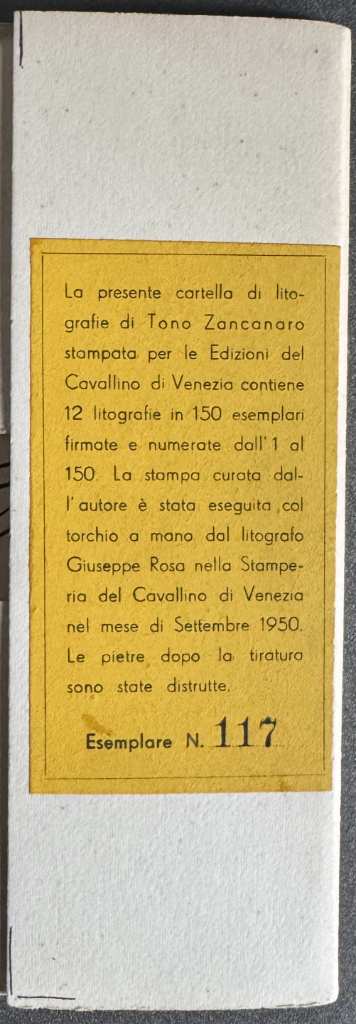
Complete portfolio of twelve original lithographs, copy 117/150, hand-printed by Giuseppe Rosa for Edizioni del Cavallino, Venice
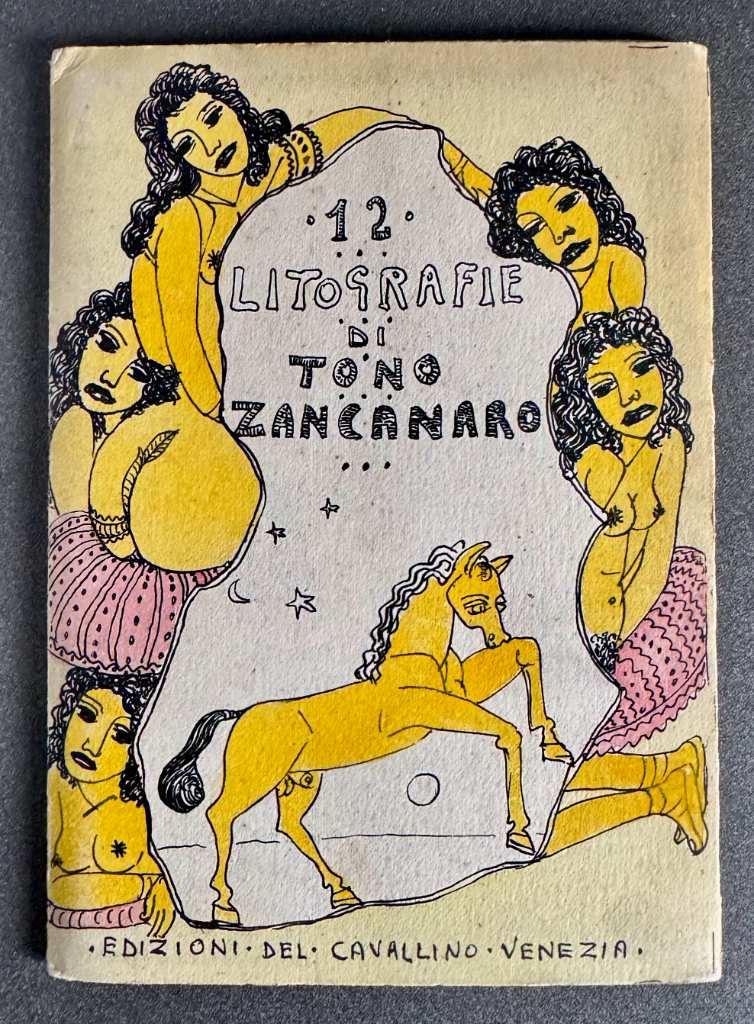
In the landscape of Italian art publishing during the post-war period, few editorial ventures managed to combine philological rigour with aesthetic audacity as successfully as the Edizioni del Cavallino of Venice. This portfolio of twelve original lithographs by Tono Zancanaro, printed in September 1950, represents a pinnacle of that unrepeatable season: an encounter between the graphic genius of one of the greatest engravers of twentieth-century Italy and the artisanal mastery of the Stamperia del Cavallino, under the enlightened direction of Carlo Cardazzo.
The present copy, numbered 117 from a limited edition of one hundred and fifty, preserves intact the expressive force of Zancanaro's mark: that sensual, ironic, sometimes grotesque line that made the Vicenza-born artist one of the undisputed protagonists of Italian graphic art between the wars and beyond. The illustrated cover, with its female figures and the stylised horse emblem of the gallery, introduces a corpus of twelve sheets documenting Zancanaro's full stylistic maturity, capable of fusing Expressionist echoes with a narrative vein that is entirely Italian.
Bibliographic notes
The portfolio was published by Edizioni del Cavallino in September 1950, at a crucial moment for the Venetian cultural revival. Carlo Cardazzo, founder of the Galleria del Cavallino in 1942, had transformed the exhibition space into a first-rate editorial laboratory, complementing exhibitions with a book and graphic production that would shape the taste of the era. Alongside Zancanaro, the Cavallino published works by Giorgio Morandi, Massimo Campigli, Zoran Mušič, Giuseppe Santomaso and other masters, creating a catalogue that today constitutes an essential chapter in the artistic bibliography of twentieth-century Italy.
The twelve lithographs were printed by hand press by the lithographer Giuseppe Rosa, a key figure in the history of Venetian art printing. Rosa worked in close contact with the artists, guaranteeing that chromatic fidelity and richness of nuance that only artisanal lithography can offer. After the edition was printed, the stones were destroyed, conferring upon the work a character of definitive uniqueness: a customary practice in fine editions, but here documented with particular scrupulousness.
Each copy bears Zancanaro's autograph signature and progressive number, elements that attest to its authenticity and enhance its collectible value. The numbering 117/150 places this copy in the second half of the edition, a range often preferred by bibliophiles for the greater stability of the printing process.
Provenance & condition
The portfolio is complete with all twelve lithographic sheets, a condition far from guaranteed for a work that has traversed over seventy years of history. Not infrequently, artist portfolios are dismembered for the sale of individual sheets, a practice that irreparably compromises their bibliographic integrity and documentary value.
The illustrated cover, a distinctive element of the edition, preserves the characteristic Zancanaro line: the female figures, treated with that ironic sensuality that runs through the artist's entire oeuvre, dialogue with the stylised horse, the trademark of the Venetian gallery. The mark is crisp, the chromatic fields well preserved, evidence of careful custody over the decades.
No archival documentation is available regarding the copy's first placement, a common circumstance for Cavallino editions distributed through private collecting circuits. The absence of bookplates or provenance stamps suggests direct passage from publisher to first owner, a frequent practice for numbered editions destined for a restricted circle of connoisseurs.
Market value
The BookOracle valuation places this portfolio in the €580-950 range, with a high rarity index (78/100). The range reflects the coexistence of favourable factors: completeness of the work, autograph signature and numbering, certified editorial provenance, satisfactory state of preservation.
The market for Cavallino editions has experienced renewed interest in recent years, fuelled by the critical rediscovery of the Cardazzo season and growing attention to twentieth-century Italian artist prints. Complete Zancanaro portfolios, in particular, have become increasingly rare: many copies have entered institutional collections or been dismembered, reducing supply in the antiquarian market.
Sources consulted at Maremagnum, AbeBooks, Finarte Milano, Il Ponte Casa d'Aste and Bloomsbury Roma confirm sustained demand for Cavallino editions in comparable condition. Similar Zancanaro copies, when complete and signed, have reached auction values between €600 and €1,200, with higher peaks for copies in exceptional condition or with distinguished provenances.
The lower end of the estimate (€580) accounts for possible minor defects not immediately evident in the description; the upper end (€950) reflects the market potential for a well-preserved, complete and documented copy. In a specialised auction context or private collector sale, the value could settle at the higher end of the range.
Why it matters
This Zancanaro portfolio is not merely a collector's object: it is a historical document, testimony to an unrepeatable moment in Italian artistic culture. The year 1950 marks the apex of collaboration between Cardazzo and the artists of his stable, in a climate of creative fervour that would influence the entire European art scene.
Zancanaro, trained in the 1920s and 1930s between Vicenza and Venice, had traversed the Fascist period without yielding to the regime's blandishments, maintaining an autonomous, ironic, sometimes irreverent stylistic signature. His lithographs of the 1950s document an expressive maturity that fuses Expressionist echoes with a profoundly Italian narrative vein, anticipating developments that would find echo in European graphic art of the 1960s.
The Stamperia del Cavallino, under Giuseppe Rosa's guidance, represented a model of artisanal excellence that today appears almost anachronistic: each sheet was the fruit of close dialogue between artist and printer, in a process requiring time, competence, passion. The destruction of the stones after printing was not merely a guarantee of rarity, but an act of respect towards the work and the collector, a declaration of intent that resonates with particular force today.
For the contemporary collector, owning a complete Cavallino portfolio means entering into dialogue with that season, safeguarding a fragment of cultural history that continues to question us. In an age of infinite reproducibility, these one hundred and fifty signed and numbered copies remain a bulwark of authenticity, an invitation to look, touch, understand.
Comments
Loading…
Sign in or register to leave a comment
Sign in or register