Signed Cardarelli: Prologhi Viaggi Favole in the 1916 Carabba Edition
Numbered copy 853 with red ink autograph, witness to Italian art prose on the threshold of La Ronda
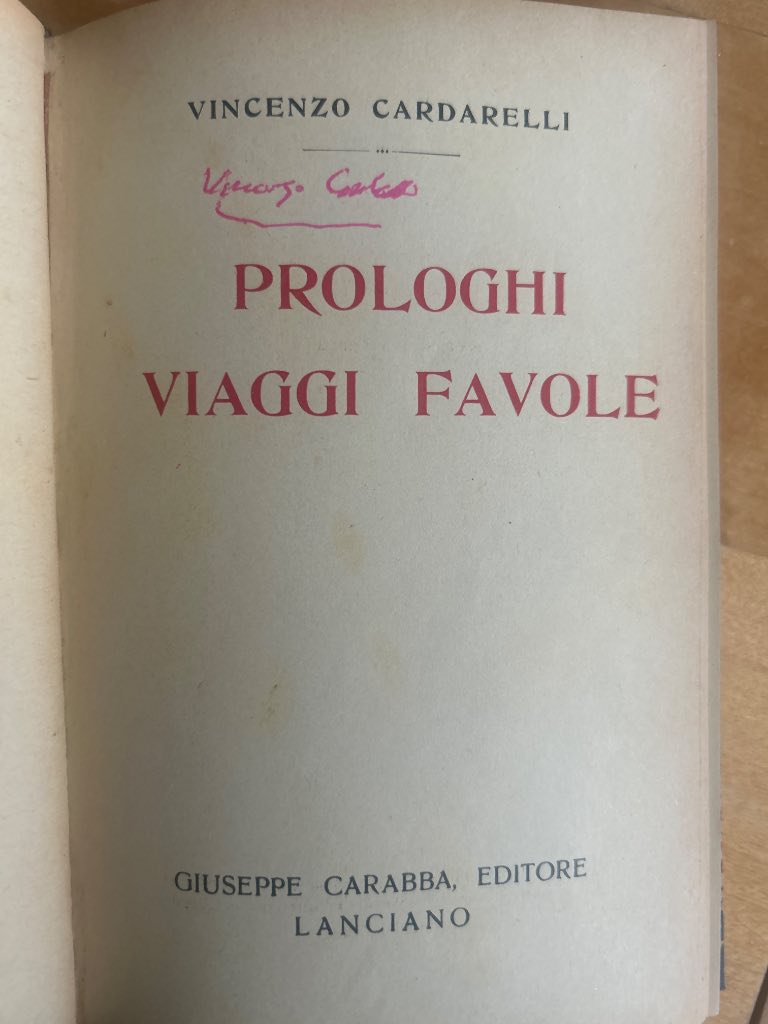
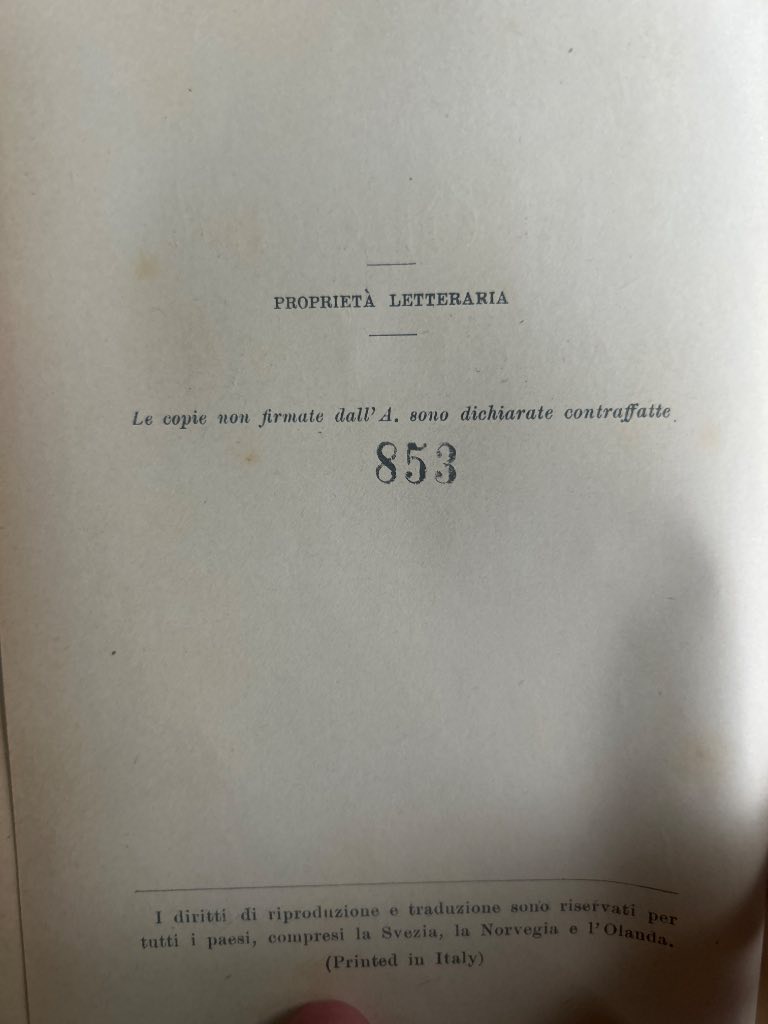
In the landscape of early twentieth-century Italian publishing, few houses managed to combine typographic rigour and literary sensitivity as successfully as Giuseppe Carabba of Lanciano. This copy of Prologhi Viaggi Favole, published in 1916 when Vincenzo Cardarelli was barely thirty-one, represents a crucial moment in the formation of modern Italian art prose. Copy number 853, signed by the author in red ink on the title page according to editorial prescriptions declaring unsigned copies counterfeit, testifies to the rigorous control Carabba exercised over its limited editions.
Bibliographic Notes
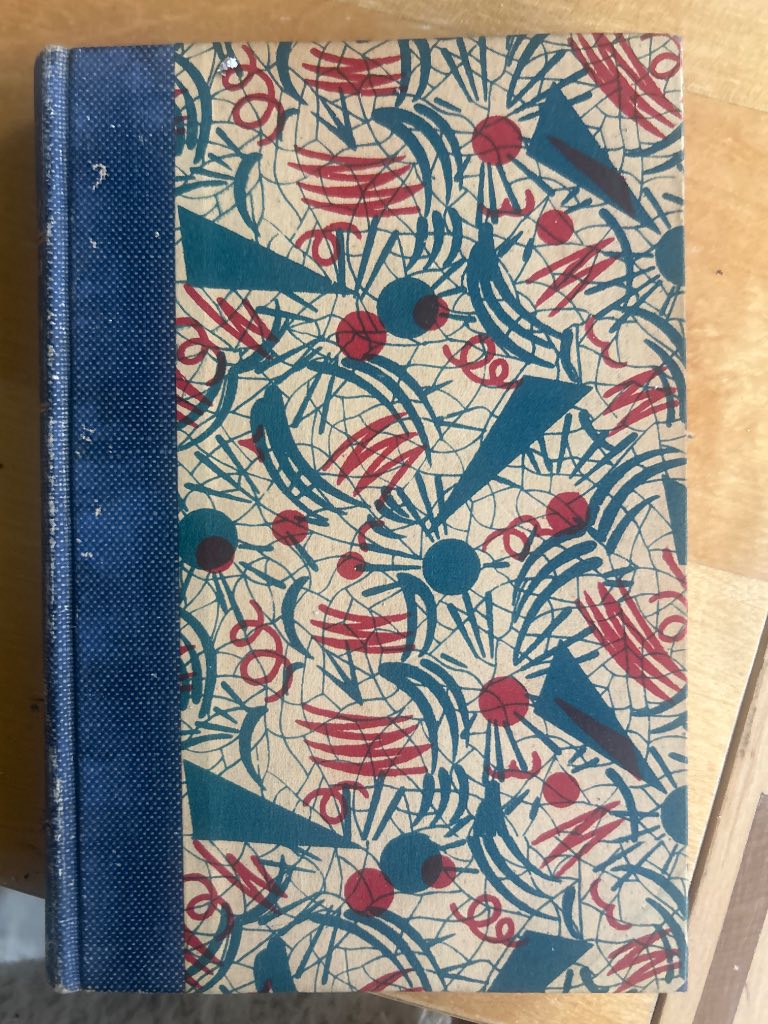
The first edition of Prologhi Viaggi Favole appeared in the Carabba catalogue during a period of extraordinary cultural vitality, when the Abruzzo publisher was simultaneously issuing classics of Italian literature and the most innovative voices of modernism. The publisher's binding in half blue cloth with boards covered in decorated paper featuring futurist geometric motifs in red and blue constitutes a distinctive element of Carabba productions from the war period, when avant-garde influences merged with a still-robust artisanal tradition. The numbered and signed edition responded to a publishing practice Carabba had adopted for works of particular merit, creating a collectors' market as early as the 1910s. The volume gathers lyrical prose pieces that anticipate by three years the founding of La Ronda, the journal that would redefine the canons of Italian prose between classicism and modernity.
Provenance and Condition
The copy presents Cardarelli's autograph signature in red ink, an element certifying its authenticity according to the period's editorial declarations. The original publisher's binding remains intact, with the characteristic geometric decoration of the boards showing the natural patina of a century-old volume handled with care. The cloth spine maintains its original blue tone without significant fading, whilst the decorated paper boards display slight rubbing traces at the corners, consistent with careful but non-institutional domestic preservation. The volume's interior shows clean leaves without notable foxing or moisture stains, indicating storage in a dry environment. The title page bearing the autograph signature presents no tears or restoration. The absence of bookplates or provenance stamps suggests a private collecting history, probably within a family context, rather than institutional.
Market Value
The valuation of €310-490 reflects this copy's position in the medium-high segment of the Cardarelli market. Signed first editions of Prologhi Viaggi Favole circulate with some regularity in the Italian antiquarian market, but the presence of the autograph signature in red ink, as prescribed by the publisher, constitutes a significant value-adding element. Consultations on Maremagnum and AbeBooks show that unsigned copies of the same edition position themselves in the €150-250 range, whilst signed copies in excellent condition can reach €600-700 at specialist booksellers such as Pontremoli. The relatively high edition number (853) places this copy beyond the halfway point of the overall print run, an element that moderates the rarity premium compared to low-numbered copies. Gonnelli auctions over the past five years have recorded realisations for signed Carabba editions by contemporary authors between €280 and €520, confirming this estimate's positioning. The market for Cardarelli remains stable, sustained by a niche but faithful collecting base concentrated primarily in Tuscany and Lazio.
Why It Matters
Prologhi Viaggi Favole represents a fundamental document for understanding the transition of Italian prose from Vocian fragmentism to the search for a modern classicism that would characterise La Ronda. Cardarelli, born Nazareno Caldarelli in Corneto Tarquinia in 1887, was elaborating during these years a prosaic language that rejected both Art Nouveau excesses and Futurist experimentation, seeking an Italian path to literary modernity. The choice of Carabba as publisher was not accidental: the Lanciano house represented an ideal compromise between provincialism and cosmopolitanism, between artisanal tradition and openness to innovation. For the collector, this volume offers the opportunity to possess a direct witness to that unrepeatable season of Italian culture, when the Great War had not yet shattered the illusions of the early twentieth century. The red ink autograph signature, far from being a bibliophilic affectation, constitutes an act of authentication that materially binds the author to the book-object, in an era when the relationship between writer and publisher still retained artisanal dimensions. For those collecting twentieth-century Italian literature, this signed first edition represents an essential piece, witness to a moment when art prose was still seeking its own voice.
Comments
Loading…
Sign in or register to leave a comment
Sign in or register