Kandinsky's Spiritual in Art: the 1949 French Edition
A copy of the first French translation of the founding manifesto of abstract art, published in the Le Cavalier d'Épée collection
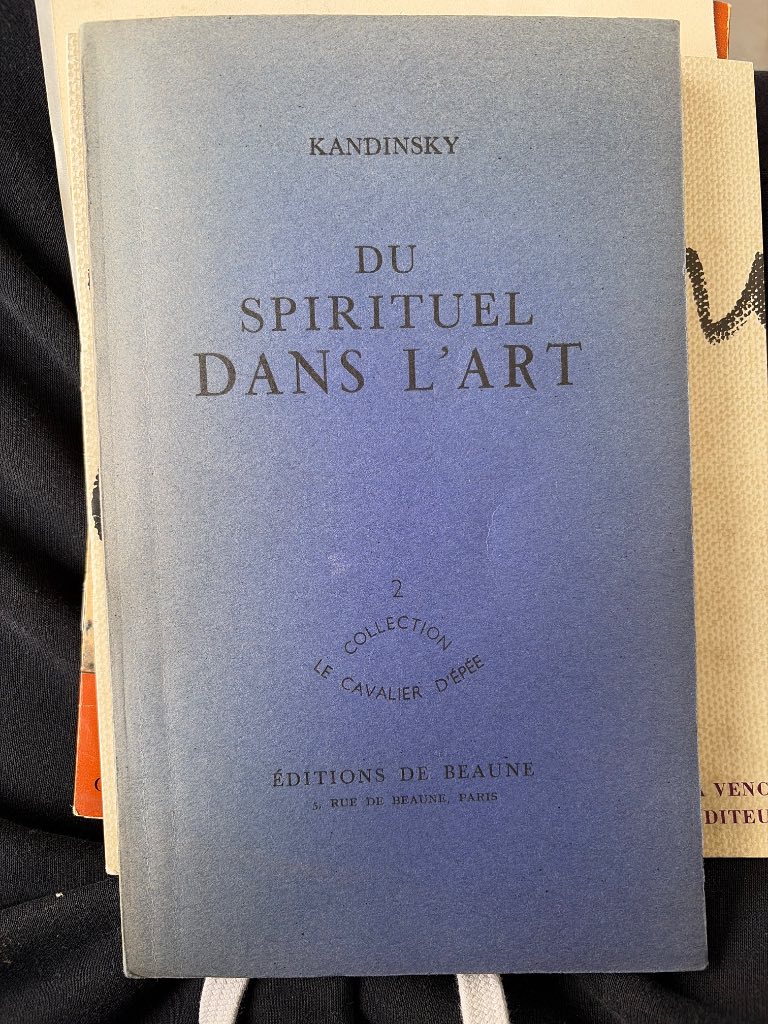
In the Parisian publishing landscape of the post-war years, few publications carry the theoretical weight of this first French edition of Wassily Kandinsky's seminal treatise. Published in 1949 by Éditions de Beaune as the second volume in the 'Le Cavalier d'Épée' collection, this copy represents the moment when the Russian master's thought — already known to specialists through the 1912 German edition — finally became accessible to French-speaking audiences within the context of European cultural reconstruction.
Bibliographic notes
The original work, Über das Geistige in der Kunst, appeared in Munich in December 1911 (dated 1912) through the Piper publishing house, marking an epochal turning point in modern art theory. The present French edition, produced by Éditions de Beaune thirty-seven years later, emerged at a crucial moment: the immediate post-war period, when Paris sought to reassert its role as Europe's cultural capital. The 'Le Cavalier d'Épée' collection — whose title evokes Der Blaue Reiter, the movement founded by Kandinsky and Franz Marc — was conceived to disseminate foundational texts of the historical avant-garde to a cultivated but not necessarily specialist readership.
The volume appears in octavo format, with the characteristic blue-grey paper wrappers that distinguish the collection. This sober yet distinctive typographic presentation reflects the austere aesthetic of the period, when quality paper remained a precious resource. The text expounds Kandinsky's conception of painting as an expression of 'inner necessity' (innere Notwendigkeit), laying the theoretical foundations for lyrical abstraction and the liberation of colour and form from the constraints of mimetic representation.
Provenance & condition
The present copy derives from a European private collection and bears neither ex libris nor annotations from previous owners, an element that preserves its bibliographic integrity. The condition proves good, with slight patina on the covers — an entirely natural phenomenon for blue-grey paper exposed to light over seven decades. The interior pages retain their original freshness, without significant foxing or tears. The spine, often a critical point in period paperbacks, appears intact and the stitching remains sound.
This general condition testifies to careful preservation, probably in a protected domestic environment, away from excessive humidity or direct sunlight. The absence of restoration or subsequent interventions constitutes added value for collectors who privilege the material authenticity of the book.
Market value
The BookOracle valuation places this copy in the €245-390 range, reflecting a mature market for post-war French editions of avant-garde theoretical texts. The rarity score (55/100, 'Discrete' index) indicates moderate availability in the international antiquarian market: this is not a common edition, but neither an absolute rarity.
Consultations conducted through AbeBooks, Maremagnum, Piasa and Catawiki confirm this price bracket. Copies in comparable condition have recently been offered between €280 and €450, with variations determined primarily by condition and the presence of a dust jacket (a rare element in this edition). The 1912 German first edition naturally commands far higher prices — often exceeding €5,000 — but the present French edition represents an accessible alternative for those wishing to own a historical witness to Kandinsky's thought without confronting museum-level investment.
The market for such publications remains stable, sustained by constant interest in modern art theory and Kandinsky's central position in the twentieth-century canon. Academic institutions and private collectors focused on the historical avant-garde constitute the natural demand pool.
Why it matters
Beyond monetary value, this volume represents a cultural document of the first order. The 1949 French translation marks the moment when Kandinsky's ideas — already assimilated by avant-garde artists in the 1920s and 1930s — became part of French public discourse in the context of post-war reconstruction. Europe emerging from war sought new expressive languages, and the recovery of historical avant-garde masters offered both roots and prospects.
For the contemporary collector, owning this edition means safeguarding a piece of the editorial history of aesthetic ideas, a book that helped form generations of artists, critics and art historians. The 'Le Cavalier d'Épée' collection, though brief, testifies to the effort to make fundamental theoretical texts accessible at a time when the international circulation of ideas was laboriously resuming after the dark years of conflict.
Ultimately, this copy commends itself to those building a library dedicated to the historical avant-garde, the Der Blaue Reiter movement or twentieth-century art theory. Its presence in a collection signals serious interest in the primary sources of modern aesthetic thought, beyond mere accumulation of rare volumes.
Comments
Loading…
Sign in or register to leave a comment
Sign in or register