René Herbst: Pioneer of the Modern Movement – Delaporte Monograph 2004
First edition of the definitive study on the UAM co-founder and master of French rationalist design
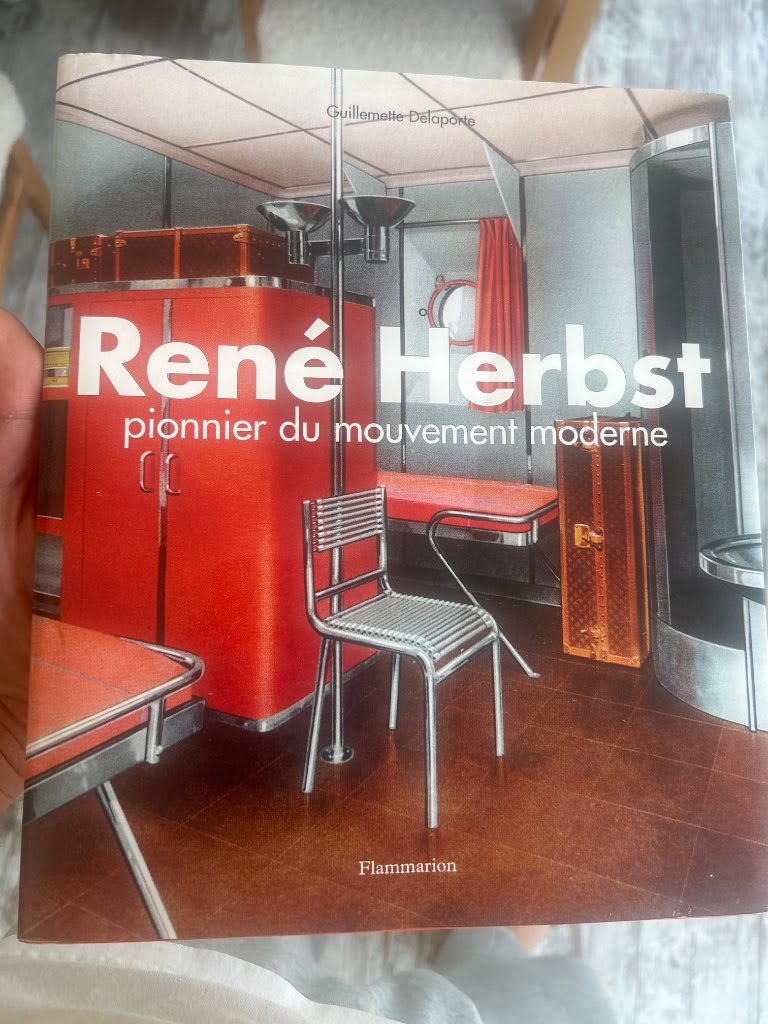
Within the editorial landscape dedicated to twentieth-century design, few publications have filled historiographical gaps with the documentary precision of the monograph Guillemette Delaporte devoted to René Herbst for Flammarion in 2004. This work represents the first organic study of a figure too often relegated to the margins of the Modern Movement narrative, yet central to the evolution of French design between the wars.
Bibliographic Notes
The volume distinguishes itself through first-rate iconographic apparatus: period photographs from the Herbst family's private archives, original technical drawings and photographic documentation of the exhibition installations that marked the designer's career. The chronological structure adopted by Delaporte allows one to follow Herbst's stylistic evolution from his architectural training at the École des Beaux-Arts through decisive collaborations with Robert Mallet-Stevens and Le Corbusier. Particular attention is devoted to the period 1929-1937, when Herbst, as co-founder of the Union des Artistes Modernes, helped define French rationalist aesthetics in opposition to the decorativism of the Société des Artistes Décorateurs. Sections dedicated to chromed tubular steel furniture – the celebrated folding chairs, demountable tables, modular bookcases – document with philological rigour the functionalist approach that characterised the master's production. Explorations of projects for the ocean liners Normandie and Île-de-France testify to the application of modernist principles to spaces of travelling luxury.
Provenance and Condition
The present copy belongs to the first edition published by Flammarion in 2004, recognisable by its specific ISBN and the quality of offset printing on coated paper. Being a recent publication, the print run was substantial and aimed primarily at academic and specialist markets. The state of preservation proves generally good for circulating volumes: the hardback binding with laminated dust jacket guarantees reasonable resistance to wear, though library copies or frequently consulted examples may show signs of use on the jacket. Flammarion's editorial quality ensures sound binding integrity and colour rendering of illustrations still faithful to the original, a non-negligible element considering the importance of visual apparatus for understanding Herbst's work.
Market Value
The market valuation for this monograph stands in the €50-80 range, reflecting the nature of a recent specialist publication with still reasonable availability on the antiquarian market. Major book commerce platforms – AbeBooks, Maremagnum, Amazon Marketplace and Catawiki – confirm this price bracket for copies in good to fine condition. The contained value derives from several factors: the absence of limited or numbered editions, standard commercial print run and relative bibliographic youth that has not yet permitted the appreciation typical of works out of print for decades. Nevertheless, the monograph maintains consistent interest among modernist design collectors, UAM scholars and bibliophiles specialising in interwar interior architecture. Copies with author's inscription or from notable collections might justify higher valuations, whilst ex-library copies or those with significant jacket damage tend towards the lower end of the range. Demand remains stable but circumscribed to a niche audience, an element limiting the speculative fluctuations typical of other sectors of book collecting.
Why It Matters
Beyond market considerations, this monograph represents an irreplaceable research tool for anyone concerned with twentieth-century French design. René Herbst embodied that synthesis of functionalist rigour and aesthetic sensibility that characterised the finest UAM production, a group that anticipated by decades themes now central to design discourse: modularity, demountability, industrial seriality. Delaporte's work restores historiographical dignity to a master too often overshadowed by more celebrated contemporaries, documenting with archival precision a corpus of works that influenced generations of designers. For the collector of art and design books, acquiring this first edition guarantees access to a primary information source, destined to remain an essential bibliographic reference until – and if – future research produces equally exhaustive studies. The relative economic accessibility makes this monograph an opportunity to enrich specialist libraries without prohibitive financial commitments, confirming how the cultural value of a work does not always coincide with market quotations.
Comments
Loading…
Sign in or register to leave a comment
Sign in or register