Wedel's Aphorismi Aphorismorum: Hippocrates Revisited at Jena, 1695
First edition of ducal physician Georg Wolfgang Wedel's Hippocratic commentary, in contemporary vellum with Fossati provenance
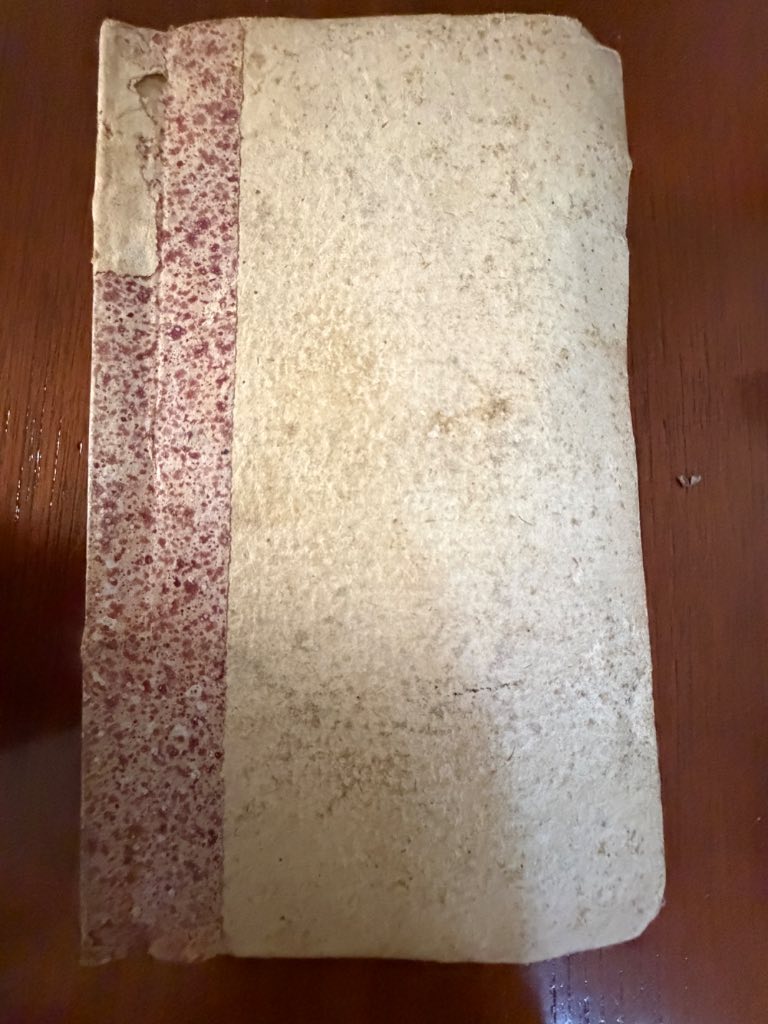
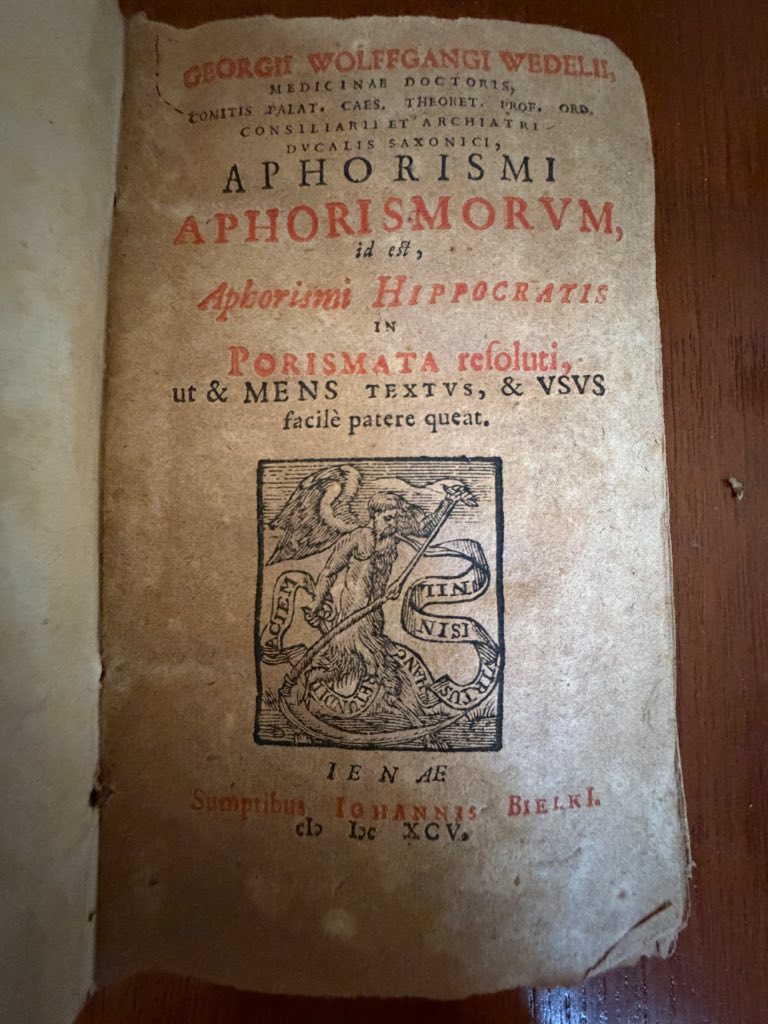
In the landscape of late seventeenth-century German academic medicine, few figures embody with equal authority the synthesis of Galenic tradition and emerging experimental imperatives as Georg Wolfgang Wedel (1645–1721), archiatrus to the Duchy of Saxony and professor of medicine at the University of Jena. His Aphorismi Aphorismorum, published in 1695 by the printer Johann Bielke, represents a systematic attempt to render the Hippocratic aphoristic corpus accessible and clinically operational by resolving it into porismata — logical corollaries that facilitate memorisation and practical application at the patient's bedside. The copy examined here, a first edition, retains its original editorial dress and bears traces of eighteenth-century Italian provenance.
Bibliographic notes
The work is presented in octavo format, with a title-page printed in red and black according to the typographic convention of the period for texts of particular scientific importance. Bielke's woodcut device — a rampant griffin — adorns the title-page, testifying to the work's place in the catalogue of one of the most active presses in the dissemination of German medical literature. Wedel adopts a rigorous didactic structure: each Hippocratic aphorism is isolated, analysed philologically, and then resolved into a series of corollary propositions (porismata) that explicate its diagnostic and therapeutic implications. The method reflects the university teaching at Jena, where Wedel held the chair of theoretical and practical medicine for over forty years, training generations of physicians in the art of clinical deduction. The first edition of 1695 is relatively scarce on the antiquarian market: subsequent eighteenth-century reprints have partly eclipsed circulation of the editio princeps, rendering copies in acceptable condition particularly sought after by collectors of medical history.
Provenance & condition
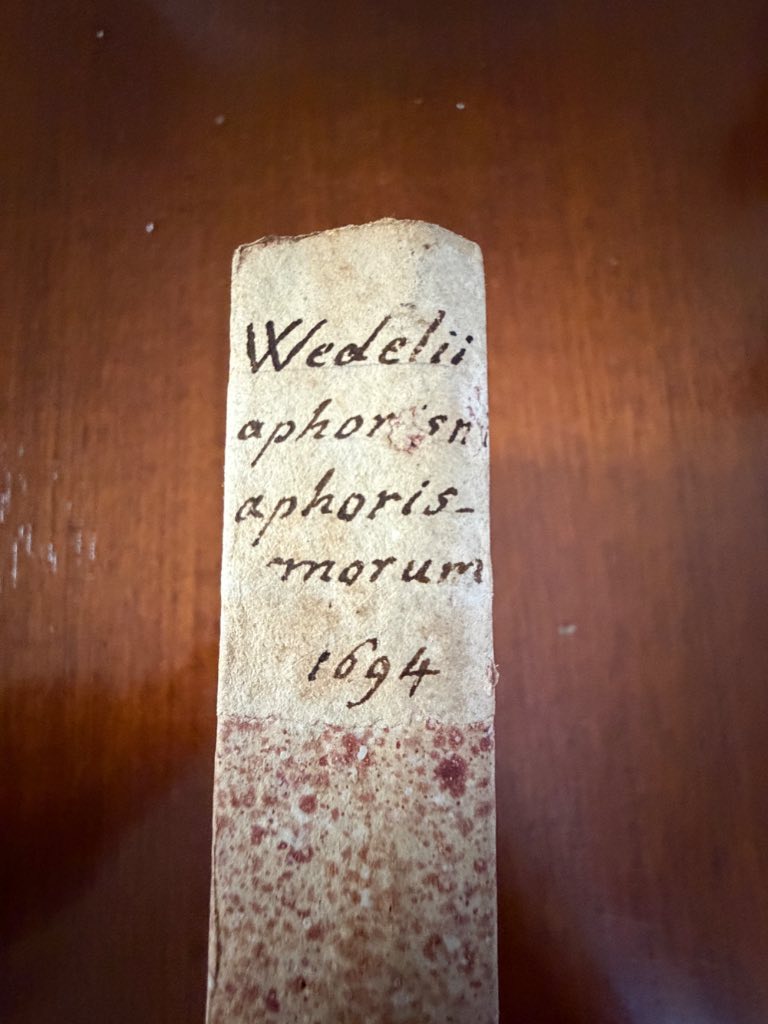
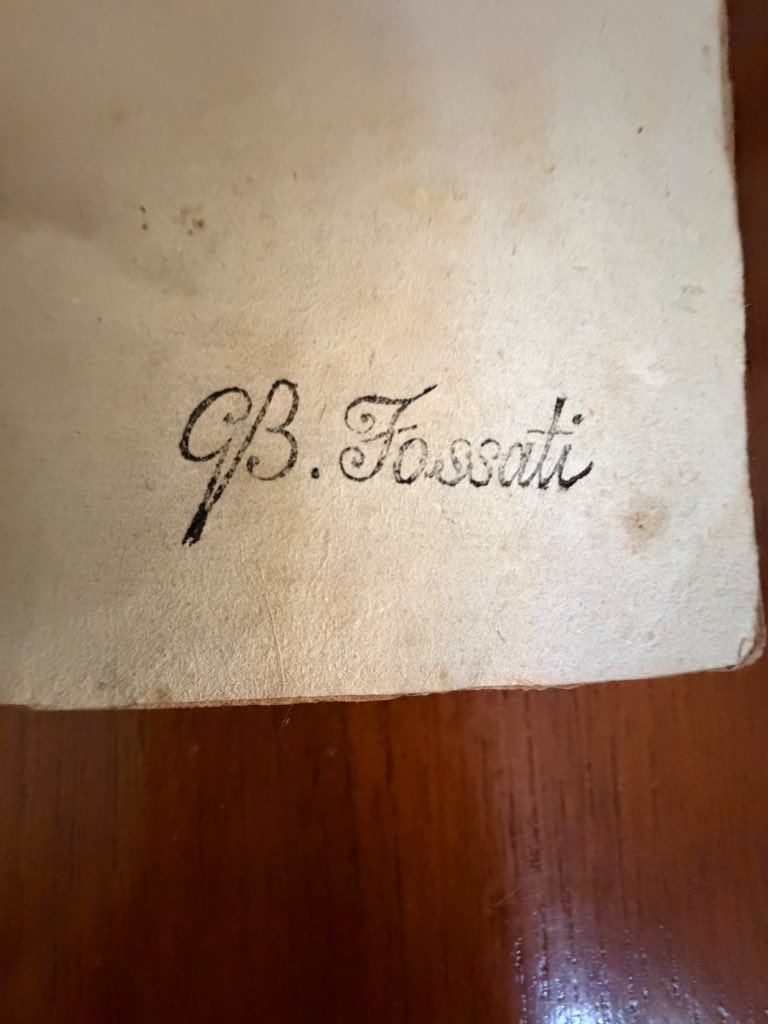
The copy bears on the front pastedown the autograph signature 'G.B. Fossati', evidence of probably eighteenth-century Italian provenance. The surname Fossati recurs frequently in the annals of the medical and legal professions of northern Italy; although precise identification of the owner requires further archival research, the presence of this ownership note enhances the volume's documentary value, inserting it into a chain of transmission of medical knowledge that crosses the borders of early modern Europe. The contemporary limp vellum binding, with manuscript title to spine in brown ink, conforms to the canons of late seventeenth-century German academic binding: economical, functional, intended for daily use rather than bibliophilic display. The red marbled paper pastedowns — a type widespread in the workshops of Nuremberg and Augsburg — add a sober decorative touch. The volume shows signs of wear consistent with over three centuries of life: abrasion to boards, slight browning of leaves at margins, occasional scattered foxing. However, the interior remains clean and perfectly legible, without textual lacunae, tears, or invasive restoration. The survival in honest working condition of a didactic text intended for frequent consultation is, in itself, a small bibliographic miracle.
Market value
The BookOracle valuation places the copy in the €180–280 range, reflecting a balance between relative rarity (index 52/100, 'discrete' category) and niche demand. The market for seventeenth-century German medical works is segmented: the great names (Vesalius, Paracelsus, Kircher) achieve high prices, while second-rank authors such as Wedel — though respected by historians of medicine — remain accessible to collectors of moderate budget. Recent comparables on specialist platforms (ZVAB, ViaLibri) confirm this price bracket for first editions of Wedel in analogous condition. Copies with documented provenance or in decorated bindings may exceed €350, whilst incomplete or heavily restored examples fall below €150. The presence of the Fossati signature and retention of the original binding justify positioning in the upper half of the valuation range. It should be noted that the Italian market, for reasons of cultural and collecting proximity, tends to value local provenances more highly, an element that could favour sale to national collectors.
Why it matters
Beyond monetary value, this copy of the Aphorismi Aphorismorum documents a crucial moment in the history of European medical pedagogy. Wedel belongs to the transitional generation between Renaissance humanistic medicine — founded on philological exegesis of the classics — and eighteenth-century experimental medicine, which privileges empirical observation. His choice to 'resolve' the Hippocratic aphorisms into logical corollaries betrays an epistemological anxiety typical of the Baroque age: the need to systematise, classify, render transmissible a body of knowledge still largely oral and casuistic. For the collector of history of science, the work represents a tessera in the long parabola of the reception of Hippocrates in the West; for the bibliophile, a tangible example of how books travelled, were annotated, owned, handed down across frontiers and centuries. The Fossati signature, minimal trace of a lost biography, reminds us that every old book is also an archive of silent lives.
Comments
Loading…
Sign in or register to leave a comment
Sign in or register