Friedrich Stowasser 1943-1949: the Albertina catalogue of young Hundertwasser
First edition of the Viennese catalogue documenting the formative years of the Austrian master, from the Stowasser signature to the birth of Hundertwasser
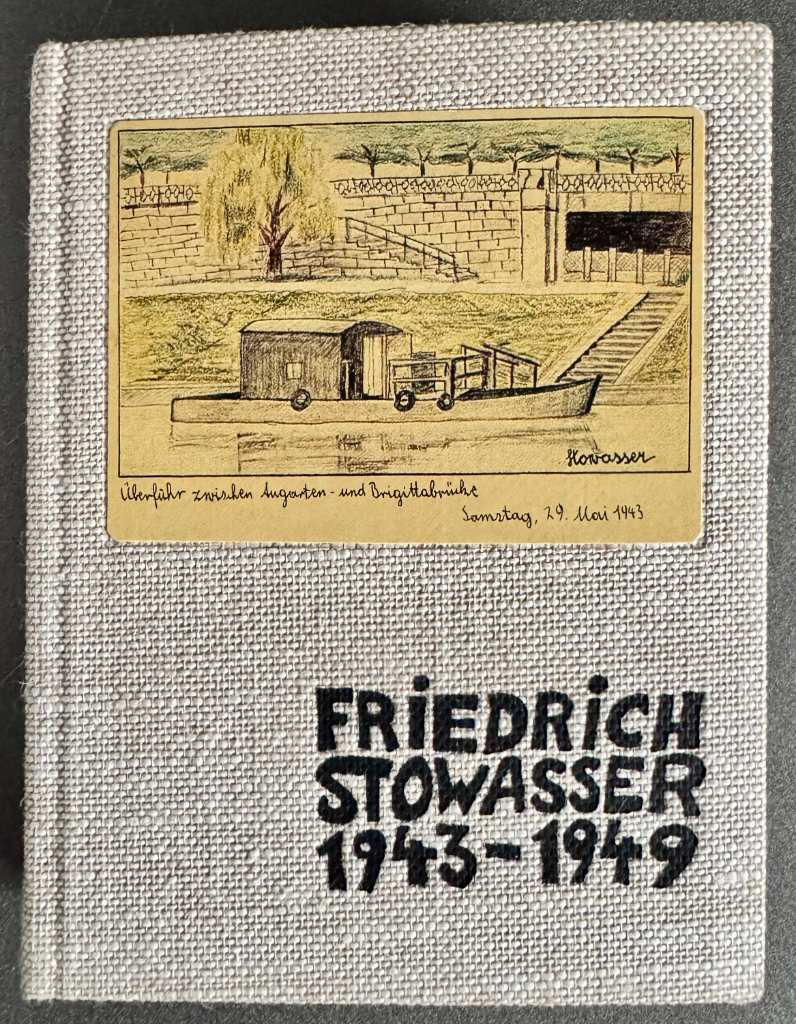
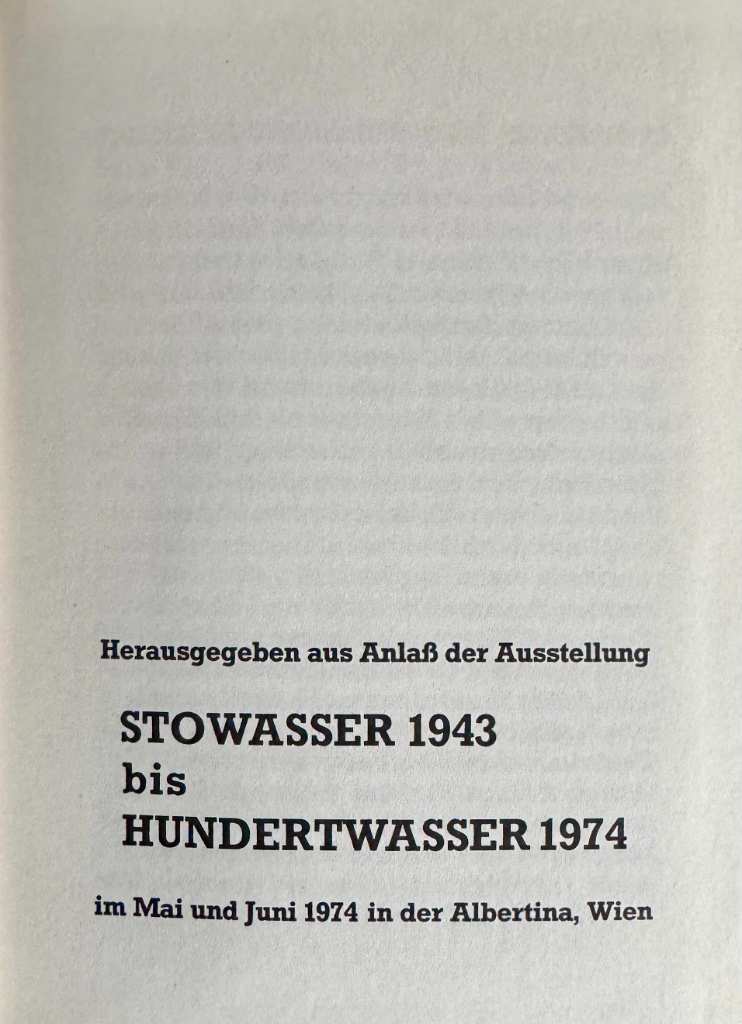
In the spring of 1974, Vienna's Albertina mounted a landmark retrospective dedicated to Friedensreich Hundertwasser, focusing on the least known period of his production: the early years under his birth name Friedrich Stowasser. The catalogue accompanying the exhibition represents today a bibliographic document of particular interest to scholars of twentieth-century Austrian art, bearing witness to the transition from artistic adolescence to full expressive maturity.
The grey cloth binding, sober and elegant, bears an applied reproduction of a youthful drawing from 1943: a view of Vienna's Donaukanal that already reveals the topographic sensitivity and attention to urban landscape that would characterise the artist's entire oeuvre. The choice of this subject is not casual: the Danube and its canals constitute a recurring leitmotif in Hundertwasser's production, linked to memories of wartime and post-war Vienna.
Bibliographic notes
The volume was printed by Cicero GmbH of Stuttgart in a substantial run of 25,000 copies, a figure testifying to the exhibition project's educational ambition. The first edition (Erste Auflage 1-25000) is distinguished by the quality of photographic reproduction and critical apparatus curated directly by the Albertina. The publisher's grey cloth binding, though functional, has demonstrated a certain fragility over time: many copies today show wear to corners and weakened spines, elements that significantly affect collectible valuation.
The publication belongs to the context of the great museum retrospectives of the 1970s, a period when European institutions began systematically to re-evaluate post-war art. The Albertina, with its tradition of excellence in graphic conservation, represented the ideal venue for an investigation into the formative period of an artist whose early production was predominantly in drawing.
Provenance & condition
Copies currently in circulation derive mostly from private libraries of Austrian and German collectors, with a significant presence also on the Italian market, where Hundertwasser enjoyed particular critical fortune during the 1980s and 1990s. The high print run ensures reasonable availability, although copies in excellent condition are progressively rarer.
State of preservation constitutes the principal evaluative discriminant: copies with intact covers, free from stains or abrasions, and with the drawing application perfectly adhered can reach the upper limit of the valuation range. Copies showing signs of use, damaged spines or yellowed pages fall within the lower bracket. The presence of ex-libris stamps or autograph dedications does not significantly affect value, given the cataloguing nature of the publication.
Market value
The BookOracle valuation places this catalogue in the €50-90 range, with a low rarity index (15/100) reflecting the substantial print run and good availability on the antiquarian market. The principal specialist platforms (AbeBooks, ZVAB, Maremagnum, Catawiki) confirm this positioning, with quotations fluctuating according to condition and provenance.
Copies in excellent condition, with immaculate covers and interiors free from foxing, reach €80-90, whilst copies with evident defects settle at €50-60. The German and Austrian markets show slightly higher demand compared to other European countries, reflecting local interest in Hundertwasser's figure. Occasionally, copies with dedications from personalities connected to the Albertina or Viennese art world may exceed standard estimates, though such occurrences are rare.
Value stability in recent years suggests a mature market, with constant but non-speculative demand. This represents a reasonable acquisition for libraries specialising in twentieth-century Austrian art or for collectors wishing to document the formative phase of a master whose mature production is now quoted at levels inaccessible to the average collector.
Why it matters
Beyond its contained monetary value, this catalogue represents an irreplaceable document for understanding the artistic genesis of Friedensreich Hundertwasser. The period 1943-1949, covered by the Albertina retrospective, coincides with the war years and immediate post-war period: an era of formation marked by collective tragedy and the search for a personal language.
The choice to exhibit under the birth name Friedrich Stowasser underscores the curatorial intention to investigate the artist's roots before the construction of the public persona Hundertwasser. The youthful drawings, first experiments with colour, attention to Viennese architectural detail: all elements that would find full expression in mature works, from the Häuser with undulating façades to ecological manifestos.
For the catalogue collector, this volume also offers a significant example of Austrian museum publishing in the 1970s, characterised by philological rigour and attention to reproductive quality. Collaboration with Cicero GmbH, a prestigious printing house, guaranteed high technical standards that still today render consultation pleasant and informative.
Ultimately, the catalogue Friedrich Stowasser 1943-1949 configures itself as an accessible acquisition for those wishing to approach twentieth-century art publication collecting without onerous financial commitments, whilst maintaining a level of historical-critical interest that is anything but negligible.

Comments
Loading…
Sign in or register to leave a comment
Sign in or register