Railway Ausweis from the German occupation of Rome, 1943-44
Bilingual identity document issued by the Bevollmächtigter Reichsbahn Italien for an Italian civilian worker during the nine months of Nazi occupation of the capital
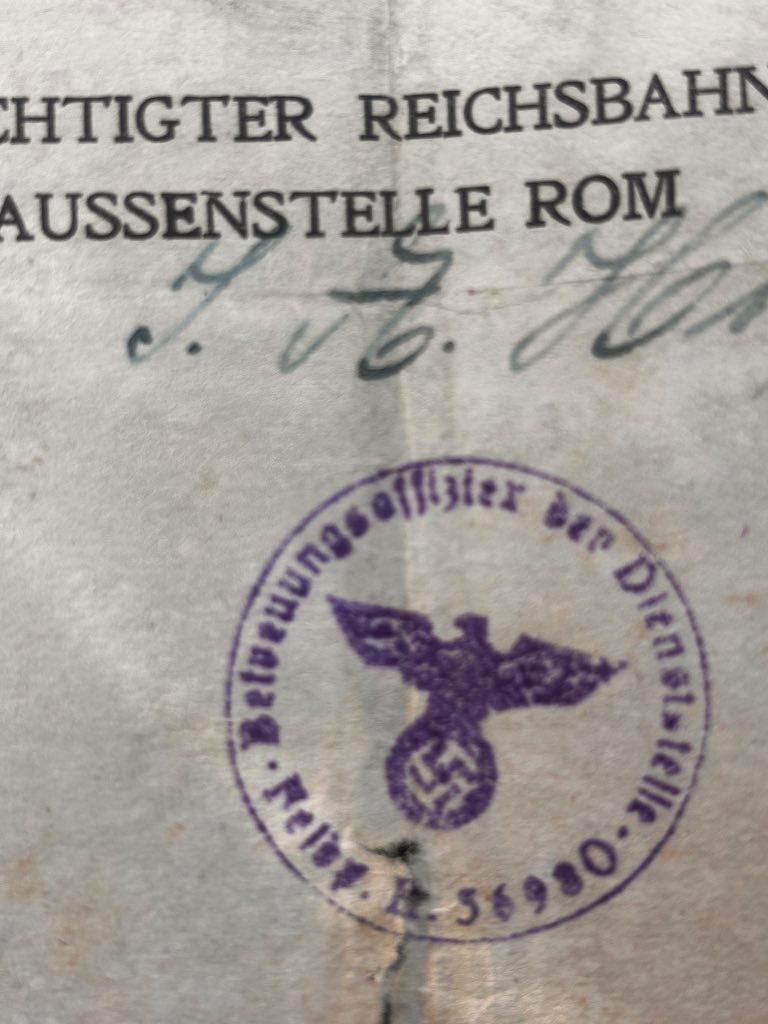
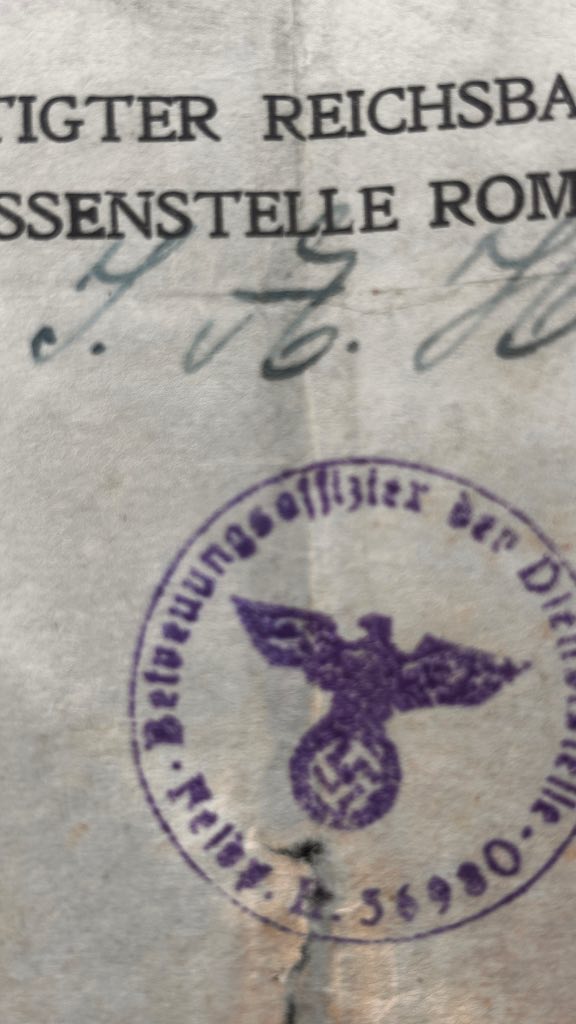
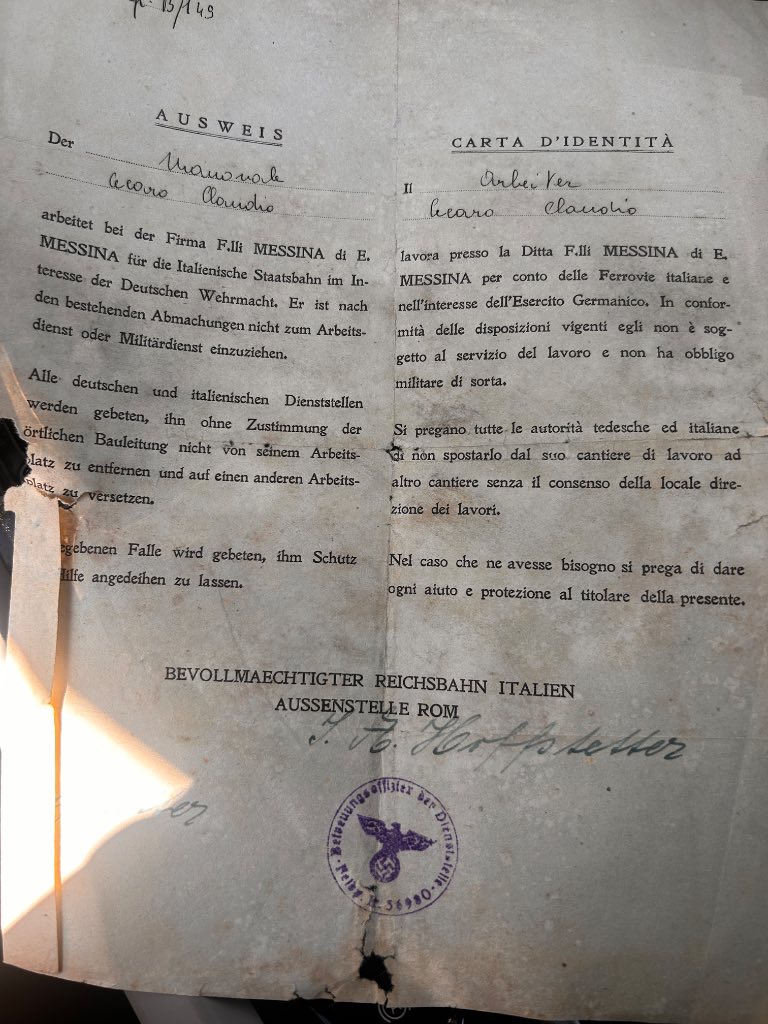
Between September 1943 and June 1944, Rome lived under German occupation. The bureaucratic machinery of the Reich overlaid the institutions of the newly formed Italian Social Republic, creating a capillary network of control over strategic infrastructure, civilian population and labour force. This bilingual Ausweis, issued by the Bevollmächtigter Reichsbahn Italien Aussenstelle Rom — the plenipotentiary office of the Reich railways for Italy based in Rome — documents that reality with surgical precision: an Italian worker, Maruschak Arcaro Claudio, employed by the firm F.lli Messina on behalf of the German railway authorities, authorised to move freely between German and Italian offices without being subject to compulsory labour or military service. The violet stamp bearing Nazi eagle and swastika, the registration number Rchv. R 5690 O III, the autograph signature of the issuing official: every element narrates the daily life of occupation, when Italian railways were placed under direct Wehrmacht control to guarantee military transport towards the Cassino and Anzio fronts.
Bibliographic notes
The document belongs to the category of Ausweise — special passes and identity cards issued by German occupation authorities in Italy between 1943 and 1945. The Bevollmächtigter Reichsbahn Italien (Plenipotentiary of the Reich Railways for Italy) was established immediately after 8 September 1943 to assume operational control of the Italian railway network, vital for supplying German troops engaged in defending the Gustav Line and, subsequently, in operations countering the Anzio landings. The Aussenstelle Rom (Rome external office) coordinated operations in the capital and Lazio, issuing bilingual documents for Italian civilian personnel employed in railway operations. The juxtaposed German and Italian text reflects the forced collaboration between RSI and Reich, with German always on the left (position of pre-eminence) and Italian on the right. The format, typography and official stamp follow Third Reich bureaucratic standards, adapted to the Italian context. This is not widely distributed printed material, but documents produced in limited quantities for specific operational needs, which explains their current rarity.
Provenance and condition
Provenance is consistent with family archives (the document made out to Maruschak Arcaro Claudio may have been preserved by descendants) or with post-war railway archive disposals, when tonnes of occupation documentation were dispersed, destroyed or sold as waste paper. Condition is Fair: widespread foxing across the entire surface, marked usage folds (the document was evidently carried in the holder's pocket), corner loss that does not compromise legibility of either text or official stamp. The violet stamp with imperial eagle and swastika remains sharp, as does the autograph signature of the issuing official. The handwritten name of the Italian worker is perfectly legible. Despite signs of use, the document retains its full evocative power: every fold, every stain recounts the nine months of occupation, when a civilian worker had to show this piece of paper to cross German and Italian checkpoints without being deported for forced labour in Germany.
Market value
The BookOracle valuation of €800-€1,500 reflects documentary rarity, historical context and market demand for Third Reich militaria related to the Italian occupation. Similar documents have appeared in specialist auctions: Hermann Historica Auction 77 (2019) sold a Wehrmacht Ausweis for central Italy at approximately €950; Catawiki has recorded hammer prices between €600 and €1,200 for German passes issued in Italy in 1943-44; eBay shows private sales of Reichsbahn Roma documents between €700 and €1,400. The upper segment of the range (€1,200-€1,500) is justified for examples with particularly sharp stamps, documented provenance or association with specific historical events (round-ups, deportations, military operations). The lower segment (€800-€1,000) applies to examples with more extensive damage or uncertain provenance. This document, with sharp stamp and clear historical context (Rome railways during occupation), positions itself in the medium-high band. The reference market is international: German and American collectors of Third Reich militaria, Second World War historians, European railway history enthusiasts, scholars of the RSI period and Italian occupation.
Why it matters
Beyond monetary value, this Ausweis is direct testimony to a tragic page of Italian and European history. It documents the daily life of occupation: not the great battles or strategic decisions, but the life of a civilian worker forced to collaborate with the occupier to survive. The bilingual text reveals the power hierarchy (German on the left, Italian on the right), the exemption from compulsory labour shows how the Reich managed Italian workforce, the stamp with eagle and swastika materialises the Nazi bureaucratic apparatus on Italian soil. For historians, it is a primary source for studying railway organisation under occupation, RSI-Reich collaboration, the conditions of Italian civilian workers. For collectors, it is a rare and authentic object, with patina of use that certifies its genuineness. For anyone wondering what it meant to live in Rome between September 1943 and June 1944, this piece of paper provides a concrete answer: it meant carrying a bilingual document in your pocket, crossing checkpoints, showing a violet stamp with Nazi eagle to avoid deportation. History you can touch.
Comments
Loading…
Sign in or register to leave a comment
Sign in or register