Romi's Factories of Glory: editorial satire in 1953 France
First edition of 'Usines à Gloire', second volume in the Copies Conformes series: an ironic analysis of success in modern society with surrealist graphics
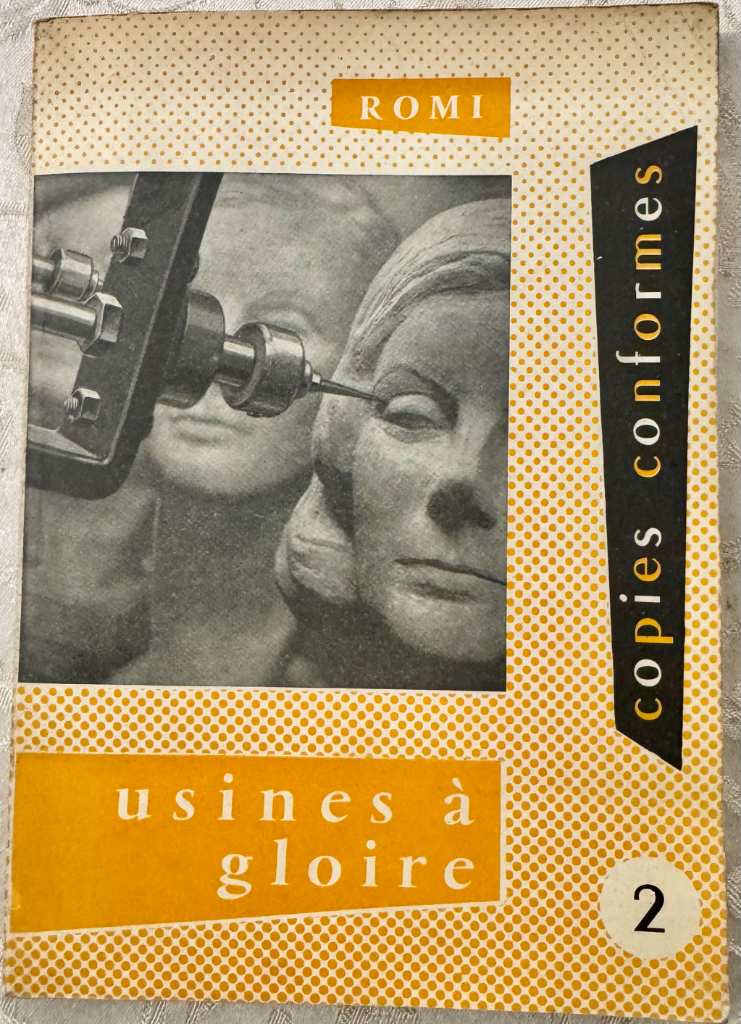
In the Parisian publishing landscape of the post-war period, when France sought to rebuild not only its cities but also its cultural identity, Robert Miquel — better known by his pseudonym Romi — published in 1953 a volume that would anticipate by decades reflections on the society of the spectacle. Usines à Gloire, the second number in the 'Copies Conformes' series published by Éditions de Paris, represents a valuable document for understanding the critical and ironic approach with which the French intelligentsia observed the emerging mechanisms of mass celebrity.
The copy examined here is presented in octavo format, bound in original publisher's wrappers. The cover itself constitutes a visual manifesto: a surrealist photomontage juxtaposing mannequin heads with mechanical instrumentation, all against a background characterised by the yellow polka-dot pattern typical of 1950s modernist graphics. This iconographic choice is not accidental: it anticipates the volume's content, where the human being is metaphorically reduced to a cog in a fame-producing machine.
Bibliographic notes
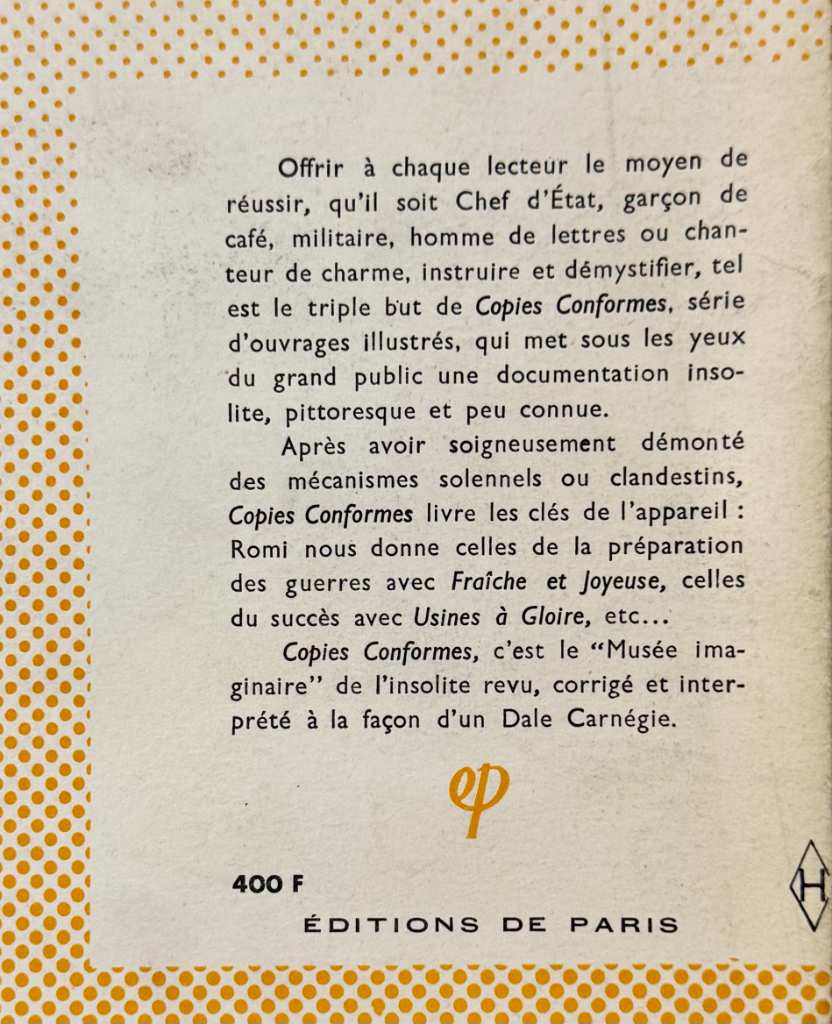
Robert Miquel (1905-1995) adopted the pseudonym Romi to sign an extraordinarily vast editorial production: over fifty works dedicated to French popular culture, from eroticism to gastronomy, from fashion history to forgotten trades. His methodology combined documentary rigour with narrative accessibility, making him one of the most prolific historians of curiosities in the twentieth century. The 'Copies Conformes' series, in which Usines à Gloire appears, was conceived with the ambition of analysing phenomena of social conformism through a simultaneously sociological and satirical lens.
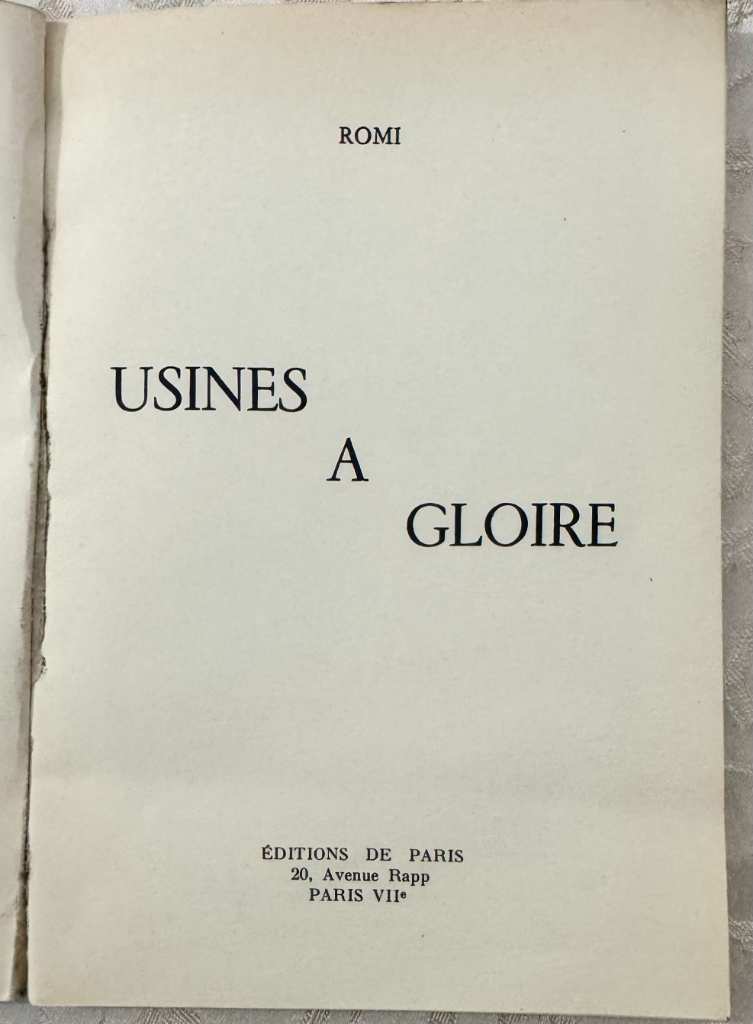
The publishing house Éditions de Paris, active in the immediate post-war period, distinguished itself through an editorial line attentive to transformations in contemporary society, publishing essays that combined critical analysis with graphic experimentation. The octavo format and illustrated wrappers represented economical choices that permitted wider distribution whilst maintaining considerable aesthetic dignity.
Provenance & condition
The copy presents itself in good general condition, with the normal patina of time that characterises volumes in wrappers from the 1950s. The cover maintains the chromatic vivacity of the yellow polka-dot pattern, a distinctive element confirming the absence of prolonged exposure to direct light. The surrealist photomontage remains intact, without significant abrasions to corners or spine.
The publisher's wrappers, a binding typology particularly vulnerable to wear, show no evident tears or restorations. The internal pages preserve their structural integrity, without widespread foxing or moisture stains. This represents more than acceptable condition for a seventy-year-old volume originally intended for popular consumption rather than bibliophilic preservation.
No particularly significant provenance elements emerge: absence of ex libris, stamps or manuscript annotations that might trace back to historic collections or prominent figures in the French cultural panorama of the period.
Market value
The market valuation for this copy stands in the €20-45 range, reflecting moderate availability on the international antiquarian market. The rarity score (25/100) confirms a 'Low' index, consistent with a print run that, whilst not precisely documented, must have been sufficiently ample to guarantee decent copy survival.
The principal antiquarian commerce platforms — AbeBooks, Maremagnum, Chapitre.com — register sporadic appearances of volumes from the 'Copies Conformes' series, with prices varying considerably according to condition and presence of the original dust jacket (when applicable). Copies in condition comparable to that described here position themselves stably in the lower portion of the valuation range.
It is important to emphasise that the market for French post-war non-fiction remains relatively niche, with interest concentrated among collectors specialising in twentieth-century cultural history and devotees of modernist editorial graphics. The absence of a particularly rare first edition or illustrious provenance elements limits the potential for significant appreciation in the short-to-medium term.
Why it matters
Beyond its contained monetary value, Usines à Gloire represents a cultural document of considerable interest. The work belongs to that strand of social criticism which, in 1950s France, anticipated themes destined to explode with 1968: the commodification of fame, the standardisation of success pathways, the reduction of the individual to product.
The cover graphics merit particular attention: the surrealist photomontage with mannequins and cogs constitutes an eloquent example of how French publishing of the period knew how to combine critical content with visual experimentation. This approach would influence European editorial graphics throughout the 1960s.
For collectors of French post-war non-fiction, the volume offers the opportunity to acquire a significant piece at an accessible price. For scholars of cultural history, it represents a primary source for understanding how the French intelligentsia was elaborating, already in the 1950s, a critique of media mechanisms that we would today define as 'image society'. Romi's prolific production, still today the object of critical rediscovery, confers further interest on this copy, testimony to an author who knew how to narrate popular France with rigour and irony.
Comments
Loading…
Sign in or register to leave a comment
Sign in or register