Venetian Proclamation of 1621 on Grain Trade: Document of the Magistratura alle Biaue
Rare printed edict of the Serenissima regulating cereal supply, with woodcut of the Lion of Saint Mark
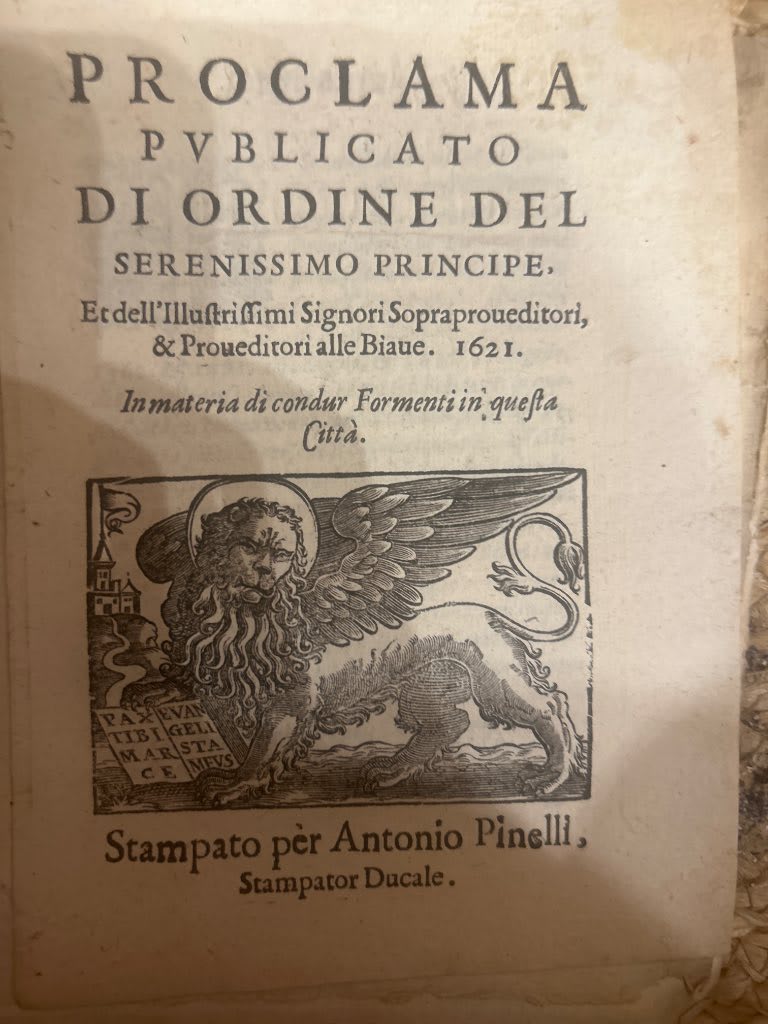
On 4 September 1621, as Venice consolidated its role as a Mediterranean power in the delicate equilibrium of the early seventeenth century, the Provveditori and Sopraprovveditori alle Biaue issued a proclamation that today represents precious testimony to the Serenissima's food supply policies. Printed by Antonio Pinelli in his capacity as Stampator Ducale, this edict regulated the transport of wheat towards the lagoon city, recalling previous decrees and imposing obligations even upon religious orders. The frontispiece is adorned with a woodcut of the striding Lion of Saint Mark with open book, emblem of doge authority that conferred juridical solemnity upon the document.
Bibliographic Notes
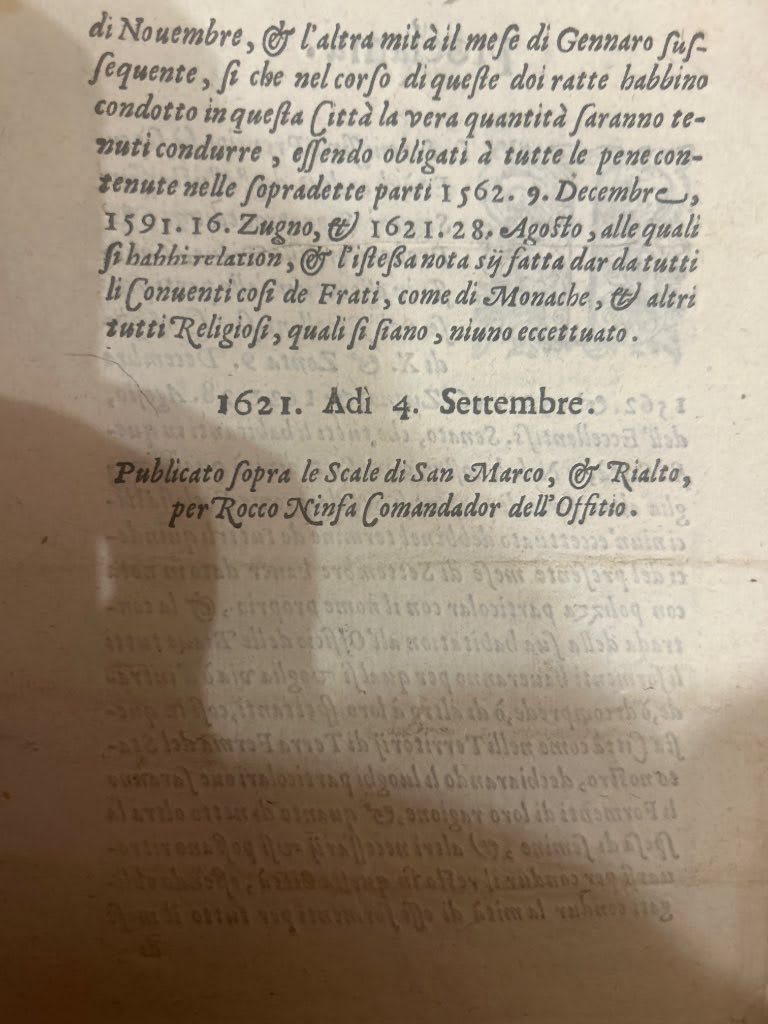
The proclamation constitutes an example of printed edict produced by the Venetian ducal press, a documentary genre that combined administrative function with symbolic value. Antonio Pinelli, active as Stampator Ducale in the second decade of the seventeenth century, was responsible for the official publication of the Republic's acts. The text explicitly recalls decrees of 1562, 1591 and August 1621, inserting itself into a normative continuity that characterised Venetian grain supply management. The promulgation formula — "Publicato sopra le Scale di San Marco & Rialto per Rocco Ninfa Comandador dell'Offitio" — attests to the procedure of public posting in designated places, a practice that guaranteed maximum diffusion of ducal dispositions. The Magistratura alle Biaue, established in 1506, represented one of the most important organs of Venetian administration, charged with overseeing cereal provisioning and preventing famines that could have destabilised the city's social order.
Provenance and Condition
The exemplar presents itself as a printed document of the early seventeenth century, a genre particularly vulnerable due to its ephemeral nature and practical destination. Venetian proclamations were posted in public places, read, handled and often dispersed once their administrative function was exhausted. The survival of this edict probably testifies to archival or collecting preservation that has maintained its integrity across four centuries. The woodcut of the Marcian Lion, a decorative element recurring in the Serenissima's edicts, confers iconographic value beyond historical significance. The motto PAX TIBI MARCE EVANGELISTA MEVS, engraved on the open book held by the lion, recalls the legend of Venice's evangelical foundation and the spiritual authority that legitimised the Republic's temporal power. The absence of indications regarding restoration or conservation interventions in the description suggests a condition compatible with age and documentary typology.
Market Value
The BookOracle valuation places this proclamation in the €185-290 range, reflecting a niche market for Venetian administrative documents of the seventeenth century. The rarity score of 62/100 and "Discrete" index indicate appreciable but not exceptional rarity, consistent with the nature of an official document produced in limited but not unique print runs. The Italian and international antiquarian market registers constant interest in edicts and proclamations of the Serenissima, particularly when adorned with woodcuts of the Marcian Lion and when documenting specific aspects of Venetian administration. Gonnelli Casa d'Aste has handled seventeenth-century Venetian proclamations in comparable price ranges, whilst platforms such as Maremagnum and AbeBooks confirm quotations in the order of hundreds of euros for analogous documents. The presence of the woodcut and explicit reference to the Magistratura alle Biaue constitute valorising elements, as do the precise dating and complete promulgation formula. The theme of grain provisioning adds interest for scholars of economic and social history of seventeenth-century Venice.
Why It Matters
This proclamation represents a privileged window onto the administrative machinery of the Serenissima and its strategies for governing territory and resources. The Magistratura alle Biaue embodied Venetian awareness that control of food supplies constituted a matter of state security, no less crucial than maritime dominion or diplomacy. The extension of obligations even to convents and religious orders testifies to the Republic's capacity to subordinate every institution, including ecclesiastical ones, to collective needs. The normative continuity recalled in the text — with references to decrees from sixty years earlier — reveals a mature juridical system, capable of stratifying dispositions and invoking precedents to reinforce the authority of new norms. For collectors of Venetian documents, this proclamation offers the opportunity to possess an authentic fragment of doge bureaucracy, complete with heraldic symbols and solemn formulae. For scholars, it constitutes a primary source for the history of Venetian economy, food supply policies and administrative culture of the early modern age. The discrete rarity and accessible price make it an interesting acquisition for those building a thematic collection on the Serenissima or on the history of European alimentation.
Comments
Loading…
Sign in or register to leave a comment
Sign in or register