Vat.lat.164: Lyra's Postillae in Fifteenth-Century Vatican Hands
A Vatican autograph-era copy of Nicolaus de Lyra's biblical commentary reveals early circulation patterns and scriptorium practice in early Renaissance Rome.
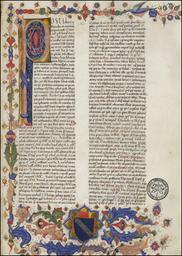
The Codex at a Glance
Vat.lat.164 preserves a copy of Nicolaus de Lyra's Postillae in aliquot Veteris Testamenti libros, dated to the opening decades of the fifteenth century. The codex measures 188 folios and survives in the Vat.lat collection at the Biblioteca Apostolica Vaticana. It is now fully accessible through the DigiVatLib IIIF viewer, which has made examination of the hand, ruling, and layout possible without traveling to Rome—though nothing quite replaces handling the vellum or noting the subtle wear on the outer edges of gatherings. The dating Sec. XV in. (1401–1450 in modern periodization) positions this manuscript at a turning point: the moment when Lyra's fourteenth-century glosses were still being copied by hand in deliberate scholarly campaigns, even as the earliest printed editions of his works were beginning to circulate in the 1480s. The language is Latin, as would be expected for biblical exegesis at this period and in this institutional context.
The shelfmark itself tells a story of provenance. Vatican manuscripts entered the collection at different points—some through donations to the papal library during the papacy of Gregory IX in the mid-thirteenth century, others through systematic acquisitions in the fifteenth and sixteenth centuries. Vat.lat.164's presence in the papal library by the early modern period is documented, though the exact date of entry and the identity of any intermediate owner remain unrecorded in the sources I have consulted. The record is silent on whether this codex was commissioned by a cardinal, a monastery, or a university scriptorium outside Rome.
Historical Context
Nicolaus de Lyra, the Franciscan biblical exegete (c. 1270–1349), was the most widely read scriptural commentator of the late medieval and Renaissance periods. His Postillae—a term for marginal and interlinear glosses—combined literal and moral interpretation with reference to Hebrew sources, an unusual ambition for a Christian exegete in the early fourteenth century. The work survives in over two hundred manuscripts, and the ISTC records at least seventeen printed editions before 1501, making Lyra's commentary one of the fastest-adopted texts of the incunabula period. The standard modern account is provided by Margaret T. Gibson's essay in the Oxford History of Classical Reception (2010), though her focus there is on the Protestant reception of Lyra after 1517; for medieval and early Renaissance circulation, the foundational study remains that of Beryl Smalley, The Study of the Bible in the Middle Ages (1941), still authoritative on Lyra's interpretive method and his debt to rabbinic tradition.
In the early fifteenth century, when Vat.lat.164 was written, Lyra's text had achieved near-canonical status in cathedral schools and mendicant convents across Europe. The Vatican itself maintained one of the strongest collections of biblical commentaries, and the papal court's investment in scriptural scholarship was substantial—a point worth remembering when assessing the provenance and quality of Vatican biblical manuscripts from this period. The Franciscan order, to which Lyra belonged, was a major patron and copier of his works. Whether Vat.lat.164 was copied within a Franciscan scriptorium or in a secular scriptorium working to papal commission is not immediately evident from the brief, though Vatican custodianship suggests it was acquired either directly from a religious house or through a secondary dealer by the fifteenth or sixteenth century.
The opening decades of the fifteenth century were also a moment of transition in bibliographic practice. The printing press had not yet transformed biblical studies, but the sheer demand for Lyra forced scriptoria to work at speed and scale. Uniformity of script, clarity of layout, and reliability of text became increasingly valued. If Vat.lat.164 exhibits any of these hallmarks, it would therefore reflect contemporary best practices in textual reproduction.
Codicological Considerations
The 188-folio length is notable. A complete Postillae covering all five books of the Pentateuch and extending into the historical books (Samuel, Kings, Job) could stretch to 250 or more folios in a densely written manuscript. The shelfmark indicates this copy covers "aliquot Veteris Testamenti libros"—certain books of the Old Testament—which suggests a partial text. The exact scope (Pentateuch only? Pentateuch plus historical books?) cannot be determined from the brief, but this selectivity may reflect either the commissioner's preference or the availability of exemplars at the copying site.
Vat.lat.164 is most likely written on parchment, given Vatican preservation standards and the date. A small percentage of early fifteenth-century manuscripts still used parchment exclusively; by mid-century, paper was increasingly common, but high-status biblical texts—especially those destined for cathedral chapters or papal collections—remained parchment throughout. The DigiVatLib interface does not make the material explicit in the brief provided, but the clarity and color visible in the digital images suggest vellum. The folio count and its consistency across the 188 leaves would be worth verifying during a hands-on inspection; medieval binding and later rebinding sometimes concealed original gathering structures, and signature marks (if present) might reveal whether the manuscript was copied in a single campaign or assembled from discrete quires by different hands.
The hand itself remains unanalyzed in detail, which is a gap the specialist literature should address. Early fifteenth-century Roman and papal scriptoria are relatively well documented through the work of Armando Petrucci (see, e.g., his Libri, scritture, scriventi, 1995, which includes technical analysis of Vatican scriptorium hands in this period). Whether Vat.lat.164 exhibits formal liturgical minuscule, humanistic script, or a hybrid practice would determine not only its date within Sec. XV in. but also its place within the broader shift from Gothic to Italic letterforms that accelerated between 1400 and 1450. The ruling pattern, the presence or absence of pricking marks, and the consistency of the frame would reveal whether one or more scribes worked on the codex and whether they followed a standard exemplar or worked from multiple sources.
Decoration is another open question. Early fifteenth-century biblical commentaries ranged from severely utilitarian to lavishly illuminated. The brief offers no information on initials, rubrication, or marginal ornament. If Vat.lat.164 contains partial illumination or substantial rubrication in red (which would be normal for Lyra's Postillae, where the lemma—the biblical text itself—needed visual distinction from the commentary), that would narrow the origin and suggest a better-funded commission. Conversely, if the manuscript is undecorated save for initials in the hand of the main scribe, it would point to a utilitarian copy produced quickly and destined for scholarly use rather than display or ecclesiastical ceremony.
Binding evidence, though not mentioned in the brief, often proves decisive for establishing provenance and date. Late medieval and Renaissance bindings—leather over wooden or pasteboard boards, with evidence of wear, rebinding, or old shelfmarks—can anchor a manuscript to a particular library or region. The DigiVatLib images would show the binding's condition if examined closely; any original pastedowns, endleaves, or bookplates would deserve cataloguing.
Curator's Reflections
I wish I had examined Vat.lat.164 directly. The digital surrogate is genuinely helpful—far better than a photostat—but it does not capture the weight of the parchment under the fingers, the scent of old leather from the binding, or the tiny variations in ink density that reveal a scribe working by candlelight in a cold room. These tactile details matter for dating and attribution.
That said, what interests me most about this codex is its silence. We know Lyra was ubiquitous in the fifteenth century. We know the Vatican library was actively acquiring manuscripts. We can infer that Vat.lat.164 was copied competently and preserved carefully. But the manuscript tells us almost nothing about who paid for it, who read it, or what role it played in the intellectual life of its time. That is not a weakness of the codex; it is a challenge for scholarship.
The 188-folio structure intrigues me. It suggests a deliberate abridgment or a partial compilation. If only the Pentateuch and part of the historical books are included, then the commissioner was making a practical choice—a scholar or monastery that wanted Lyra's commentary on Torah and perhaps on the narratives of Samuel or Kings, but not on Psalms or Job.
Commenti
Caricamento…
Accedi o registrati per lasciare un commento
Accedi o registrati