Capogrossi 1954: Seuphor and Original Lithographs from Cavallino
First edition monograph with original lithographic plates, documenting Italian abstraction at its zenith
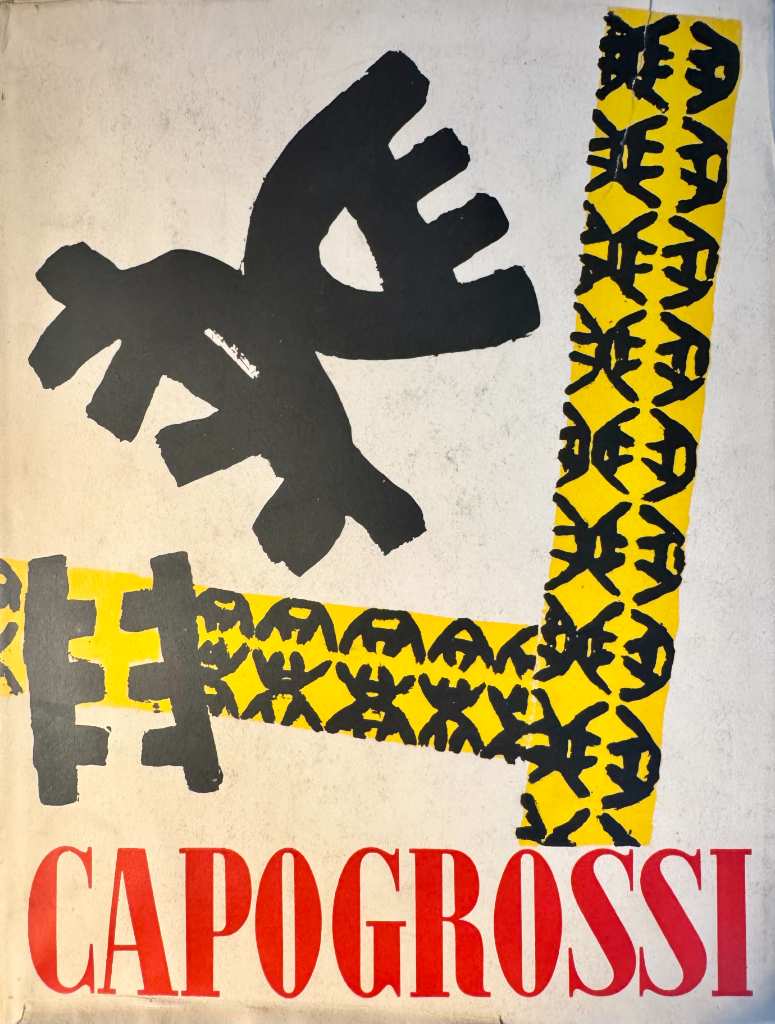
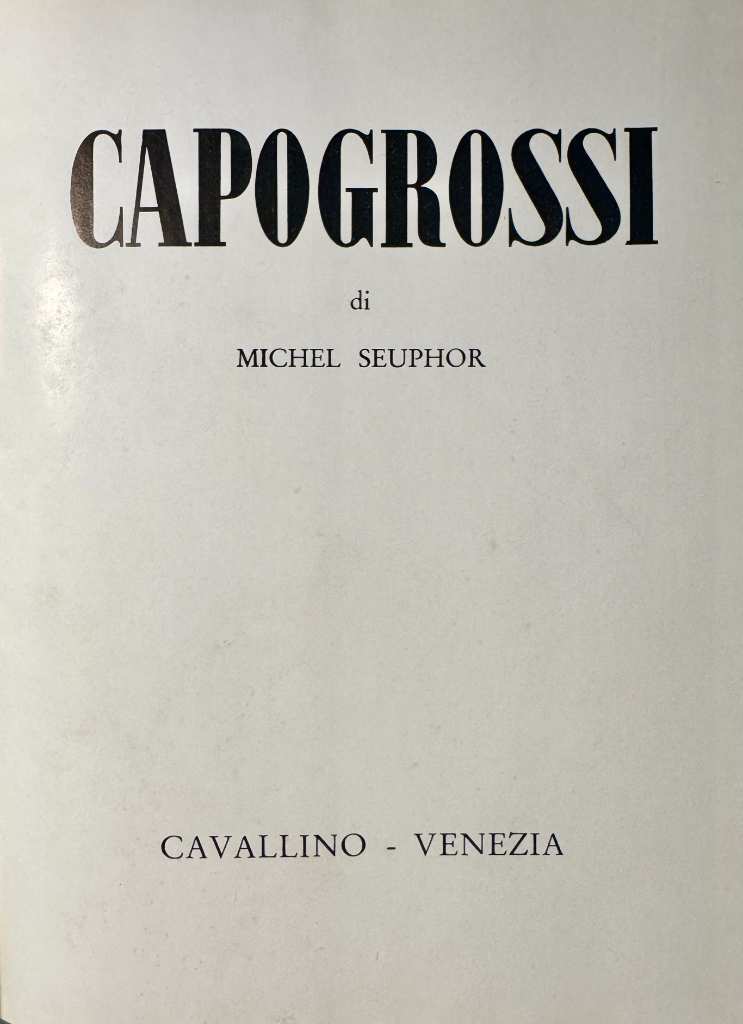
Within the landscape of post-war Italian art publishing, few works embody with such precision the dialogue between militant criticism and artistic production as this monograph dedicated to Giuseppe Capogrossi, published by Edizioni del Cavallino in Venice in 1954. The volume represents not merely a first-hand critical document — signed by Michel Seuphor, the reference theorist for European geometric abstraction — but also an autonomous work of art, enriched by four numbered original lithographs (plates 7, 8, 9, 10) executed by the artist himself.
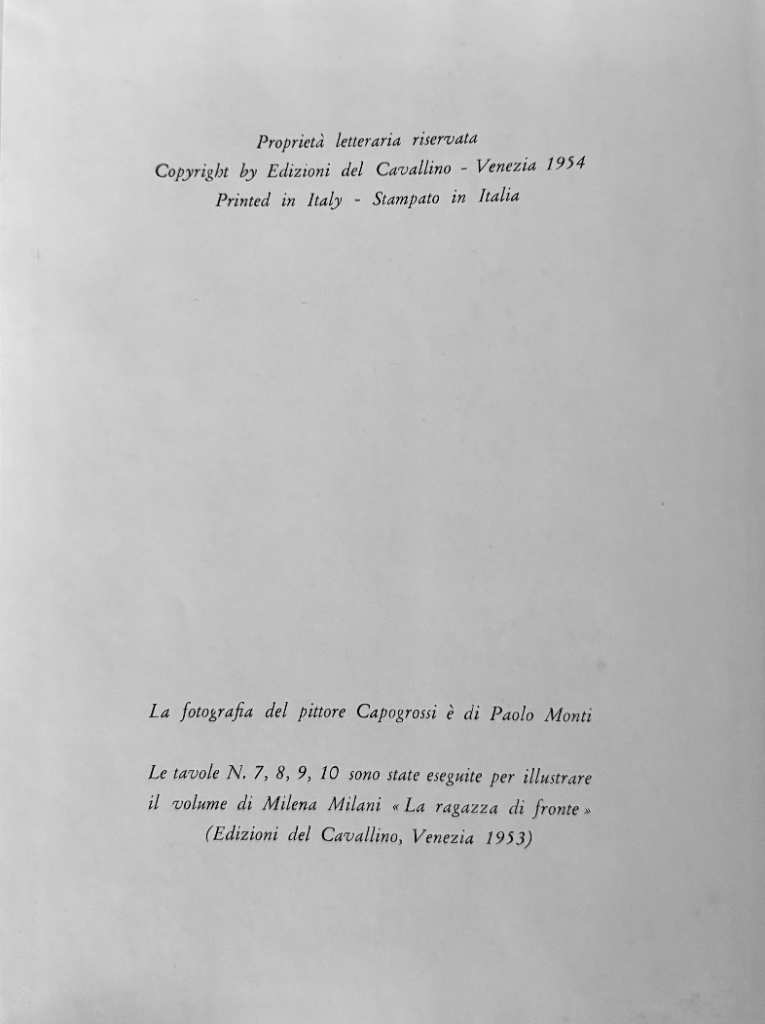
Giuseppe Capogrossi (1900-1972) had recently completed his definitive turn towards abstraction, abandoning the tonal figuration of his early work to develop the celebrated 'fork-sign', that repeated and varied ideogram which would become his distinctive language. Seuphor's monograph captures the artist in this phase of expressive maturity, when the sign becomes a visual alphabet and the pictorial surface transforms into a field of infinite rhythmic combinations. The lithographs included in the volume — some of which had already been used to illustrate Milena Milani's 'La ragazza di fronte', published by Cavallino the previous year — document this research with graphic immediacy, offering the collector not a reproduction but an original multiple work.
Bibliographic notes
The volume is presented in illustrated publisher's wrappers, with two-colour abstract graphics (yellow and black) that echo Capogrossi's visual language. Michel Seuphor's critical text — pseudonym of Fernand Berckelaers, author of the seminal 'L'Art abstrait' (1949) — articulates an analysis of the artist's poetics, contextualising it within the panorama of European abstraction. The four original lithographic plates, numbered progressively, are inserted within the body of the volume and represent variations on the fork-sign theme, executed with the lithographic technique that permits limited and controlled editions.
The presence of a period photograph by Paolo Monti — the Milanese photographer among the most refined interpreters of Italian contemporary art — adds a further documentary layer, capturing the painter in his studio. Monti collaborated systematically with Italy's principal galleries and art publishers, and his photographs today constitute an iconographic source of primary importance.
Provenance & condition
The copy presents in good condition, with normal signs of use compatible with seventy years of existence. The publisher's wrappers retain their original chromatic vivacity, an element far from guaranteed for publications of this period often subject to fading. The lithographs maintain the freshness of ink and the clarity of line, without foxing or moisture stains. No losses, tears or restorations are recorded. The absence of dedications or manuscript annotations preserves the bibliographic integrity of the volume, rendering it particularly appealing to institutional collectors.
Provenance is not documented beyond the current collection, but the conservation care suggests attentive custody over time. The copy bears no library or gallery stamps, an element confirming its nature as a private copy.
Market value
The BookOracle valuation places this copy in the €1,800-2,800 range, with a high rarity index (74/100). This estimate is founded upon analysis of primary Italian market sources — Pandolfini Florence, Wannenes Milan — and monitoring of quotations among specialised international dealers. Cavallino monographs with original lithographs constitute a well-defined market segment, characterised by constant demand and limited supply.
Copies in analogous condition have registered hammer prices between €1,500 and €3,200 over the past five years, with an upward trend for publications dedicated to artists of Capogrossi's calibre, whose quotation in primary and secondary markets shows constant growth. Original lithographs from the 1950s, in particular, benefit from growing interest in post-war Italian auteur graphics, a segment that has seen an average increase of 18% in the five-year period 2018-2023.
The presence of plates already used for another Cavallino publication (Milani 1953) represents an element of philological interest that may enhance appeal among collectors specialising in Venetian art publishing.
Why it matters
This monograph is not merely a book about Capogrossi: it is a document of the intellectual network that sustained the affirmation of Italian abstraction within the European context. Carlo Cardazzo, founder of Edizioni del Cavallino in 1942, constructed an editorial catalogue comparable in rigour and quality to that of Vanni Scheiwiller, privileging limited editions, fine paper and direct collaborations with artists. Each Cavallino publication was conceived as an art object, not as mere critical support.
Michel Seuphor, for his part, represented the bridge between historical abstraction (De Stijl, Bauhaus) and the new post-war generations. His involvement conferred upon Capogrossi an international legitimation, inserting him into the canon of European geometric abstraction. The original lithographs, finally, transform the volume into a multiple work, positioning it midway between the artist's book and the graphic portfolio.
For the contemporary collector, acquiring this volume means entering into possession of a material witness to that unrepeatable season when publishing, criticism and artistic production converged in a unitary cultural project. An epoch when the book remained an object of cult, before digital reproducibility altered its status forever.

Comments
Loading…
Sign in or register to leave a comment
Sign in or register