Capogrossi Autograph Drawing on Naviglio Gallery Invitation, 1963
Rare ephemeron bearing the artist's signature comb motif and personal dedication
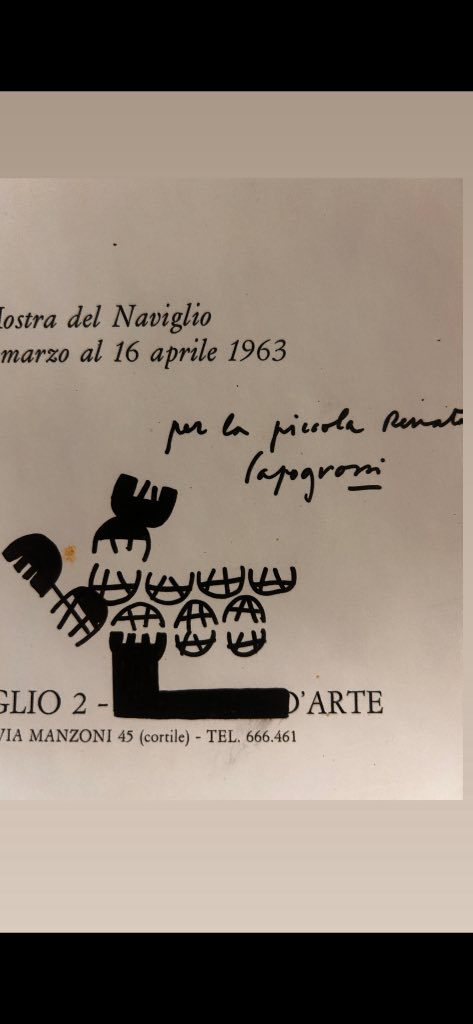
Within the landscape of post-war artist graphic collecting, personalised invitations bearing autograph drawings represent testimonies of particular documentary fascination. The example under examination — an original invitation to Giuseppe Capogrossi's solo exhibition at Galleria del Naviglio 2 in Milan, held from March to 16 April 1963 — is distinguished by the presence of a black marker drawing depicting the celebrated 'comb' motif, accompanied by the handwritten dedication 'per la piccola Renata' and the artist's autograph signature.
Bibliographic notes
Giuseppe Capogrossi (Rome, 1900-1972) ranks among the absolute protagonists of European sign-based abstraction. Trained within figurative painting, in 1949 he executed a radical turn, abandoning mimetic representation to devote himself exclusively to a visual alphabet founded upon the serial repetition of a single sign-symbol, the so-called 'comb' or 'fork'. Co-founder in 1951 of Gruppo Origine alongside Alberto Burri, Ettore Colla and Mario Ballocco, Capogrossi developed a pictorial language of extraordinary formal coherence, exploring infinite chromatic and compositional variations of his iconic motif. The March 1963 exhibition at Galleria del Naviglio falls within the full maturity of the artist's expressive period, when his research had already achieved international recognition through participation in the Venice Biennale and exhibitions across Europe and the United States. The invitation, printed on ivory paper in reduced format, bears the customary exhibition information on the verso; the recto was personalised by the artist with the marker drawing, transforming a simple promotional document into an autonomous graphic work.
Provenance & condition
The dedication 'per la piccola Renata' suggests the invitation was gifted by the artist to a young collector or a friend's daughter, conferring upon the object an intimate and affectionate character. Galleria del Naviglio, founded in Venice in 1946 by Carlo Cardazzo and transferred to Milan with a second location in 1955, represented one of the nerve centres of Italian and European post-war avant-garde, hosting exhibitions by Lucio Fontana, Emilio Vedova, Mark Rothko and Jackson Pollock. To exhibit at the Naviglio meant entering the international circuit of the most advanced contemporary art. The condition of the example proves good: the paper displays the natural patina of time, with slight traces of handling at the margins, yet the marker drawing maintains its graphic freshness intact. No tears, losses or restorations are detected. The autograph signature and dedication remain perfectly legible, elements that significantly enhance the documentary and collectible value of the piece.
Market value
The valuation of €3,900-€6,500 reflects the convergence of several factors: the object's rarity, the presence of the autograph drawing, the prestigious provenance and the historical-artistic context. The market for personalised invitations by Italian Informale artists has registered growing interest in recent years, with significant results at auction houses including Christie's Milan, Pandolfini Florence, Il Ponte and Finarte. Autograph drawings by Capogrossi on small-format paper generally range between €4,000 and €8,000, depending upon dimensions, compositional complexity and provenance. The invitation under examination positions itself in the medium-high band of this range, considering that the ephemeral nature of the support is offset by typological rarity and historical-documentary value. Comparable examples — invitations with autograph dedications by contemporary artists such as Fontana or Vedova — have achieved analogous prices at specialised auctions. The personal dedication, far from constituting a depreciating element, adds a coefficient of uniqueness that collectors of artist documents particularly appreciate.
Why it matters
This personalised invitation transcends its original function as promotional ephemeron to rise as tangible testimony of the direct relationship between artist and public in boom-era Italy. Capogrossi's gesture — transforming a banal invitation into a personalised gift through the application of his iconic sign — reveals the generosity and human accessibility of a master who, whilst operating on an international scale, maintained personal bonds with Milan's social fabric. From a historical-artistic perspective, the object documents the centrality of Galleria del Naviglio within the Italian exhibition system of the 1960s and the capillary diffusion of Informale aesthetics even through unconventional channels. For the contemporary collector, acquiring such a piece means possessing an authentic fragment of Italian art history, an object that combines aesthetic, documentary and affective value. The rarity of autographed invitations by Capogrossi on the market — the majority dispersed or preserved in private archives — renders each emerged example an opportunity difficult to replicate.
Comments
Loading…
Sign in or register to leave a comment
Sign in or register