Capogrossi at Rive Gauche: catalogue of the 1956 Paris exhibition
Rare document of the Roman artist's international consecration, witness to his partnership with Carlo Cardazzo and the Spatialist period
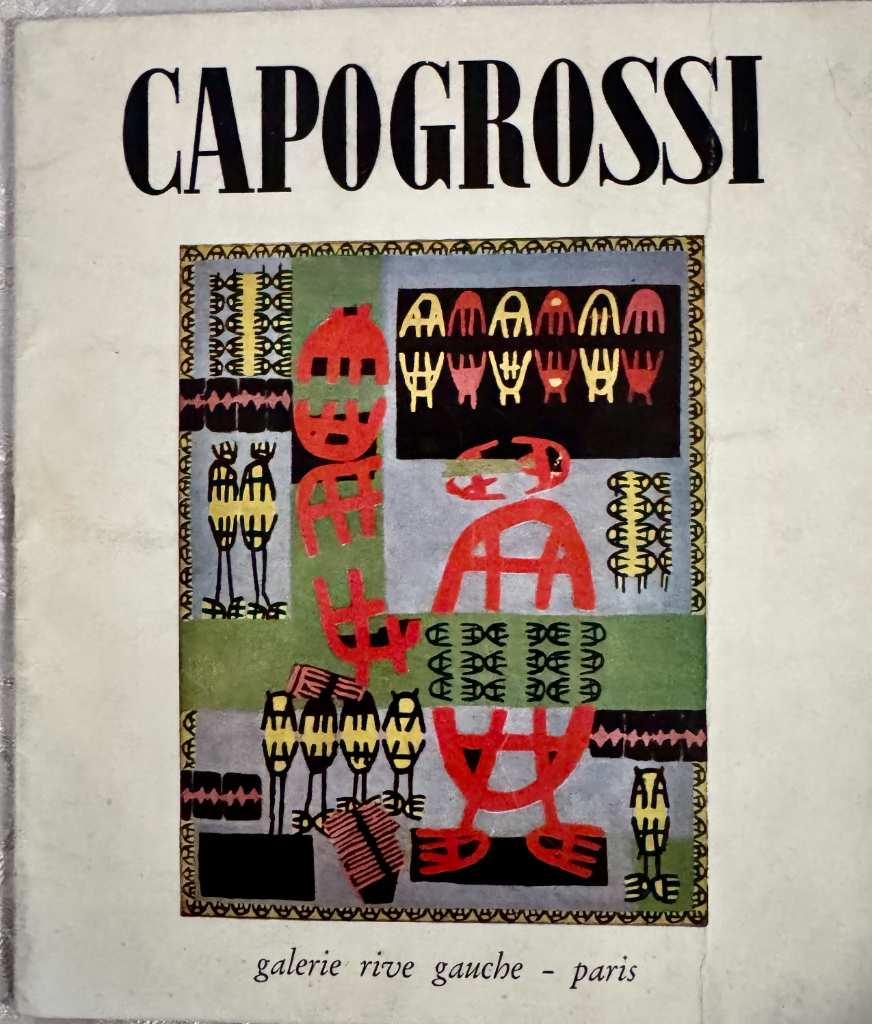
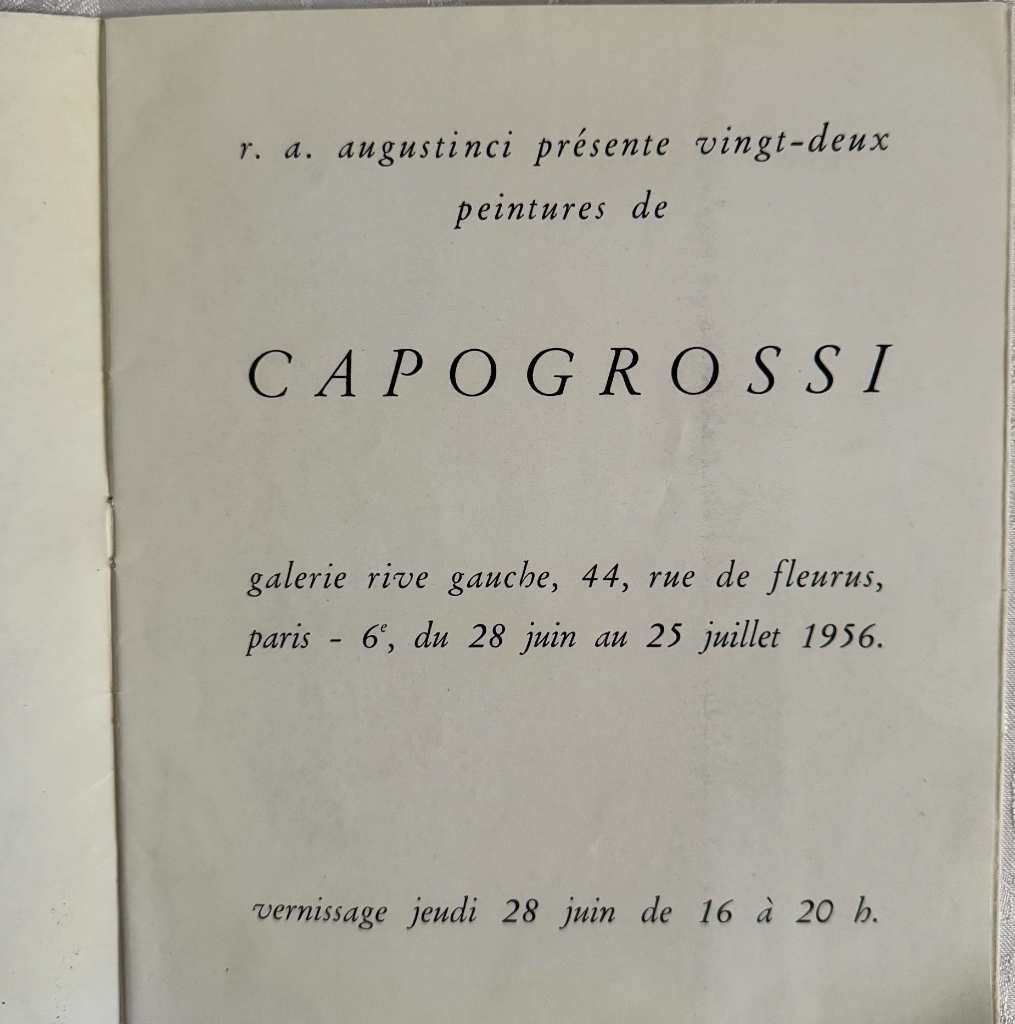
In June 1956, whilst Europe still absorbed the tremors of the Cold War and Paris confirmed its role as capital of contemporary art, the Galerie Rive Gauche hosted a solo exhibition by Giuseppe Capogrossi. The catalogue documenting the event — Vingt-deux peintures — represents today a bibliographic testimony of moderate rarity, mirror of a crucial moment in the trajectory of the Roman artist and, more broadly, in the international promotion of Italian post-war avant-garde.
Bibliographic notes
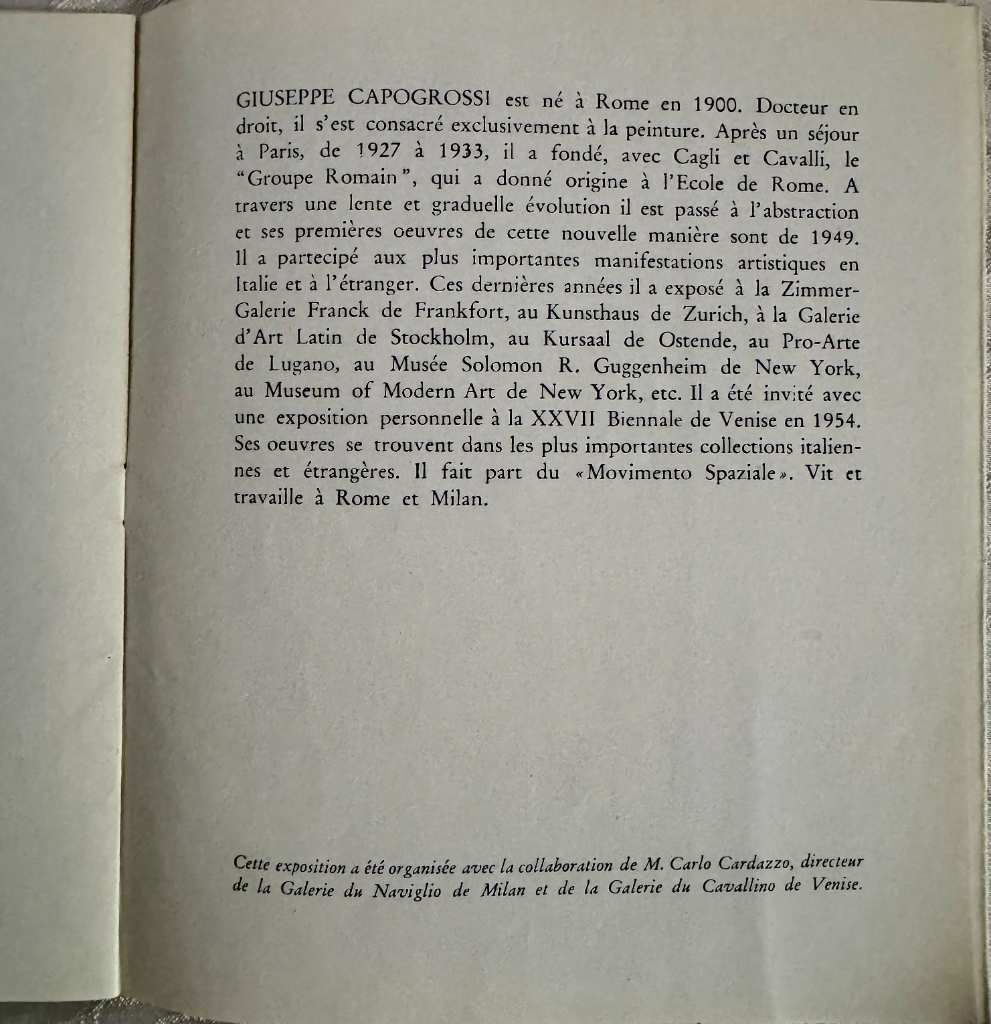
The catalogue is presented in publisher's wrappers with colour-illustrated cover, a format the Rive Gauche adopted for its more refined publications. The cover reproduction — one of the celebrated 'fork' compositions Capogrossi had begun elaborating from 1950 onwards — constitutes an immediate visual manifesto of the artist's sign-based language. The biographical text in French, sober yet informed, situates Capogrossi within the context of the Movimento Spaziale and underscores his recent exhibition achievements, particularly the solo room at the XXVII Venice Biennale of 1954, an event that marked official recognition of his research by Italian institutions. The Paris exhibition was organised in collaboration with Carlo Cardazzo, the Venetian dealer and gallerist whose Galleria del Naviglio in Milan and Il Cavallino in Venice were epicentres for the dissemination of abstract and informal art in Italy. Cardazzo's involvement guaranteed not only a qualitative selection of works, but also a network of collectors and critics already sensitised to Capogrossi's practice.
Provenance & condition
The present copy derives from a European private collection and presents itself in good general condition. The wrappers display the typical signs of use for a period catalogue: slight edge abrasions, minimal scattered foxing, but no significant losses or tears. The illustrated cover maintains good chromatic stability, a factor not to be taken for granted with 1950s printing, often subject to colour shift. The integrity of the fascicle and the absence of annotations or institutional provenance stamps suggest a discreet collecting history, probably linked to an exhibition visitor or an admirer of the artist who followed his European showings. No restorations or conservation interventions are detected.
Market value
The BookOracle valuation places this catalogue in a range of €80-150, consistent with the current market for Italian post-war artist catalogues of limited but not exceptionally rare print run. The rarity score (52/100, 'moderate' index) reflects intermittent availability: copies appear sporadically on specialist platforms such as AbeBooks, ZVAB and Maremagnum, but not with the frequency of more widely distributed publications. The value is sustained by several factors: the historical importance of the exhibition, Cardazzo's role as cultural mediator, the graphic quality of the cover and, not least, the growing collecting interest in documentation of the Movimento Spaziale and Italian abstractionism. Contemporary catalogues of related artists — one thinks of Fontana, Burri, Vedova — circulate in higher brackets when tied to key exhibitions or accompanied by weighty critical texts, but Capogrossi, though recognised, does not yet reach the quotations of the leading names. It should be considered that copies in excellent condition or bearing autograph dedications by the artist could exceed the upper estimate.
Why it matters
Beyond its monetary value, this catalogue merits attention for what it represents in the historical-artistic context. 1956 was a year of consolidation for Capogrossi: after the abstract turn of 1950 and the Biennale success, the Roman artist was building a stable presence in European circuits. The Rive Gauche, a gallery active on the Left Bank of the Seine and frequented by international collectors, offered a showcase complementary to Italian channels. The collaboration with Cardazzo also testifies to the promotional strategy orchestrated around the Naviglio artists, a partnership that would mark the critical and commercial fortune of many protagonists of informel and spatialism. For today's collector, owning this catalogue means safeguarding a fragment of that network of relationships, exhibitions and publications that wove the identity of Italian art abroad. It is a document that speaks as much of the artist as of the system that sustained him, a modest yet eloquent tessera in the reconstruction of an era when Paris still looked to Rome and Milan as laboratories of linguistic renewal.
Comments
Loading…
Sign in or register to leave a comment
Sign in or register