L'Esprit NRF 1908-1940: Anthology of French Modernism
Pierre Hebey's anthology documenting the golden age of the Nouvelle Revue Française, from Gide's foundation to the Occupation
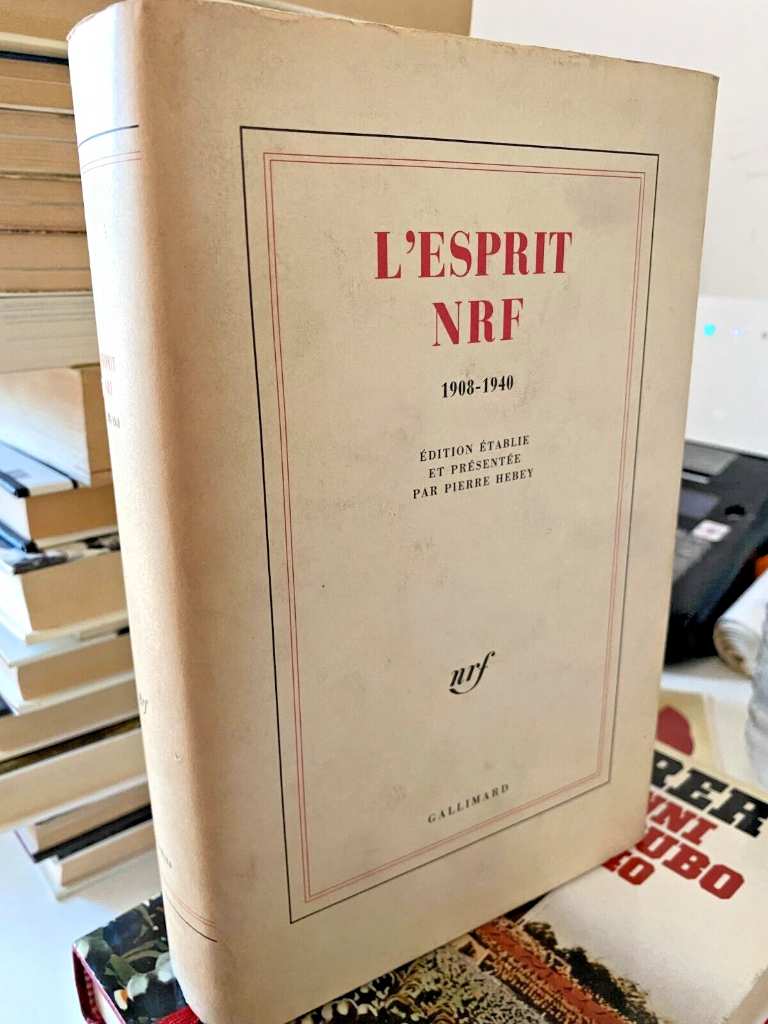
A paperback volume from Gallimard's Blanche collection, published in 1990, encapsulates thirty-two years of French literary history. L'Esprit NRF 1908-1940, edited by Pierre Hebey, stands as documentary testimony to the most brilliant period of the Nouvelle Revue Française, from its foundation in February 1908 until its forced suspension during the German Occupation. The characteristic cream-coloured cover immediately identifies its belonging to the prestigious collection that defined twentieth-century French publishing aesthetics.
Bibliographic notes
The edition, published by Gallimard in 1990, appears in octavo format with original publisher's wrappers. Pierre Hebey, literary historian and specialist in twentieth-century French publishing, has assembled an anthology of the most representative texts published in the review during the successive directorships of André Gide, Jacques Rivière and Jean Paulhan. The volume documents the intellectual evolution of the NRF through critical essays, narrative extracts, aesthetic reflections and cultural manifestos that defined the review's identity. The chronological structure allows readers to follow the transformations of French literary thought through three crucial decades, from late Symbolism to the avant-gardes, from the Great War to the eve of the second conflict. Hebey's critical apparatus contextualises each selection, offering interpretative keys indispensable for understanding the NRF's central role in the European cultural landscape.
Provenance & condition
The copy presents in good general condition with the normal patina of use expected for a volume over thirty years old. The publisher's wrappers maintain structural integrity, though showing signs of time and consultation. The cream-coloured cover of the Blanche collection, a distinctive element of Gallimard's visual identity, retains its recognisability whilst displaying slight traces of handling. The text block remains intact and free from significant annotations, a characteristic appreciated in study and reference volumes. No elements of particular bibliographic distinction emerge: this is a reading and study copy, lacking dedications, bookplates or documented provenance from specialised collections. The condition corresponds to that of a volume used carefully by a scholar or attentive collector, without restoration interventions or alterations to the original configuration.
Market value
The BookOracle valuation places this copy in the €15-35 range, accurately reflecting the market positioning for recent editions of academic-popular character. The rarity score of 15/100 indicates consistent availability on the international antiquarian market. Platforms consulted (AbeBooks, Maremagnum, ZVAB, Chapitre.com) confirm regular presence of copies in varying conditions, with prices generally oscillating between €12 and €45 depending on state of preservation and completeness of dust jacket when present. The 1990 printing, though neither numbered nor limited, benefits from constant interest among scholars of twentieth-century French literature and collectors specialising in Gallimard publishing history. The volume maintains stable value over time thanks to its function as a reference tool for academic research. No speculative peaks or particular volatility are recorded: this is a market segment characterised by constant but moderate demand, with transactions predominantly oriented towards bibliographic use rather than pure collecting.
Why it matters
Beyond its modest monetary value, this volume represents privileged access to one of the most influential publishing phenomena of the European twentieth century. The Nouvelle Revue Française was not merely a literary review, but the intellectual laboratory that formed generations of writers, critics and thinkers. Through its pages passed Proust and Valéry, Claudel and Gide, Malraux and Sartre, defining the aesthetic canons and cultural debates that would shape literary modernity. Hebey's anthology offers a reasoned synthesis of this heritage, rendering accessible material otherwise scattered across rare and costly original issues. For scholars of French literature, it constitutes an indispensable working tool; for bibliophiles interested in publishing history, it documents the cultural identity of a publishing house that defined the literary taste of an era. The Blanche collection, with its iconic cream-coloured cover, itself represents a chapter in the history of editorial design. To possess this volume means to preserve a fragment of European cultural memory, a material witness to that intellectual dialogue which, from the Belle Époque to the Second World War, made Paris the undisputed capital of Western literary life.
Comments
Loading…
Sign in or register to leave a comment
Sign in or register