Franco Gentilini at Fuji Art Gallery: signed Tokyo 1969 catalogue
Rare document of the Faentine master's Japanese visit, with autograph dedication and original tricolour design
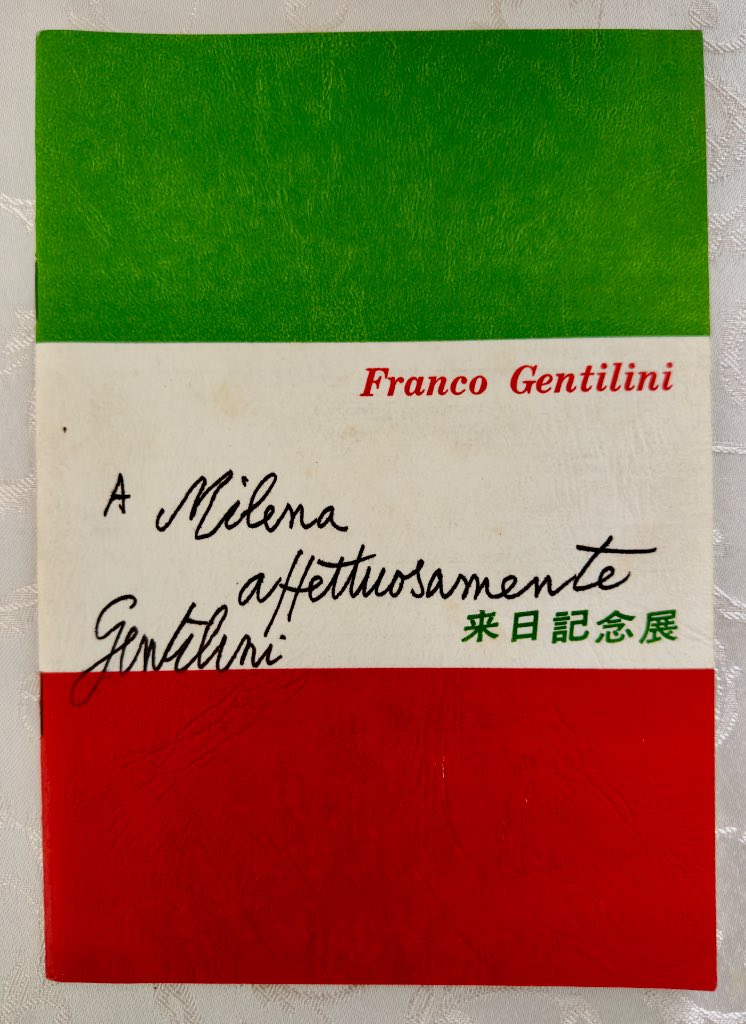
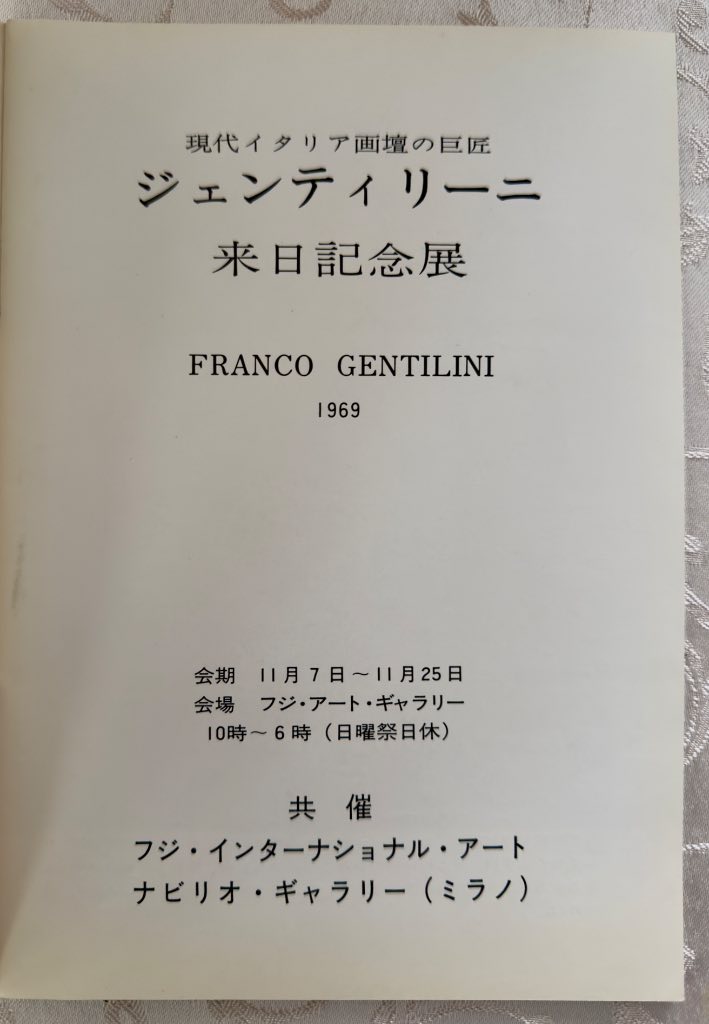
In November 1969, Franco Gentilini (Faenza 1909 – Rome 1981) crossed the Pacific for a solo exhibition at the Fuji Art Gallery in Tokyo, an event co-organised by Milan's Galleria del Naviglio. The catalogue documenting this occasion – enhanced by the autograph dedication 'A Milena affettuosamente Gentilini' on the tricolour cover – represents today a rare document of post-war Italian-Japanese cultural relations and the international fortune of one of the protagonists of the Scuola Romana.
Bibliographic notes
The publication, issued for the 来日記念展 (Commemorative Exhibition of the Visit to Japan), constitutes the first edition of the catalogue for this Japanese solo show. The cover bears a tricolour design explicitly recalling the artist's Italian identity, a graphic choice far from casual in an exhibition context aimed at a Japanese audience. The imprint of Galleria del Naviglio – the historic Milanese institution founded by Cardazzo in 1946 – guaranteed the prestige of the cultural operation. The format and layout reflect the cataloguing standards of late-1960s international exhibitions, a period when Gentilini enjoyed wide visibility beyond national borders. The autograph dedication 'A Milena affettuosamente' adds an element of personalisation that transforms the copy from mere catalogue to testimony of a direct relationship between artist and collector or admirer.
Provenance & condition
The copy comes from an Italian private collection and bears Franco Gentilini's autograph signature on the cover, an element certifying its authenticity and significantly increasing its documentary value. The nominative dedication 'A Milena' suggests a personal gift from the artist, probably upon returning from the Japanese journey or on the occasion of a subsequent meeting. No further provenance information is available, but the presence of the dedication indicates that the object never passed through commercial channels until recent times. The state of preservation is not specified in available documentation, but for a 1969 catalogue one may reasonably expect signs of use compatible with age: slight paper oxidation, possible yellowing of margins, potential creases to the cover. The autograph dedication, if well preserved, represents the element of greatest value and requires particular attention in handling and conservation.
Market value
The BookOracle valuation places this copy in the €180–350 range, with a discrete rarity index (58/100). The price reflects several factors: the intrinsic rarity of a Japanese catalogue from the 1960s, the artist's autograph signature, the documentary value of the event, and the Galleria del Naviglio provenance. Catalogues of Gentilini's solo exhibitions abroad are less common than Italian publications, and the Japanese component adds an element of interest for collectors of reverse Japonisme and post-war cultural history. The autograph dedication constitutes a premium over an unsigned copy, which would struggle to exceed €120–150. The market for Japanese art catalogues from the 1960s–70s is niche but stable, with particular interest from Italian and Japanese collectors documenting bilateral cultural exchanges. Direct comparables have not emerged from consulted sources (AbeBooks, specialist market), which confirms the object's relative rarity but limits the possibility of anchoring the price to recent transactions. The upper end of the estimate (€350) is achievable in the presence of excellent condition and a particularly active Gentilini collectors' market.
Why it matters
This catalogue documents a precise moment in Franco Gentilini's career: 1969, when the sixty-year-old artist enjoyed consolidated international recognition. The Scuola Romana, of which Gentilini was a central figure alongside Mafai and Scipione, had by then acquired historiographic dignity, and exhibitions abroad multiplied the visibility of twentieth-century Italian artists. The journey to Japan was not an isolated episode: in the 1960s, galleries such as the Naviglio actively promoted Italian art in Asia, anticipating market globalisation dynamics that would become dominant in subsequent decades. The choice of Fuji Art Gallery as exhibition venue signals Japanese collecting interest in European figurative painting, at a moment when Tokyo was establishing itself as an international cultural hub. For scholars of Italian-Japanese relations, this catalogue offers concrete testimony of bilateral cultural exchanges often neglected by historiography. For Gentilini collectors, it represents a rare piece of exhibition bibliography, enriched by the artist's autograph presence. The dedication 'A Milena' humanises the object, transforming it from public document to private relic, trace of a friendship or personal esteem that spans half a century.
Comments
Loading…
Sign in or register to leave a comment
Sign in or register