Georges Mathieu: lyrical lithograph with autograph dedication, 1965
A signed multiple from French gestural abstraction, enriched by the artist's personal inscription on verso
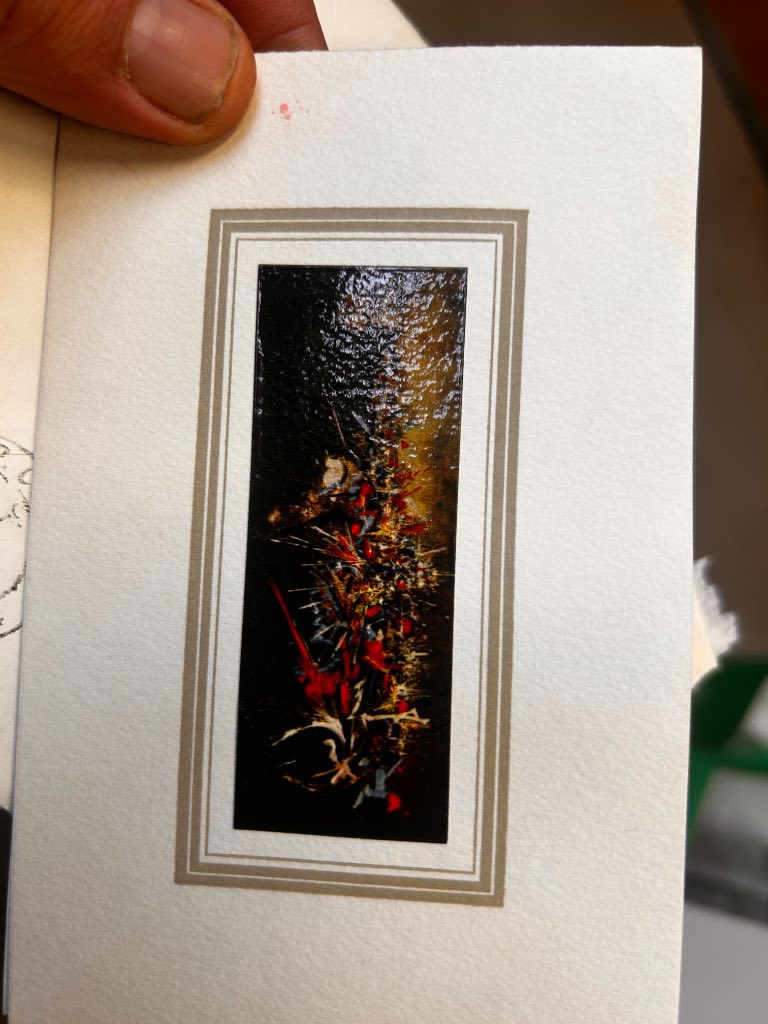
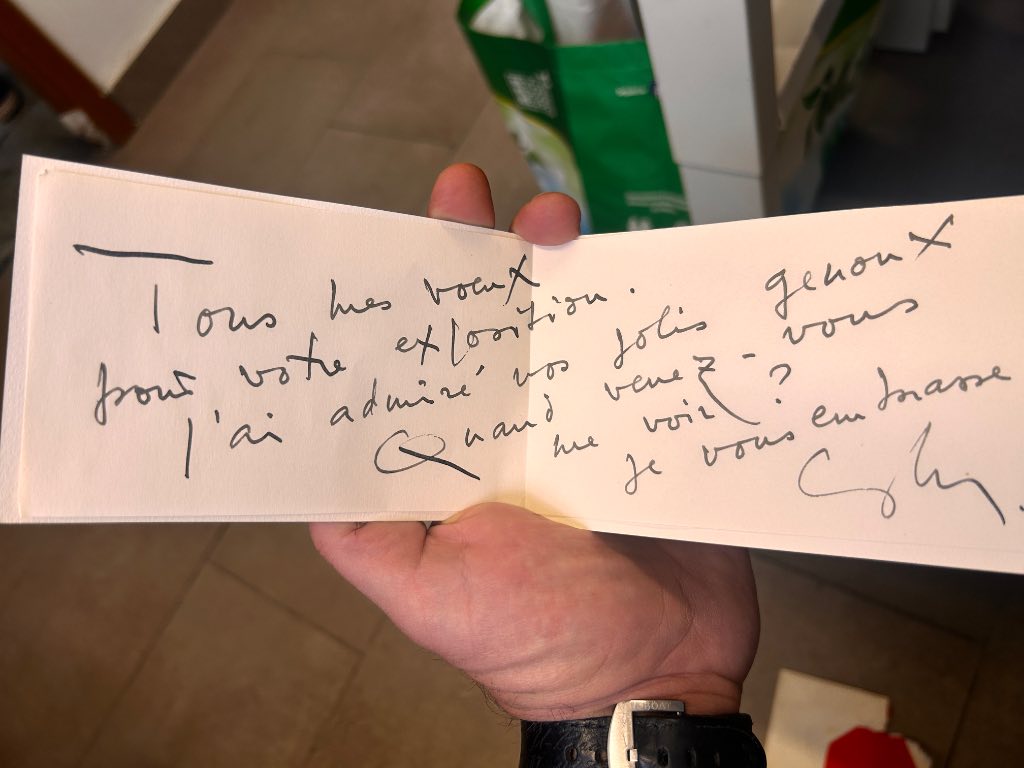
In 1965, as European lyrical abstraction consolidated its position in the international market, Georges Mathieu entrusted the Parisian publisher Braun et Cie with a series of lithographs designed to disseminate his gestural aesthetic to a broader audience. La Victoire de Demain belongs to this season of accessible multiples, but it is distinguished by a detail that radically alters its status: the autograph dedication on the verso, traced in pen by the artist, transforms the sheet from a simple editorial print into a personal document, testimony to a direct relationship between creator and recipient.
Mathieu (1921-2012) was among the protagonists of French informel, a theorist of lyrical abstraction and painter-performer who in the 1950s and 1960s created monumental canvases before live audiences, in a sort of pictorial choreography that anticipated happenings. His calligraphic gesturality — black, red and gold marks launched onto canvas with controlled energy — became the recognisable signature of an aesthetic that rejected figuration without renouncing dramatic tension. The lithographs published by Braun represented a strategy of democratising the work, maintaining intact the expressive force of the original gesture.
Bibliographic notes
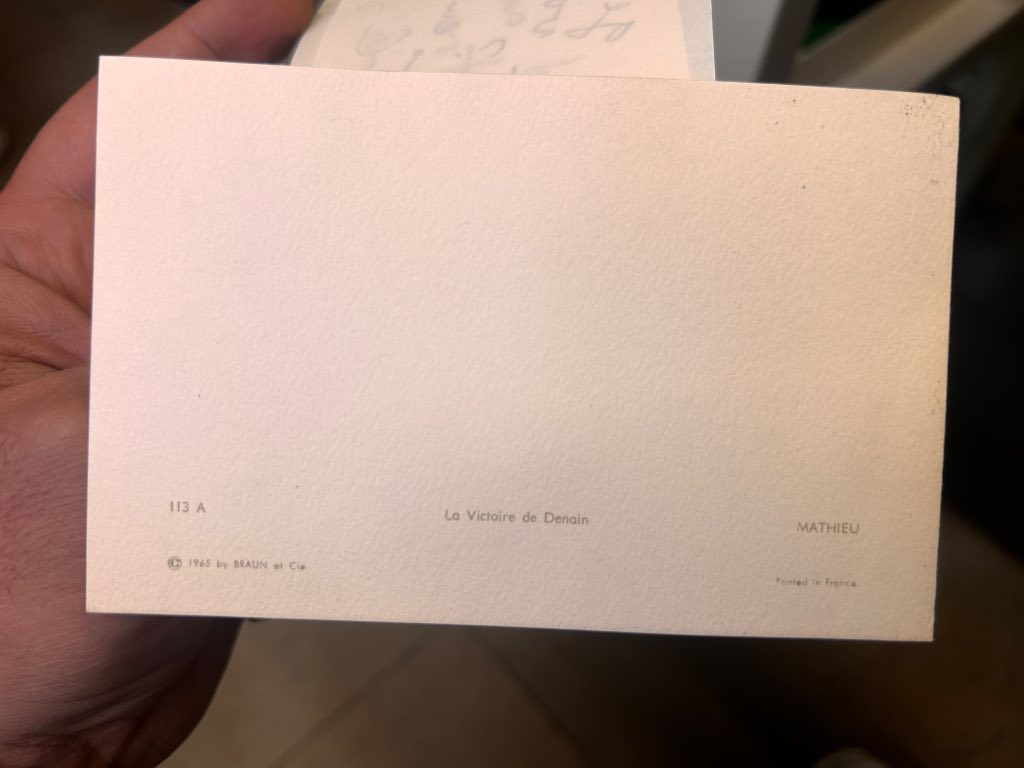
La Victoire de Demain was published by Braun et Cie, a Parisian publishing house active in the art print sector since the post-war period. The lithograph, executed on paper mounted on white support with a grey-beige printed frame, presents Mathieu's characteristic gesturality: black, red and gold marks on a dark ground, arranged according to a dynamic that evokes both Oriental calligraphy and American action painting. The edition is limited, as was customary for Braun multiples of the 1960s, and bears the artist's signature in print or pencil (market sources do not always specify the signing method for each print run).
The element that distinguishes this copy is the autograph dedication on the verso, written in pen with an affectionate tone and signed "G. Mathieu". This inscription, not provided for in the standard edition, confers a hybrid status on the sheet: no longer a simple multiple, but testimony to a personal relationship, perhaps a gift or tribute to a collector, critic or friend. The dedication is undated, but the handwriting and tone suggest temporal proximity to publication.
Provenance & condition
The provenance of the work is not documented beyond the autograph dedication, which nonetheless constitutes evidence of first circulation: the sheet was probably delivered directly by the artist to the recipient, removing it from the ordinary commercial circuit. The absence of gallery or auction house stamps on the verso reinforces the hypothesis of private transmission, at least in the initial phase.
The condition is good, with signs compatible with non-professional domestic storage. There is slight marginal yellowing, typical of 1960s paper exposed to ambient light, and a small red stain on the white support, external to the lithographic image. The printed surface shows no abrasions, tears or significant creases. The grey-beige printed frame shows slight traces of handling at the edges. Overall, the work has passed through six decades without structural damage, maintaining the legibility of the gesture and the chromatic vivacity of the red and gold pigments.
Market value
The BookOracle valuation places La Victoire de Demain in the €800-1,400 range, with a discrete rarity index (62/100). The market for Mathieu's 1960s lithographs has stabilised over the past ten years at values between €600 and €2,000, depending on dimensions, print quality and the presence of autograph signature. Sources consulted — Artprice for Mathieu's 1960s lithographs and Swann Galleries for post-war prints — confirm that Braun multiples, while not reaching the prices of unique works, maintain consistent interest among collectors of European abstraction and bibliophiles interested in original graphic art.
The autograph dedication constitutes a significant but not determining factor of valorisation: the market rewards above all aesthetic quality and editorial rarity, while personal inscriptions interest a niche of collectors sensitive to the documentary dimension. In this case, the dedication elevates the sheet above the average of anonymous multiples, approaching the upper end of the estimate, but does not transform it into a unique piece. The good condition, with minor and reversible defects, supports the valuation without penalising it.
Why it matters
La Victoire de Demain represents an eloquent example of how the French publishing industry of the 1960s managed to translate the energy of informel into accessible objects, without betraying its expressive charge. Mathieu, an artist-theorist conscious of his own historical role, used lithography not as passive reproduction, but as an extension of the pictorial gesture, entrusting to print the dissemination of an aesthetic vision that would otherwise have remained confined to museums and major collections.
The autograph dedication adds a narrative dimension: the sheet becomes a trace of an encounter, a dialogue, a relationship that art history does not record but that private collecting preserves. For those who seek in the object not only aesthetic value but also biographical memory, this lithograph offers privileged access to Mathieu's world, an artist who made performance and direct relationship with the public one of the cornerstones of his practice. In a market increasingly attentive to provenance and the history of objects, La Victoire de Demain presents itself as a stratified document: work of art, editorial multiple, personal testimony.
Comments
Loading…
Sign in or register to leave a comment
Sign in or register