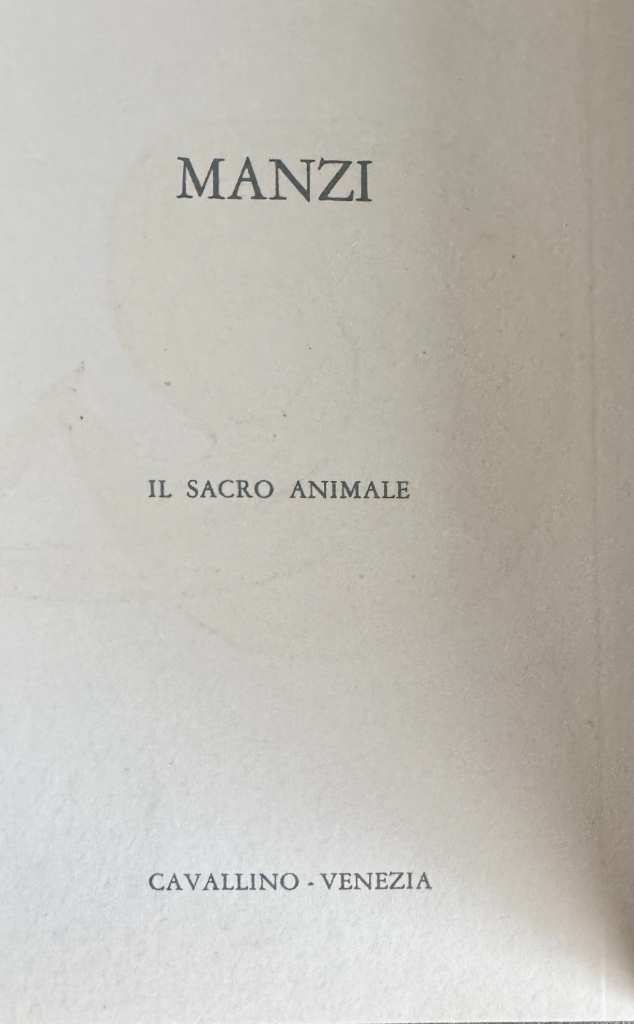
Il Sacro Animale by Giacomo Manzi: Edizioni del Cavallino, 1966
First numbered edition of 400 copies: a rare Venetian artist's book from the golden age of Carlo Cardazzo's legendary gallery
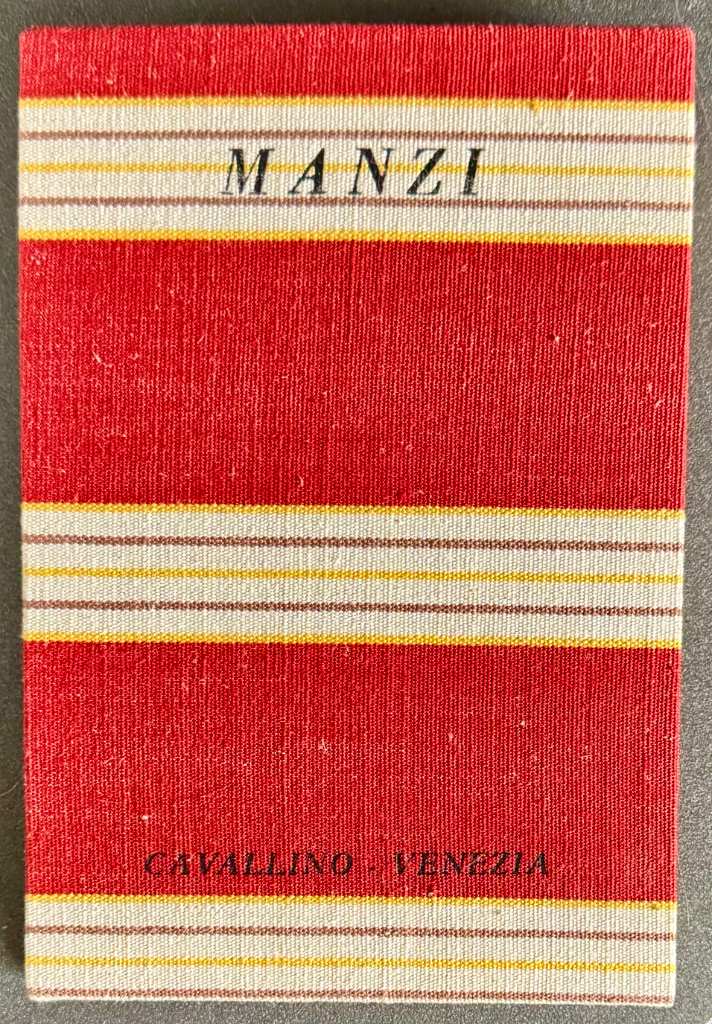
In the landscape of post-war Italian publishing, few ventures managed to combine typographic rigour and artistic experimentation with the consistency demonstrated by Edizioni del Cavallino. Giacomo Manzi's Il Sacro Animale, published in 1966 in a limited numbered edition of 400 copies, represents an eloquent example of that unrepeatable season when Venice established itself as an international crossroads of contemporary art.
Bibliographic notes
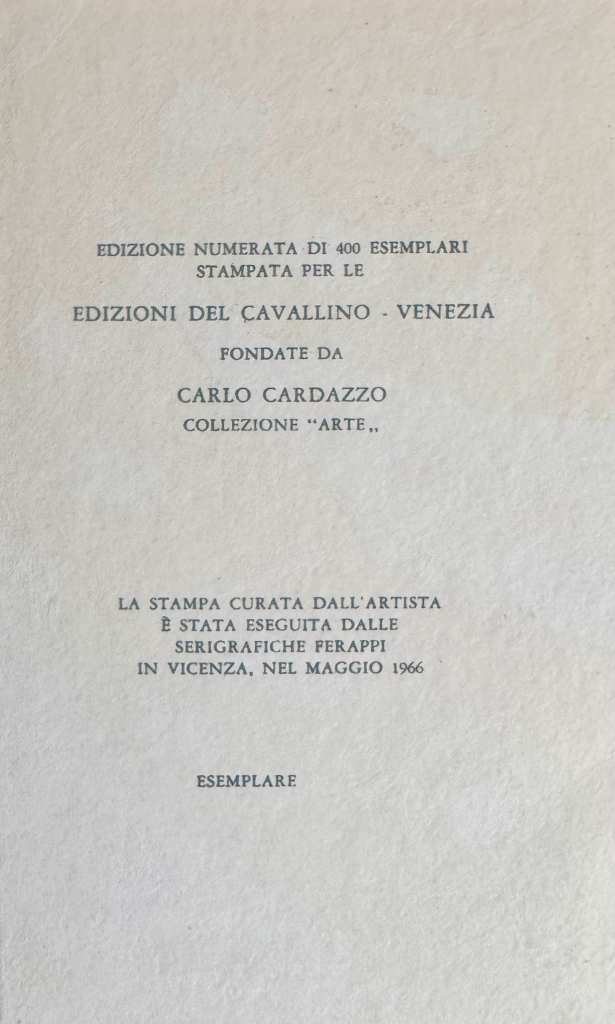
Printed by Serigrafiche Ferappi of Vicenza under the artist's direct supervision, the volume is presented in an elegant publisher's binding of red cloth embellished with the characteristic polychrome decorative bands that distinguish Cavallino productions of the 1960s. The chromatic choice and quality of execution reflect the meticulous attention to detail that Carlo Cardazzo, founder of the gallery-publisher in 1942, devoted to every publication. Edizioni del Cavallino were not mere catalogues or monographs: they were fully-fledged art objects, conceived to dialogue with the works exhibited in the Venetian and Milanese gallery spaces. Collaboration with Serigrafiche Ferappi guaranteed elevated technical standards, particularly appreciated for chromatic rendering and fidelity to the artists' intentions. The numbered limitation of 400 copies places the work within the typical range for Cavallino's artist's books, balancing exclusivity with reasonable accessibility for the period's collecting market.
Provenance & condition
The present copy is in good general condition, a circumstance not to be taken for granted with volumes of this type which, given the very nature of cloth binding and the use of chromatically vivid materials, tend to show signs of wear more evidently than traditional editions. The numbering attests to membership in the original print run, a fundamental element for authentication and market valuation. No restoration interventions or replacements of original components are recorded, a factor that preserves the bibliographic integrity of the volume. The red cloth retains its original brilliance and the polychrome bands show no significant fading, evidence of careful conservation and limited exposure to direct light. For collectors of Italian artist's books, condition remains paramount: even modest defects can significantly impact value, whilst well-preserved examples command premium prices within their valuation range.
Market value
The market valuation for this copy stands in the €120-190 range, reflecting several concurrent factors. The rarity score (55/100, Discrete index) places the work in an intermediate position: it is not a common edition, but neither is it an unobtainable title. Edizioni del Cavallino enjoy a consolidated collecting market, particularly lively among specialists in twentieth-century Italian artist's books and scholars of post-war Venetian art. The limitation of 400 copies, whilst restricted, is not exceptionally narrow by the standards of art publishing of the era: many Cavallino publications ranged between 200 and 500 copies. Giacomo Manzi's name, though situated within the context of Italian avant-gardes, does not achieve the renown of other artists promoted by Cardazzo such as Emilio Vedova, Tancredi Parmeggiani or Giuseppe Santomaso, which affects market demand. However, interest in Cavallino publications as a whole maintains stable prices, with occasional peaks for particularly sought-after titles or copies in exceptional condition. Consultation of specialist antiquarian sources confirms the proposed range as consistent with recent market activity.
Why it matters
Beyond monetary value, Il Sacro Animale represents a precious document for understanding the role of gallery-publishers in Italy's economic boom years. Carlo Cardazzo was not merely an enlightened dealer: he was a visionary who intuited how the artist's book could become a vehicle for cultural diffusion and an instrument of critical legitimation. Edizioni del Cavallino published monographs, catalogues raisonnés, illustrated poetry collections and experimental volumes that today constitute primary sources for art historians. The gallery promoted Lucio Fontana's Spatialism, supported the Informel movement, dialogued with European and American currents. Each publication was conceived as a tessera in an organic cultural project, not as a mere commercial product. For contemporary collectors, acquiring a Cavallino edition means entering into possession of a fragment of that extraordinary creative season, when Venice competed with Paris and New York as a capital of artistic innovation. The typographic quality, editorial care and relative rarity ensure these volumes a durable market, immune to the more volatile fluctuations that characterise other segments of book collecting. As institutional interest in post-war Italian art continues to grow internationally, such publications gain scholarly and monetary value in tandem.
Comments
Loading…
Sign in or register to leave a comment
Sign in or register