La situazione poetica 1938-1968: Luciano Chefchi and Edizioni del Naviglio
Signed first edition of a visual poetry manifesto, testament to Milan's avant-garde movements of the 1960s
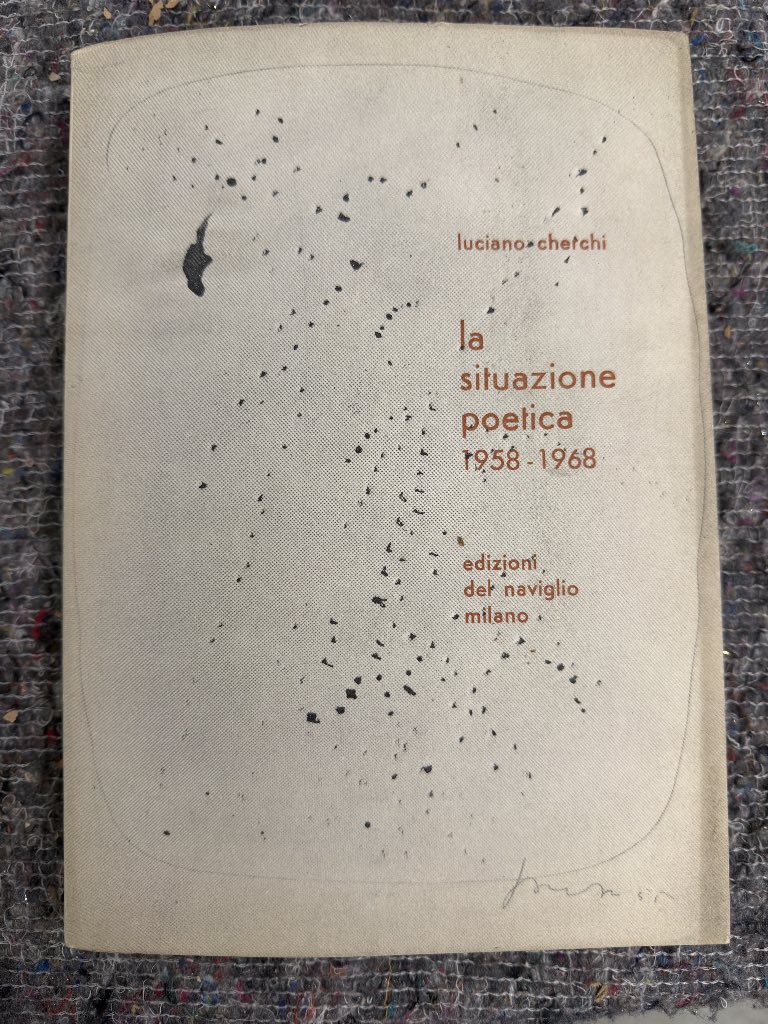
Among the publications documenting the revolutionary season of Italian visual poetry, Luciano Chefchi's La situazione poetica 1938-1968 occupies a position of considerable importance. Published in 1968 by Edizioni del Naviglio in Milan, this volume represents not merely a critical assessment of three decades of experimentation, but an art object in its own right, where the materiality of the book dialogues with its theoretical content. The copy under consideration, signed by the author on the cover, constitutes direct testimony to the cultural ferment animating the Lombard capital during the years of Gruppo 63 and the contestation of traditional forms.
Bibliographic notes
Edizioni del Naviglio was founded in Milan in the post-war period and rapidly became one of the nerve centres of Italian avant-garde publishing, alongside the more celebrated Scheiwiller and Sampietro. The house distinguished itself through typographic care and its choice of authors connected to the neo-avant-garde, concrete poetry and verbo-visual research. Luciano Chefchi, a figure less known to the general public today but central to Milan's experimental circles, gravitated around Vanni Scheiwiller's circle and maintained relationships with exponents of kinetic art and the nascent Italian Fluxus. La situazione poetica takes the form of a critical anthology traversing the period 1938-1968, thirty crucial years for Italian and European poetry, from the eve of the Second World War to the contestations of 1968.
The cover in raw linen presents a composition of scattered typographic signs, a visual anticipation of the content: not mere ornament, but a programmatic manifesto declaring the intention to transcend the linearity of traditional poetic text. The paperback binding, an editorial choice typical of avant-garde publications for economic and ideological reasons, confers upon the volume an ephemeral, militant character, far removed from the monumentality of bound editions.
Provenance & condition
The copy bears Luciano Chefchi's autograph signature on the cover, an element that significantly enhances its documentary and collectible value. Author signatures on experimental poetry volumes from the 1960s are relatively rare: many such publications circulated in restricted circles, often through informal channels, and only a minority were personalised by the author. The presence of the autograph transforms the volume from bibliographic specimen to direct testimony of the relationship between poet and reader, between artist and collector.
The condition is good, with normal signs of use attributable to a paperback volume over fifty years old. The linen cover shows slight traces of handling, compatible with reading and consultation over the decades. The absence of significant structural damage—tears, losses, extensive staining—confirms that the copy has been carefully preserved, probably by a collector aware of its historical and artistic value.
Market value
The BookOracle valuation places this copy in the €800-1,400 range, with a high rarity index (78/100). The market for first editions of Italian visual poetry and neo-avant-garde has experienced steady growth in recent years, driven by interest from international collectors and critical attention towards movements long considered marginal. Edizioni del Naviglio, in particular, is sought after for the quality of its publications and the historical role it played in disseminating verbo-visual research.
Sources consulted (AbeBooks and Maremagnum) confirm the scarcity of copies in commerce: La situazione poetica appears sporadically in antiquarian catalogues, and rarely with author signature. Comparable volumes of Italian experimental poetry from the 1960s, when signed and in good condition, achieve prices between €600 and €1,800, depending on the author's renown and the publishing house. The presence of Chefchi's autograph justifies positioning in the medium-high range of the valuation bracket.
The reference market comprises collectors of visual poetry, Italian Fluxus, historical avant-gardes of the late twentieth century, and bibliophiles interested in Milanese art publishing. This is a sophisticated niche, where rarity and historical-artistic relevance prevail over the author's popularity.
Why it matters
La situazione poetica 1938-1968 represents an essential document for understanding the transformations of Italian poetry in the post-war period. The volume stands at the intersection of literary criticism, programmatic manifesto and artwork, embodying the neo-avant-garde's aspiration to transcend boundaries between genres and disciplines. The choice of a thirty-year span—from 1938, the year of racial laws and the eve of war, to 1968, the year of student contestation—is not casual: Chefchi intends to trace a genealogy of rupture, demonstrating how formal experimentation is inseparable from historical and social upheavals.
Edizioni del Naviglio, through publications such as this, contributed to building an international network of exchanges among poets, artists and theorists, anticipating dynamics we would today define as transdisciplinary. The dialogue with kinetic art, with Brazilian and German concrete poetry, with Gruppo 63, made Milan a laboratory of ideas comparable to Paris or New York. For the contemporary collector, acquiring a signed copy of La situazione poetica means taking possession of a fragment of that unrepeatable season, when poetry aspired to redefine the boundaries of language and aesthetic experience.
Comments
Loading…
Sign in or register to leave a comment
Sign in or register