Le Livre des Mères by Victor Hugo: Hetzel illustrated edition by Froment
Scarce edition from the Bibliothèque d'Éducation et de Récréation with decorated binding, witness to late nineteenth-century children's publishing
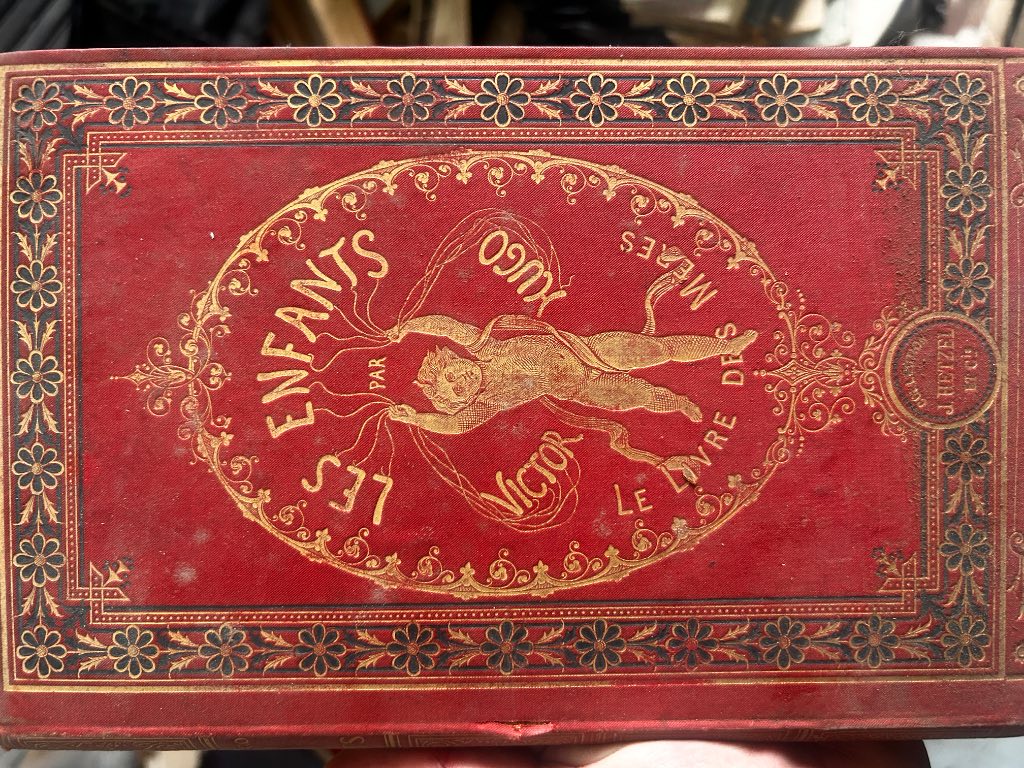
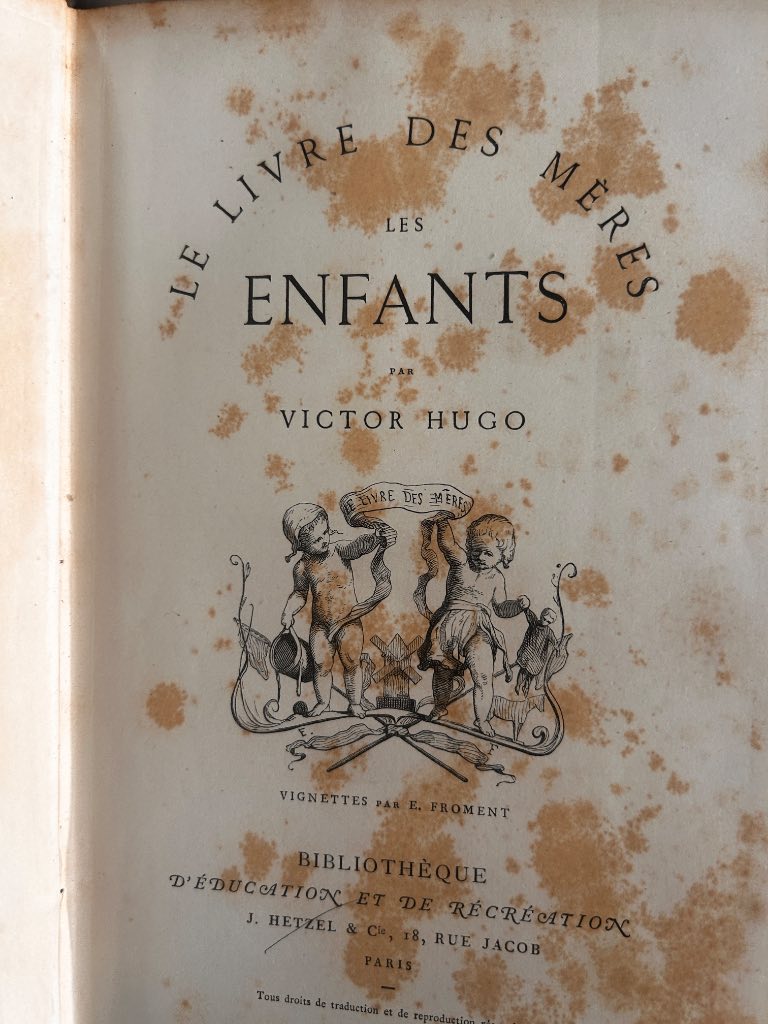
This illustrated edition of Le Livre des Mères – Les Enfants represents a characteristic example of the publishing output of Pierre-Jules Hetzel, the Parisian publisher who revolutionised children's books in the second half of the nineteenth century. Published between 1880 and 1900 in the celebrated Bibliothèque d'Éducation et de Récréation series, the work gathers poems drawn from the cycle L'Art d'être grand-père (1877), Victor Hugo's late masterpiece dedicated to his grandchildren Georges and Jeanne. The title page bears vignettes engraved by E. Froment, depicting putti with scrolls and musical instruments, following the decorative aesthetic that Hetzel reserved for his editions intended for children.
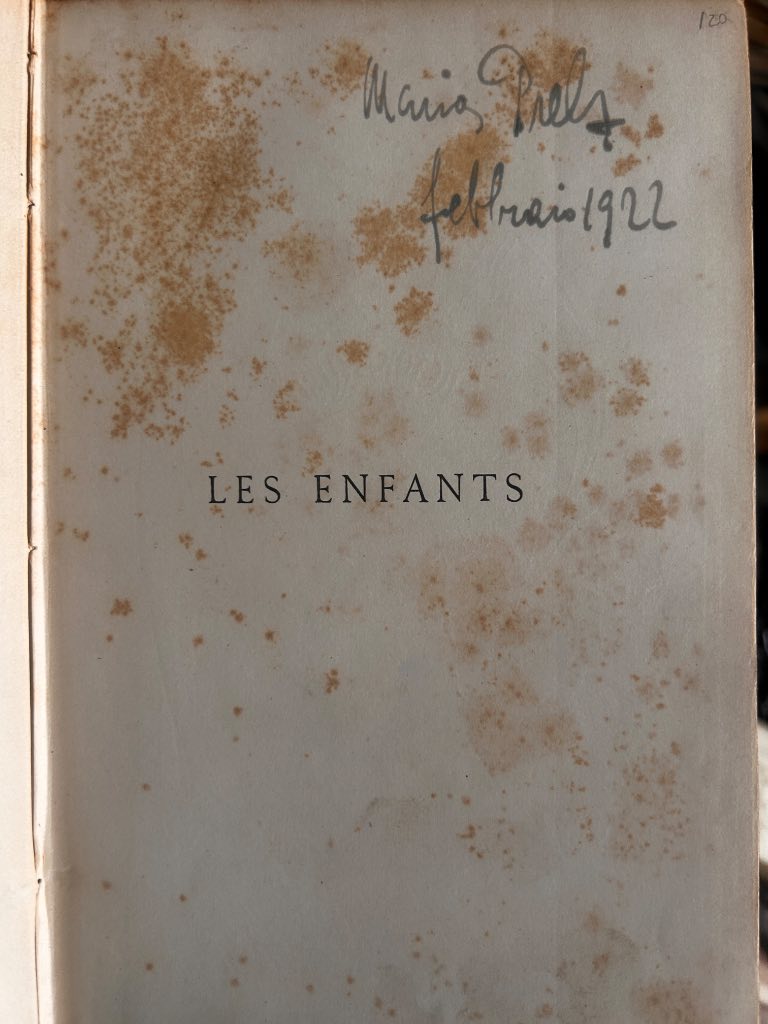
The publisher's binding in red percaline presents notably elaborate decoration in blind and gilt: a floral frame encloses a central medallion with a winged putto holding a scroll bearing the title. The smooth spine is ornamented with geometric and floral gilt motifs. The oblong sextodecimo format is typical of Hetzel editions for children, designed to facilitate reading and handling by young readers. The manuscript dedication "Maria Mills / 1° Marzo 1922" on the half-title testifies to the social function of these volumes, often given as school prizes or family gifts.
Bibliographic notes
Pierre-Jules Hetzel (1814-1886) was not only Victor Hugo's historic publisher, but also the creator of modern children's publishing in France. His Bibliothèque d'Éducation et de Récréation, founded in 1864, published the works of Jules Verne and became synonymous with editorial quality. Hetzel editions were distinguished by their graphic care, illustrations commissioned from the finest engravers of the period, and decorated bindings that transformed each volume into a precious object.
L'Art d'être grand-père, published by Hetzel in 1877, represents Hugo's last major poetic collection, composed between 1871 and 1876. The work celebrates childhood through the eyes of the poet, now seventy-five, who observes his grandchildren with tenderness. The anthological selection Le Livre des Mères – Les Enfants extracted the poems most suitable for a child audience, inserting them into a specifically pedagogical editorial context.
E. Froment, an engraver active in the second half of the nineteenth century, collaborated regularly with Hetzel for decorative vignettes. His style, characterised by putti and allegorical motifs, fitted perfectly into the aesthetic of children's books of the period, which favoured reassuring and morally edifying images.
Provenance and condition
The copy presents a condition definable as Fair, with evident signs of use compatible with its function as a book intended for children's reading. The widespread foxing on all pages is characteristic of the acidic paper used in economical late nineteenth-century editions. The spine is partially detached or very weak, a frequent condition in percaline bindings of this period when subjected to repeated handling. The corners and boards show wear, whilst the paper appears yellowed according to the natural oxidation process.
The 1922 dedication to Maria Mills constitutes an element of social-historical interest, documenting the volume's circulation more than twenty years after its publication and confirming the editorial longevity of Hetzel productions. Despite the imperfections, the decorated binding retains its aesthetic impact and the gilding remains legible, testifying to the quality of the original materials.
Market value
The BookOracle valuation places this copy in the €180-320 range, reflecting the balance between bibliographic interest and conservative conditions. The market for illustrated Hetzel editions of the late nineteenth century shows consistent demand from collectors specialising in French children's literature, Hugo editions, and publishing history.
On AbeBooks, Hetzel editions of Victor Hugo from the same period in Good-Fine condition reach higher quotations (€400-800), whilst copies in Fair-Good condition settle in the €150-350 range. Catawiki auctions for lots of late nineteenth-century Hetzel editions in mixed conditions confirm this valuation range. Drouot sales for illustrated Hetzel books by various authors in comparable condition support the proposed estimate.
The rarity score of 45/100 (index: discrete) reflects the relative market availability of Hetzel editions from the period, whilst recognising the specificity of this title and the quality of the decorated binding. The accessible price makes the work suitable for collectors who privilege historical-editorial interest over perfect physical condition.
Why it matters
This copy represents a tangible document of the editorial revolution operated by Hetzel in children's books. The Bibliothèque d'Éducation et de Récréation did not merely publish texts, but created cultural objects that united pedagogical value, aesthetic quality, and economic accessibility. The choice to extract from L'Art d'être grand-père the poems most suitable for children testifies to Hetzel's editorial strategy: making great authors accessible to child audiences through targeted anthologies.
The decorated binding, with its winged putto and floral motifs, embodies the aesthetic of late nineteenth-century children's books, when the book-object was meant to educate also through beauty. Froment's vignettes complete this cultural project, inserting the work into a recognisable and reassuring iconographic system.
For collectors, this volume offers an accessible entry point into the Hetzel world, allowing acquisition of an authentic example of the historic production at a contained price. The 1922 dedication adds a human dimension, reminding us that these books lived in homes, accompanied children's education, and were passed down as testimonies of affection. Despite the conservative imperfections, the copy maintains intact its capacity to tell an editorial, literary, and social story of considerable interest.
Comments
Loading…
Sign in or register to leave a comment
Sign in or register