Les Vampires by Tony Faivre: pioneering study of an immortal myth
First edition 1962 of the seminal essay published by Le Terrain Vague, with dust jacket illustrated by Gustave Doré
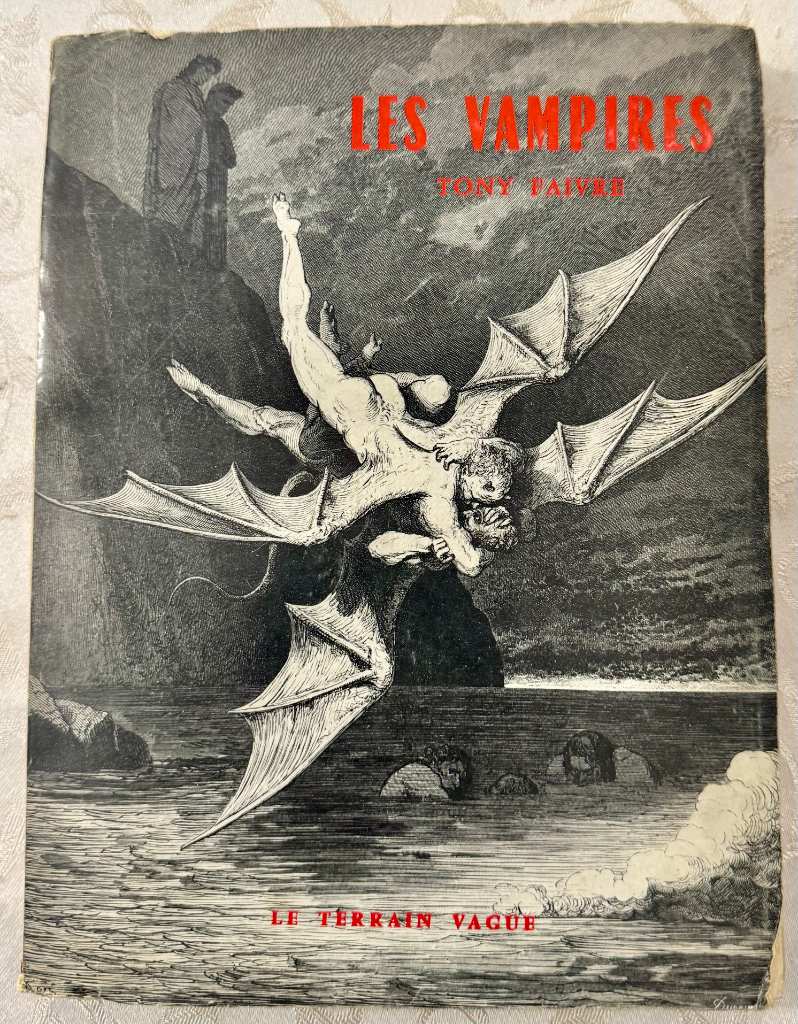
When the Parisian publishing house Le Terrain Vague issued Tony Faivre's Les Vampires. Essai historique critique et littéraire in 1962, the literary vampire was experiencing renewed academic interest. This work immediately distinguished itself as one of the first systematic attempts to trace the genealogy of the vampire myth through centuries of folklore, history and literature, from classical antiquity to the Romantic and Gothic manifestations of the nineteenth century.
The copy examined here represents the first edition in original publisher's wrappers, octavo format, with the characteristic illustrated dust jacket reproducing an engraving by Gustave Doré. The iconographic choice is not casual: Doré, master of Romantic illustration, had captured in his etchings the essence of the Gothic supernatural that Faivre analyses in his essay.
Bibliographic notes
Tony Faivre, French scholar of esotericism and fantastic literature, constructed with this volume a methodological investigation that began with the historical roots of vampirism in the Balkans and arrived at its literary sublimations. The work examines the epidemics of vampire hysteria that swept through Eastern Europe in the eighteenth century, phenomena documented by medical and theological chronicles of the period, and traces the transformation of the vampire from folkloric menace to literary figure through the works of John Polidori, Sheridan Le Fanu and Bram Stoker.
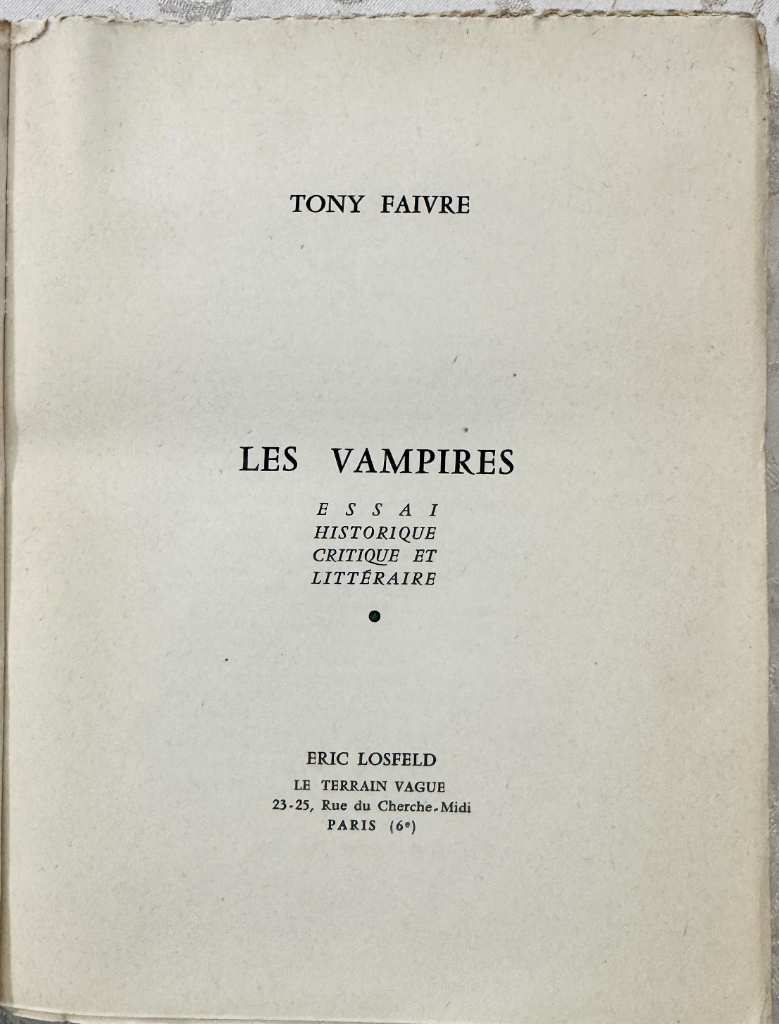
Publication by Eric Losfeld and the Le Terrain Vague imprint confers particular bibliographic prestige upon the volume. This publishing house, active between the 1950s and 1970s, specialised in editions of Surrealist, erotic and fantastic literature, publishing authors such as Georges Bataille, Pierre Klossowski and Jean-Jacques Pauvert. Le Terrain Vague editions are today sought by collectors for their editorial quality and for the cultural role played in French avant-garde publishing.
The octavo format and publisher's wrappers correspond to the standards of the series, whilst the illustrated dust jacket represents a distinctive element that increases the collectible value of the copy when present and in good condition.
Provenance & condition
The copy described presents in good general condition, with the original dust jacket showing normal wear consistent with a volume over sixty years old. The presence of the dust jacket is a significant element for valuation: many circulating copies lack it, having suffered over time the loss of this fragile protective element.
The publisher's wrappers maintain their structural integrity, without evident losses or repairs. For a volume published in 1962 and belonging to an editorial category (specialist non-fiction) subject to frequent consultation, these conditions are to be considered satisfactory.
No manuscript annotations, bookplates or other elements are noted that might indicate particular provenance. The absence of such marks, in this case, does not diminish value: for critical and scholarly literature, cleanliness of the copy is generally preferred by collectors.
Market value
The BookOracle valuation places this copy in the €55-110 range, with a discrete rarity index (45/100). This estimate reflects several market factors observable through the principal antiquarian commerce platforms.
On AbeBooks and Maremagnum, first editions of Les Vampires in comparable condition are generally offered between €60 and €120, with variations determined by the presence and state of the dust jacket. Copies lacking the dust jacket position themselves in the lower range (€40-70), whilst those with dust jacket in excellent condition can reach €130-150.
The German market (ZVAB) shows slightly higher quotations, reflecting the interest of German-speaking collectors in Gothic literature and vampire studies. On Catawiki, in recent auctions, similar copies have found hammer prices between €50 and €95.
Demand for this work comes principally from three categories of collectors: specialists in Gothic and fantastic literature, scholars of folklore and cultural anthropology, and bibliophiles interested in Le Terrain Vague editions. This multiplicity of audiences sustains constant demand, though not particularly intense.
Why it matters
Tony Faivre's Les Vampires represents a significant moment in the history of studies on the literary supernatural. Published at a time when academic analysis of the Gothic was acquiring critical dignity, the essay anticipated many of the methodological approaches that would become standard in subsequent studies.
The work documents the passage of the vampire from folkloric figure to literary icon, a process of cultural transformation that would find further development in cinema and popular culture of the twentieth century. For collectors of fantastic literature, owning the first edition of this study means preserving testimony to the academic roots of a genre today universally recognised.
Publication by Le Terrain Vague places the volume in an editorial context of particular historical-cultural interest. Eric Losfeld's publishing house represented in the 1960s a reference point for French avant-garde publishing, and its editions are today sought as much for content as for testimonial value.
For the contemporary collector, Les Vampires offers an accessible entry point into the market for French specialist non-fiction of the post-war period, with a favourable quality-price ratio compared to other more highly quoted Le Terrain Vague editions. The stability of demand and relative availability on the market make this title suitable both for the beginning collector and for the specialist wishing to complete a thematic collection.
Comments
Loading…
Sign in or register to leave a comment
Sign in or register