Sonia Delaunay Bielefeld 1958 Catalogue: Orphism in Postwar Germany
Rare witness to the solo exhibition at Städtisches Kunsthaus with photographs by Florence Henri and Maywald
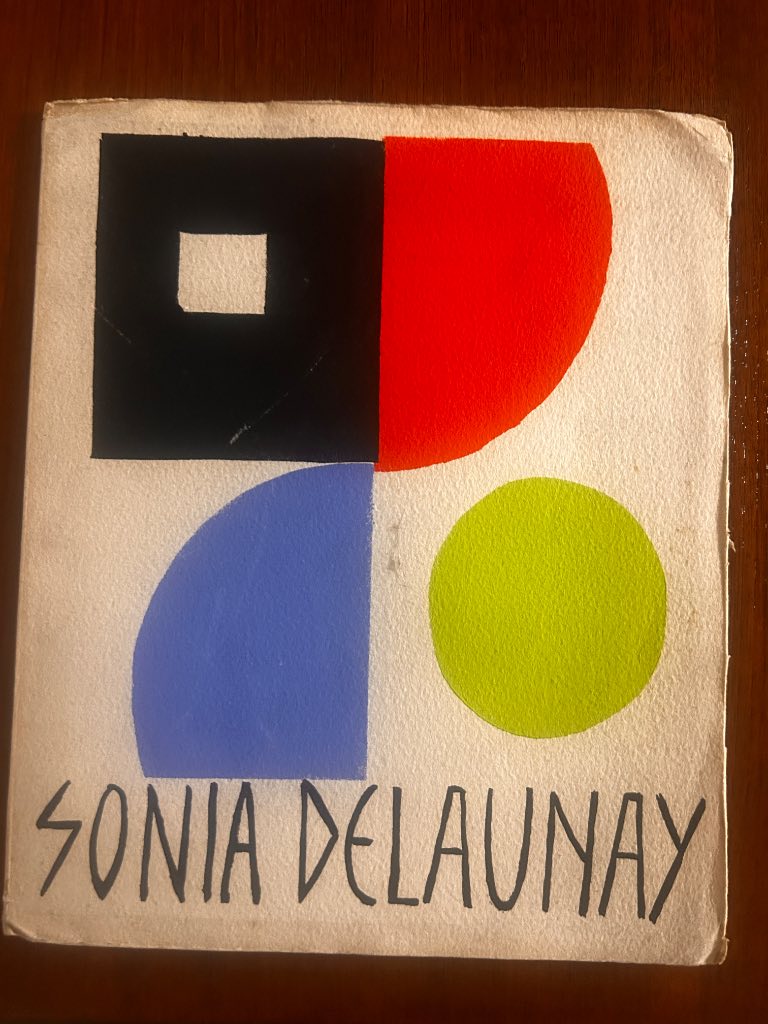
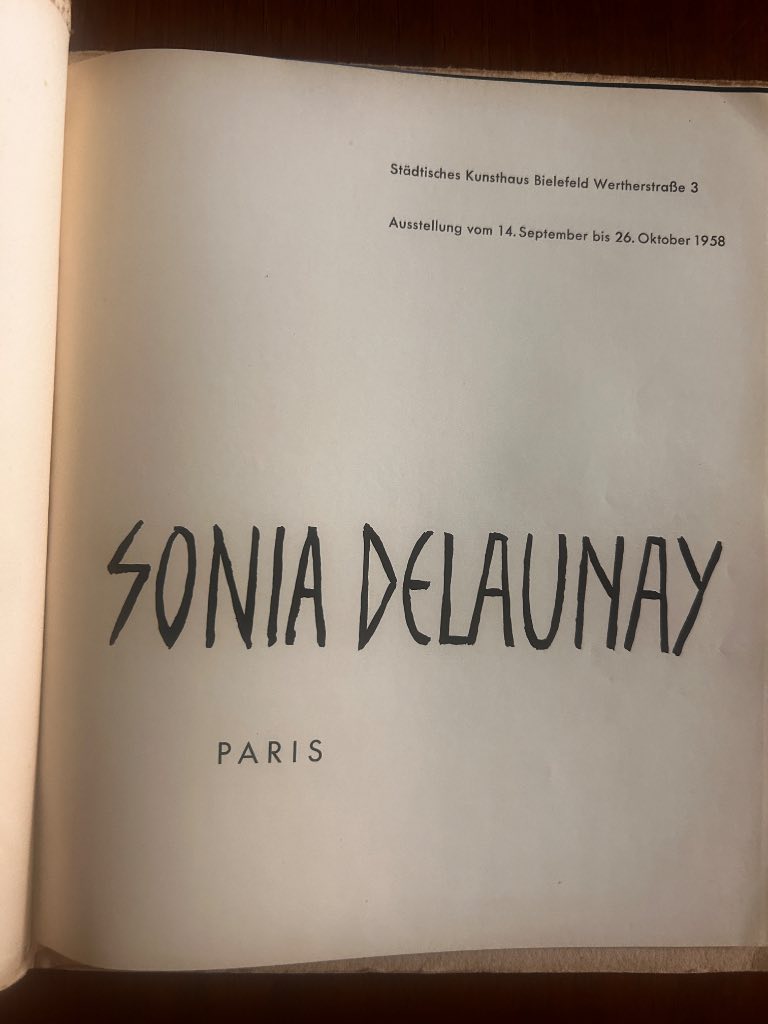
In September 1958, the Städtisches Kunsthaus in Bielefeld hosted a solo exhibition by Sonia Delaunay (1885-1979), seminal figure of the European avant-garde and co-founder of Orphism. The catalogue documenting this event represents today a bibliographic witness of discrete rarity, reflecting a crucial moment in the reception of the artist's work in postwar Germany.
Bibliographic notes
The publication, issued on the occasion of the exhibition held between September and October 1958, presents an illustrated cover featuring a polychrome geometric composition — the unmistakable visual language that Delaunay had developed since the 1910s alongside her husband Robert Delaunay. The photographic apparatus, curated by Florence Henri (1893-1982), Swiss-American photographer and painter active in Paris, and Willy Maywald (1907-1985), German portraitist transplanted to the French capital, confers upon the volume a documentary value that transcends mere cataloguing function. The presence of these names attests to the network of relationships that Delaunay had woven within the Parisian artistic milieu of the postwar period, when her work was experiencing renewed critical and collecting interest.
The choice of Bielefeld as exhibition venue was not accidental: during the 1950s, several German institutions were rediscovering the historical avant-gardes that the Nazi regime had banned as "degenerate art". The catalogue thus forms part of a broader process of cultural rehabilitation and Franco-German dialogue within the context of European reconstruction.
Provenance & condition
The present copy is in good condition, showing signs of normal wear consistent with age and the ephemeral nature of the publication. As often occurs with temporary exhibition catalogues, the print run was limited and primarily intended for a specialist audience: critics, collectors, museum institutions. The survival of intact copies is therefore relatively rare, especially outside German public libraries.
No particular structural defects or losses are recorded, an element that enhances the bibliophilic appeal of the piece. The polychrome cover, whilst showing slight traces of handling, retains its original chromatic vivacity — an aspect not to be taken for granted for publications of this type, often subject to fading through light exposure.
Market value
The BookOracle valuation places this catalogue within a price range of €80-150, with a discrete rarity index (42/100). This estimate reflects several factors: the specialist nature of the publication, the presence of authored photographs, the documentary value for studies on Orphism and the reception of French art in Germany, as well as the presumably limited print run.
The international antiquarian market, consulted through platforms such as AbeBooks, ZVAB and Catawiki, confirms this price range for analogous catalogues of the period. Copies in excellent condition or bearing the artist's autograph dedication may achieve higher quotations, whilst examples with significant defects position themselves at the lower end of the valuation range.
It should be observed that the market for twentieth-century art catalogues has witnessed growing attention in recent years from collectors and institutions, who recognise their value not only as bibliographic items but also as historical-artistic documents. The presence of photographs by Florence Henri and Maywald constitutes a further element of interest, given the increasing appreciation for art photography of the period.
Why it matters
This catalogue represents far more than a simple list of exhibited works. It documents a turning point in the critical fortune of Sonia Delaunay, an artist who in the 1950s was finally obtaining the recognition due to her after decades of relative obscurity compared to her husband Robert. The Bielefeld exhibition formed part of a series of solo shows — in Paris, London, New York — that would lead the artist, by then in her seventies, to international consecration culminating in the major retrospective at the Musée National d'Art Moderne in 1967.
For scholars of Orphism and the historical avant-gardes, publications such as this offer a precious cross-section of the circulation of artistic ideas in postwar Europe. The collaboration with leading photographers such as Henri and Maywald also testifies to the dialogue between different visual disciplines that characterised the Parisian milieu of the period.
For the collector, finally, this catalogue represents an accessible opportunity to approach the universe of a first-rank artist whose painted production today achieves six-figure quotations at international auctions. A paper document that, in its apparent modesty, preserves fragments of art history still capable of speaking to the present.
Comments
Loading…
Sign in or register to leave a comment
Sign in or register