Farfa: Ovabere. Sincopatie Futuriste with autograph, 1933
First edition of Vittorio Osvaldo Tommasini's parole in libertà collection, enhanced by autograph dedication on personal letterhead
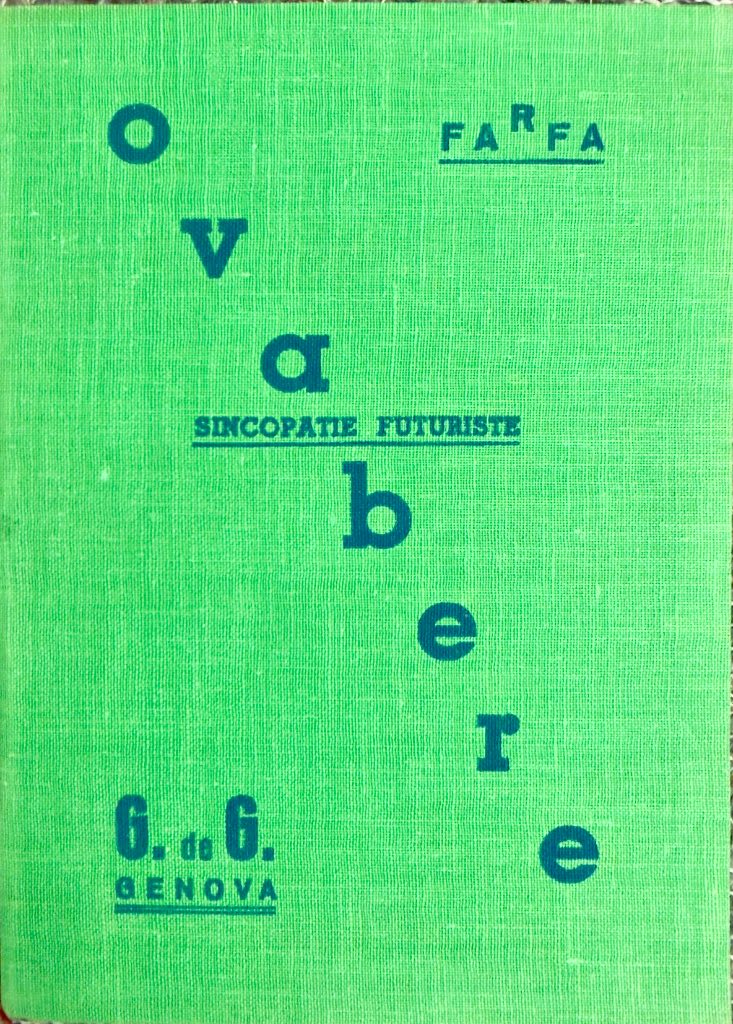
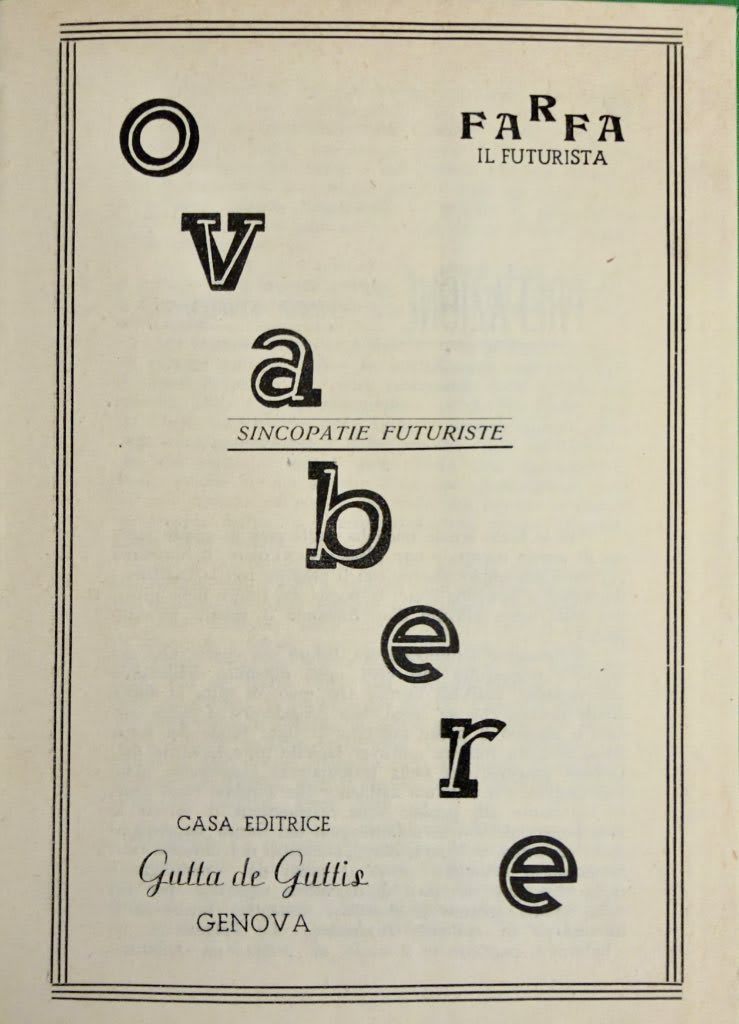
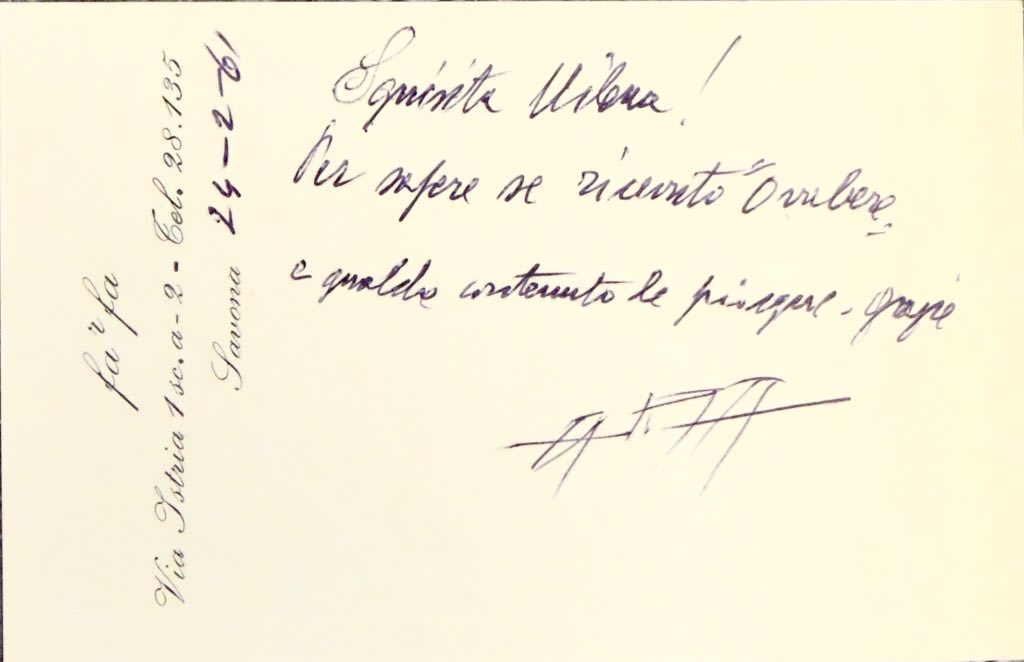
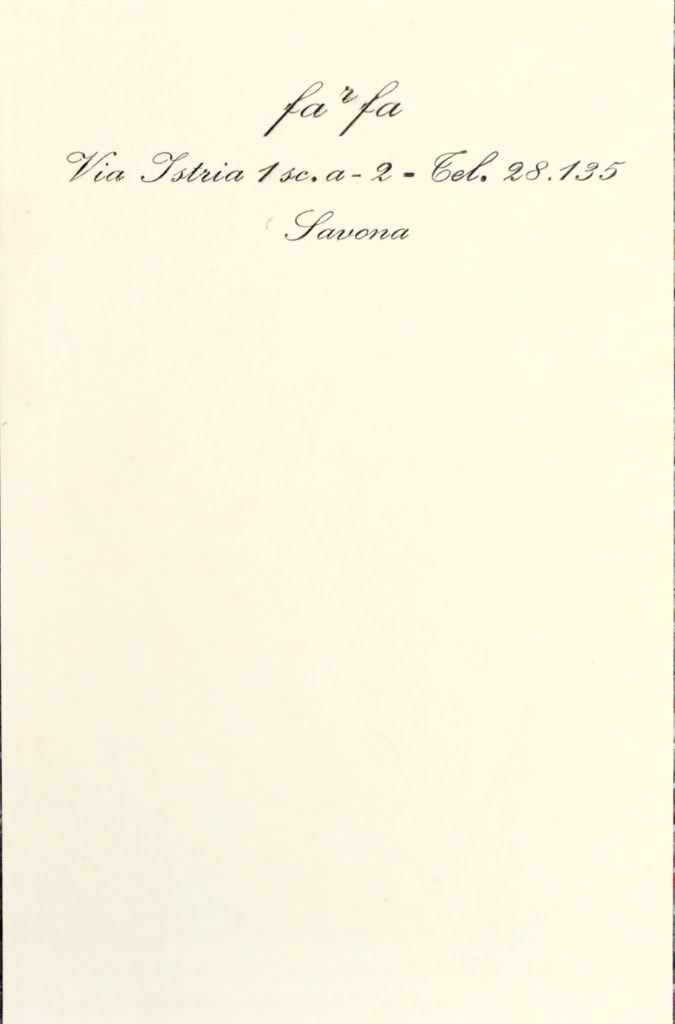
In the landscape of Italian Futurism, few voices traversed the movement's entire arc with such consistency as Farfa, pseudonym of Vittorio Osvaldo Tommasini. Ovabere. Sincopatie Futuriste, published in 1933 by Casa Editrice Gutta de Guttis in Genoa, represents a mature moment in his literary production, when the aesthetic of parole in libertà had already consolidated its expressive canons. This copy in sextodecimo format, bound in green cloth with blue typographic impressions arranged diagonally, perfectly embodies the Futurist ideal of the book-as-object. The presence of an autograph note from the author, dated 24 February and addressed to 'Squisita Milena' on letterhead from Via Istria in Savona, significantly elevates the documentary and collectible value of the volume.
Bibliographic notes
Casa Editrice Gutta de Guttis, active in Genoa during the 1930s, distinguished itself through the publication of avant-garde and experimental works. Ovabere belongs to the corpus of Farfa's 'lightning-poems', extremely brief compositions characterised by lightning-fast verbal associations and a typographic arrangement that deliberately breaks with traditional linearity. The term 'sincopatie' in the subtitle alludes to the rhythmic and fragmentary nature of the texts, reflecting the aesthetic of speed and simultaneity dear to the Futurists. The publisher's green cloth binding with blue impressions arranged diagonally constitutes a visual manifesto in itself: the rejection of orthogonality, the dynamism of composition, the use of contrasting colours are all elements that translate into material form the movement's theoretical principles. The reduced format, sextodecimo, made the volume manageable and almost pocket-sized, in line with the Futurist idea of an art that should penetrate everyday life.
Provenance & condition
The copy presents in good general condition, with minimal signs of use to the binding that testify to limited circulation. The accompanying autograph note, on personal letterhead bearing the address Via Istria in Savona, offers a precious glimpse into Farfa's private life. The dedication to 'Squisita Milena', written with the author's characteristic signature, suggests a personal gift, perhaps to an admirer or a figure from the Savonese intellectual circle. Savona was indeed one of the centres of Farfa's activity, where he maintained stable connections for decades. The autograph, dated 24 February without year indication but presumably contemporary with publication, constitutes an element of association that transforms the volume from simple editorial testimony to biographical document. The letterhead, an apparently minor detail, confirms authenticity and roots the object in a precise geography and chronology.
Market value
The valuation of €800-1,250 reflects several converging factors. Futurist first editions, especially those published by minor houses such as Gutta de Guttis, are relatively rare on the antiquarian market. The print run of Ovabere is not precisely documented, but it is reasonable to suppose it was limited, as customary for avant-garde publications of the period. The associated autograph material represents a significant value multiplier: dedications and letters by Farfa appear sporadically at auction, and their presence elevates an ordinary copy to a piece of particular interest for collectors of Futurist autographs. Consultations with Maremagnum, AbeBooks, Finarte Milano and Bloomsbury Roma confirmed the scarcity of copies in commerce, with very few first edition examples available, none accompanied by manuscript material. The rarity score of 78/100 and 'High' index place the volume in the upper tier of minor Futurist production, below the masterworks of Marinetti or Boccioni but well above reprints and late editions.
Why it matters
Farfa was among the most faithful and longest-lived exponents of Futurism, active from 1909 until the 1960s, a timespan covering the movement's entire trajectory. His fidelity to the parole in libertà aesthetic, even when this was perceived as anachronistic, makes him a figure of particular historiographic interest. Ovabere documents the mature phase of this fidelity, when the revolutionary enthusiasm of the early years had transformed into consolidated practice, but no less radical for that. The volume also testifies to the provincial rooting of Futurism: Genoa and Savona, distant from the Milanese and Roman centres, maintained vibrant intellectual communities that produced quality works. For collectors of historical avant-gardes, a copy such as this offers an ideal balance between economic accessibility and historical-artistic significance. This is not an incunabulum of the movement, but an authentic and well-preserved document, enriched by a provenance element that increases its narrative appeal. The dedication to Milena, a name evoking Kafkaesque echoes, adds a note of biographical mystery that invites research and deeper investigation.
Comments
Loading…
Sign in or register to leave a comment
Sign in or register