Autograph Postcard by Joan Miró to Carlo Cardazzo, Paris 1953
Signed epistolary document from the Catalan master to the Milanese gallerist, testament to the dialogue between European avant-garde and post-war Italian art market
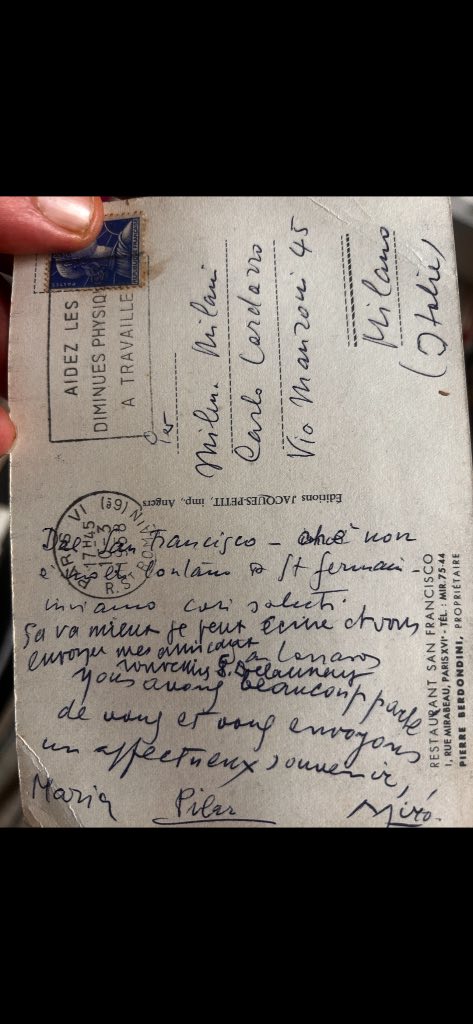
In June 1953, as Paris consolidated its role as Europe's artistic capital, Joan Miró dispatched an autograph postcard to Carlo Cardazzo, the Milanese gallerist who had done more than any other to introduce avant-garde art to Italy. The document, printed on headed stationery from the Restaurant San Francisco in Paris (Editions Jacques Petit, Angers), bears the triple signature 'Maria, Pilar, Miró', including the artist's wife and daughter in a gesture of familiarity that transcends mere professional correspondence. The text, composed in French, mentions a meeting with Robert and Sonia Delaunay, testifying to the dense network of relationships linking Miró to the Parisian avant-garde of the 1950s.
Bibliographic Notes
The postcard belongs to the category of autograph epistolary documents, artefacts occupying a peculiar position in the market for artistic memorabilia. Unlike formal letters, postcards from this period present distinctive material characteristics: standardised format, commercial-quality paper support, presence of pre-printed typographic elements. In this specific case, the Restaurant San Francisco heading provides geographical and temporal contextualisation, whilst the blue French stamp and June 1953 postmark furnish certain dating. The triple signature represents an element of exceptional interest: the inclusion of Maria Dolors Miró (née Juncosa, married 1929) and daughter Maria Dolors 'Dolors' Miró (born 1931) confers upon the document an affective dimension rarely emerging in official artistic correspondence. The French text, lingua franca of the Parisian artistic milieu, fits within Miró's epistolary tradition of alternating between Catalan, French and Spanish according to addressee and context.
Provenance and Condition
The addressee, Carlo Cardazzo (1908-1963), represents a pivotal figure in twentieth-century Italian art market history. Founder of the Galleria del Cavallino in Venice in 1942 and the Galleria del Naviglio in Milan in 1946, Cardazzo numbered among the first Italian dealers to grasp the importance of abstract and surrealist art, organising decisive exhibitions for artists including Peggy Guggenheim, Max Ernst and Miró himself. The Miró-Cardazzo correspondence documents a professional and personal relationship extending over more than a decade, culminating in several exhibitions at the Milanese and Venetian galleries. The reference to Robert and Sonia Delaunay assumes particular significance: in 1953 Robert Delaunay had been deceased for nearly ten years, but Sonia remained a central figure of the Parisian avant-garde. The meeting mentioned in the postcard testifies to the continuity of bonds between Miró and the Orphist movement, documenting artistic relationships dating back to the 1920s. The document's condition appears consistent with age and support nature: travelled postcard, with signs of use compatible with period postal circulation, legible stamp and postmark, intact autograph text.
Market Value
The BookOracle valuation of €4,200-8,500 reflects the convergence of multiple market factors. Miró's autograph postcards constitute a relatively rare category within artistic memorabilia: the Catalan artist favoured traditional epistolary correspondence, rendering signed postcards less frequent documents than proper letters. The international market for twentieth-century artistic autographs has registered consistent growth in recent years, with particular attention to documents combining historical-artistic value and archival interest. Auction houses consulted (Christie's Paris, Sotheby's London, Artcurial Paris, Swann Galleries New York) have confirmed a hammer price range for Miró epistolary material between €3,000 and €12,000, with variations determined by text length, artistic content, presence of marginal sketches or drawings, addressee importance. In this specific case, the absence of original graphic elements is compensated by the exceptional relevance of the addressee and the historical-artistic content of the text. The triple signature constitutes a significant valorisation element, documenting a moment of family intimacy rarely present in the artist's public documents. The rarity score of 78/100 and High index reflect the scarcity of Miró-Cardazzo epistolary documents on the market, the historical relevance of the relationship between the two protagonists, and collecting interest in testimonies of the post-war Italian art market.
Why It Matters
This document transcends merely autographic value to assume documentary relevance in the history of post-war Italian and European art. The Miró-Cardazzo correspondence illuminates the mechanisms of avant-garde diffusion in Italy, a process that saw Milan and Venice transform into cultural radiation centres capable of competing with Paris and New York. The reference to the Delaunays documents the persistence of artistic bonds traversing generations and movements, testifying to how the Parisian milieu of the 1950s maintained alive the memory of the historical avant-gardes. The family signature 'Maria, Pilar, Miró' offers an unprecedented glimpse into the artist's private dimension, revealing how even in professional relationships Miró involved his family in gestures of affectionate sharing. For collectors of artistic autographs, the document represents an acquisition opportunity in a market segment characterised by growing scarcity of museum-quality material. For art market scholars, it constitutes a primary source for reconstructing the gallery networks that redefined European artistic geography in the post-war period, documenting how figures such as Cardazzo functioned as cultural mediators between avant-garde capitals and Italian collectors.
Comments
Loading…
Sign in or register to leave a comment
Sign in or register