Fontana Exhibition Catalogue, Galleria L'Attico Rome 1959
Bibliographic record of the historic Roman solo show during the golden period of Spatial Concepts, featuring works from the Cavellini collection

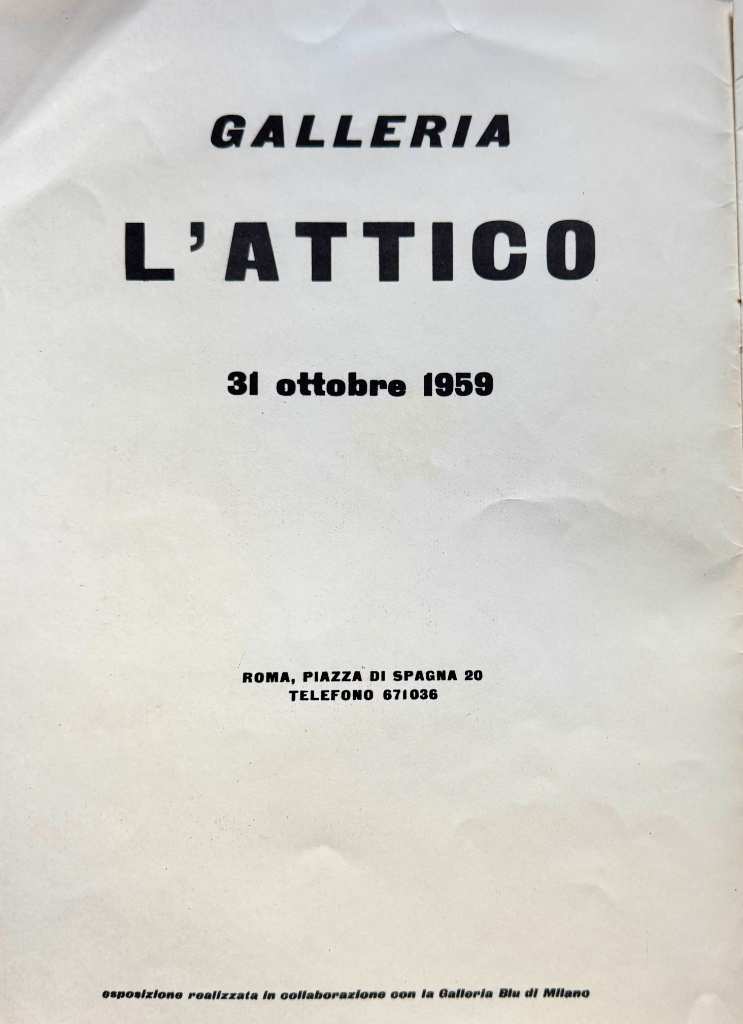
On 31 October 1959, at the prestigious address of Piazza di Spagna 20, Galleria L'Attico inaugurated a solo exhibition by Lucio Fontana destined to mark a crucial moment in the documentation of the European avant-garde. The catalogue accompanying the exhibition, realised in collaboration with Galleria Blu in Milan, represents today a bibliographic witness of primary importance for reconstructing the exhibition activity of the Italian-Argentine artist during his years of full creative maturity.
The cover constitutes a perfect manifesto of Spatialist poetics: the iconic motif of 'holes' printed in black on a grey-beige ground, with the name FONTANA in red characters, graphically synthesises the conceptual revolution the artist was bringing to completion. Not merely an aesthetic choice, but the editorial translation of a gesture that had redefined the boundaries between painting and space, between surface and depth.
Bibliographic Notes
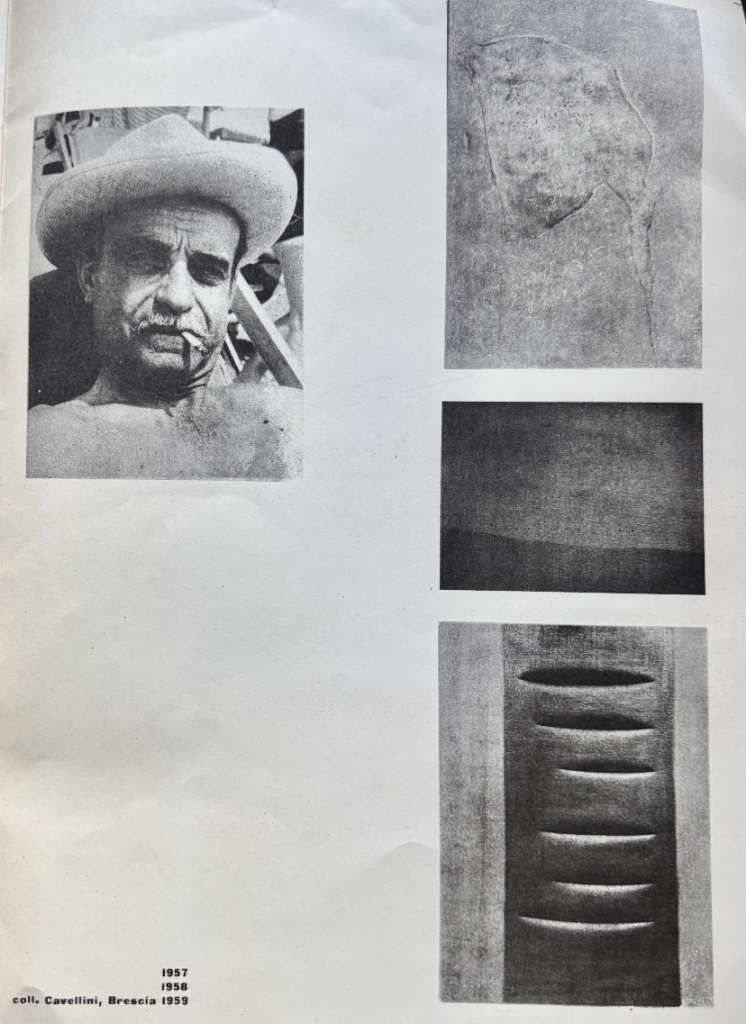
The publication documents works created between 1957 and 1959, a period when Fontana had by then consolidated the Spatial Concepts series, begun in 1949 with the first 'holes' on canvas. The photographic reproductions inside the catalogue include works from the prestigious collection of Guido Cavellini of Brescia, a central figure in Italian post-war avant-garde collecting.
The collaboration between Galleria L'Attico in Rome and Galleria Blu in Milan reflects the exhibition network that supported the diffusion of Spatialism in Italy. Fabio Sargentini, founder of L'Attico, would later transform the space into one of the nerve centres of conceptual and performance art in the 1960s and 1970s, but in 1959 the gallery was already a reference point for the national avant-garde.
The first edition of this catalogue is distinguished by the quality of photographic reproduction, an element not taken for granted in gallery publications of the period, often produced with limited budgets. The choice to document works from the Cavellini collection confers additional historical value on the volume, witnessing the relationship between the artist and one of his most important supporters.
Provenance and Condition
The example under examination comes from an Italian private collection. As with many temporary exhibition catalogues, the original print run was limited and destined primarily for collectors, critics and institutions. The ephemeral nature of these publications, conceived as promotional tools rather than bibliographic editions intended for preservation, explains their current rarity on the antiquarian market.
The state of conservation proves determinant for valuation: examples with intact covers, without tears or significant abrasions to the characteristic grey-beige ground, maintain a substantial premium over deteriorated copies. The presence of autograph dedications by Fontana, though not documented in this case, can multiply market value.
Consultation of the principal market sources—Wannenes Genova, Christie's Milano, Maremagnum, AbeBooks and Finarte Milano—confirms the scarcity of examples in circulation. Auction appearances are sporadic, concentrated primarily in the Italian market where interest in Fontana documentation remains consistently elevated.
Market Value
The BookOracle valuation places this catalogue in a range of €580-950, with a rarity index of 78/100 reflecting the difficulty of sourcing on the market. Positioning in the 'High rarity' category is justified by the combination of factors: the early date (1959), the prestigious exhibition venue, the documentation of works from the Cavellini collection, and the graphic quality of the cover.
Comparables on the international market show significant oscillations as a function of condition and provenance. Catalogues of Fontana exhibitions from the 1950s at historic Italian galleries have reached, in excellent condition, values exceeding €1,200, whilst examples with evident defects settle below €500.
The market for Fontana catalogues benefits from growing interest in primary documentation of Spatialism, a movement that has seen constant critical and commercial revaluation over the past two decades. The impossibility for most collectors of acquiring original works by the artist—whose auction prices regularly exceed one million euros—has shifted attention towards quality documentary materials.
The presence of works from the Cavellini collection constitutes an element of particular interest: Guido Cavellini was among the first and most systematic collectors of Fontana, and documentation of his acquisitions represents a fundamental chapter in the history of the artist's critical reception.
Why It Matters
This catalogue transcends the function of simple exhibition publication to assume the role of historical document. 1959 represents a moment of consolidation for Fontana: at fifty-nine years of age, after decades of experimentation, the artist had achieved a mature synthesis of his spatial research. The 'cuts' would arrive shortly thereafter, in 1958-1959, but the 'holes' documented in this exhibition already constituted a completed revolution.
Galleria L'Attico, situated in the heart of the touristic and aristocratic Rome of Piazza di Spagna, offered a strategic showcase for an artist who, though recognised in avant-garde circles, sought broader legitimation. The collaboration with Galleria Blu in Milan witnesses the support network that permitted experimental artists to reach diverse publics in Italy's principal cities.
For scholars of Spatialism, catalogues such as this provide crucial information on the chronology of works, their early collecting placements, and the artist's exhibition strategy. Photographic reproduction, however limited by the technical standards of the period, documents the original state of works that may have been subsequently modified, restored or dispersed.
In the landscape of contemporary bibliographic collecting, catalogues of historic post-war avant-garde exhibitions represent an expanding segment, sustained by academic interest and the search for accessible alternatives to the market for original works. This example, with its combination of documentary rarity and graphic quality, positions itself as a significant acquisition for collections specialised in twentieth-century Italian art.
Comments
Loading…
Sign in or register to leave a comment
Sign in or register