Joan Miró, Peintures sur papier: Maeght catalogue with original lithograph
The 1971 Paris exhibition catalogue with original lithograph by the Catalan master, testament to the Miró-Maeght collaboration
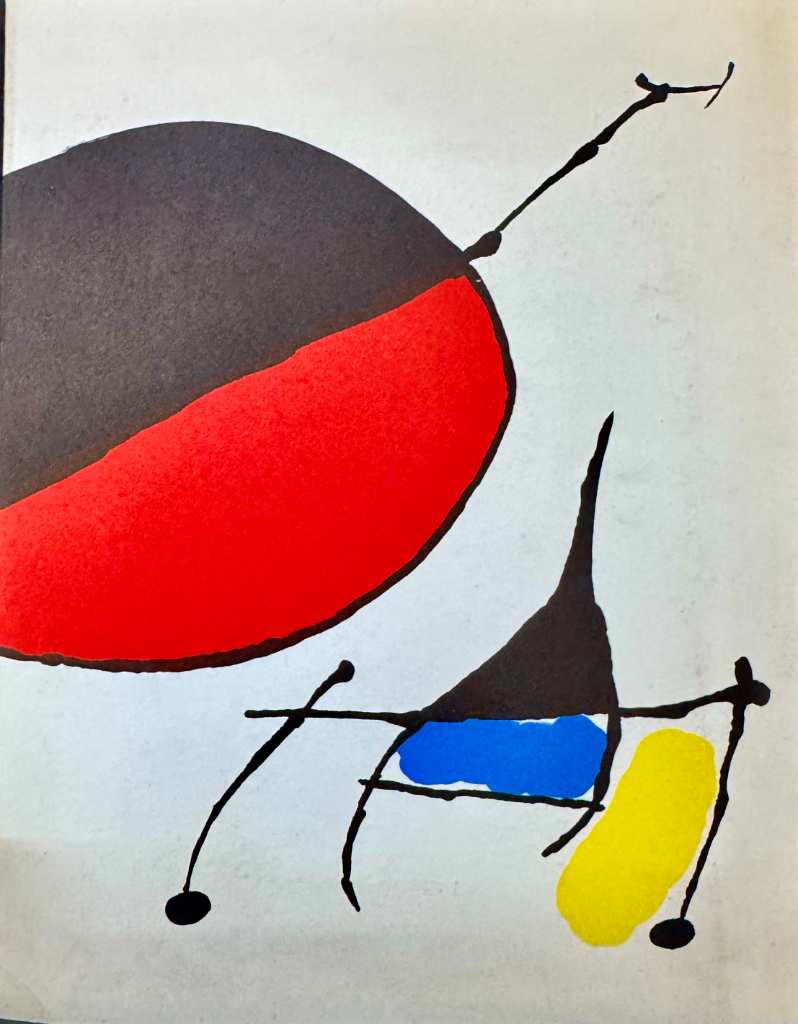
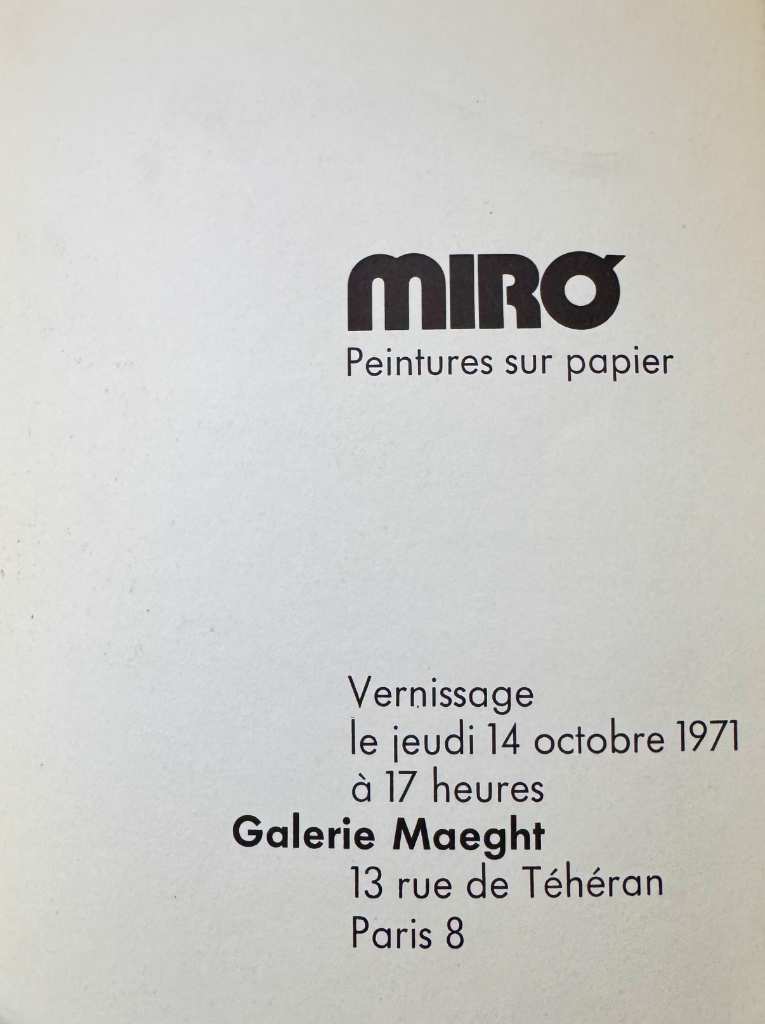
In October 1971, the Galerie Maeght in Paris hosted an exhibition dedicated to Joan Miró's paintings on paper, when the artist was seventy-eight years old and at the height of his expressive maturity. The catalogue accompanying the exhibition represents today a bibliographic document of particular interest, situated at the intersection between art publishing and original printmaking. The first edition copy examined here retains the characteristic cover enhanced by an original lithograph by the artist, printed at the Maeght atelier according to the quality standards that distinguished the publications of the celebrated Parisian gallery.
Bibliographic notes
The volume belongs to the editorial tradition established by Aimé Maeght, who from the 1950s onwards had made his gallery not only a leading exhibition space but also a centre of avant-garde publishing production. Maeght catalogues with original lithographs on the cover constitute a category unto themselves in the landscape of twentieth-century art publishing: not mere documentary tools, but collectable works that merge critical information with artistic creation. The lithograph adorning this catalogue's cover presents Miró's unmistakable visual vocabulary: biomorphic forms in black, vivid red, blue and yellow on a light ground, animated by the characteristic threadlike lines that traverse the compositional space. The print, executed at the Maeght atelier, guarantees the technical quality and authenticity of the artistic intervention, elements that distinguish these publications from common photographic reproductions.
The 1971 exhibition occurred at a crucial moment in Miró's career, when the Catalan artist, after decades of experimentation, had achieved a perfect synthesis between gestural spontaneity and compositional rigour. Paintings on paper represented for Miró a terrain of expressive freedom, where rapidity of execution combined with immediacy of mark-making.
Provenance and condition
The copy presents itself in good general condition, with the well-preserved cover maintaining the chromatic freshness of the original lithograph. This aspect assumes particular importance, considering that many period catalogues have suffered the wear of time, with fading or damage that compromises their aesthetic and collectable value. The absence of specific provenance information does not constitute a penalising element for this type of publication, distributed on the occasion of the exhibition opening and subsequently commercialised through the gallery's channels. The presence of the original lithograph in good condition represents the principal element of value, distinguishing this copy from deteriorated or incomplete examples that occasionally appear on the antiquarian market.
The solidity of the binding and the integrity of the internal pages confirm that the volume has been carefully preserved, probably by a collector conscious of its documentary and artistic value. Maeght catalogues, indeed, have always enjoyed particular attention from bibliophiles and print collectors, who recognise their dual nature as historical-critical document and work of art.
Market value
The market valuation for this catalogue stands in the range between €140 and €220, reflecting the intermediate position that the object occupies in the panorama of Miró collecting. The rarity score of 55 out of 100, corresponding to a "Discrete" index, indicates that this is an uncommon but not extremely rare edition, obtainable with some patience through the specialised channels of the international antiquarian market. The sources consulted—AbeBooks, Catawiki, Maremagnum and Swann Galleries—confirm that similar catalogues from the Galerie Maeght with original Miró lithographs circulate in the market with a certain regularity, although conservative conditions and the quality of the lithographic printing significantly influence the final price.
The value of this copy benefits from several factors: the presence of the original lithograph in good condition, the provenance from one of the most prestigious galleries of the twentieth century, the relatively late date (1971) which places the work in the artist's full maturity. On the other hand, the initial distribution of the catalogue and the very nature of the object—an exhibition edition rather than a livre d'artiste in limited print run—contain its value within limits accessible even to mid-range collectors. For those wishing to approach Miró's graphic universe without facing the investments required by numbered prints or illustrated volumes in limited edition, this catalogue represents an interesting opportunity.
Why it matters
The "Peintures sur papier" catalogue testifies to a significant moment in the history of relationships between artists and publishers in the twentieth century. The collaboration between Joan Miró and the Galerie Maeght, begun in the 1940s and continued for over three decades, produced some of the most refined art publications of the past century. Aimé Maeght had understood that the exhibition catalogue could transcend its documentary function to become itself a work of art, directly involving the artist in the creation of the cover through original techniques such as lithography. This innovative approach transformed Maeght catalogues into collectable objects, sought after as much for their critical content as for their aesthetic value.
For the contemporary collector, owning such a catalogue means preserving a tangible fragment of the exhibition history of one of the undisputed masters of twentieth-century art, in an accessible format that nonetheless retains the authenticity of direct artistic intervention. The original lithograph on the cover is not a reproduction, but a graphic work in its own right, printed with the same techniques and the same care reserved for art prints. In an era when the boundary between original and reproduction becomes increasingly blurred, these catalogues represent a bastion of authenticity, testifying to an epoch when material quality and artistic integrity were non-negotiable values in art publishing.
Comments
Loading…
Sign in or register to leave a comment
Sign in or register