Kandinsky in Munich: vintage photograph of the father of abstraction
Rare gelatin silver print from the Munich period, with French and Italian editorial annotations (ca. 1910, print 1920s-50s)
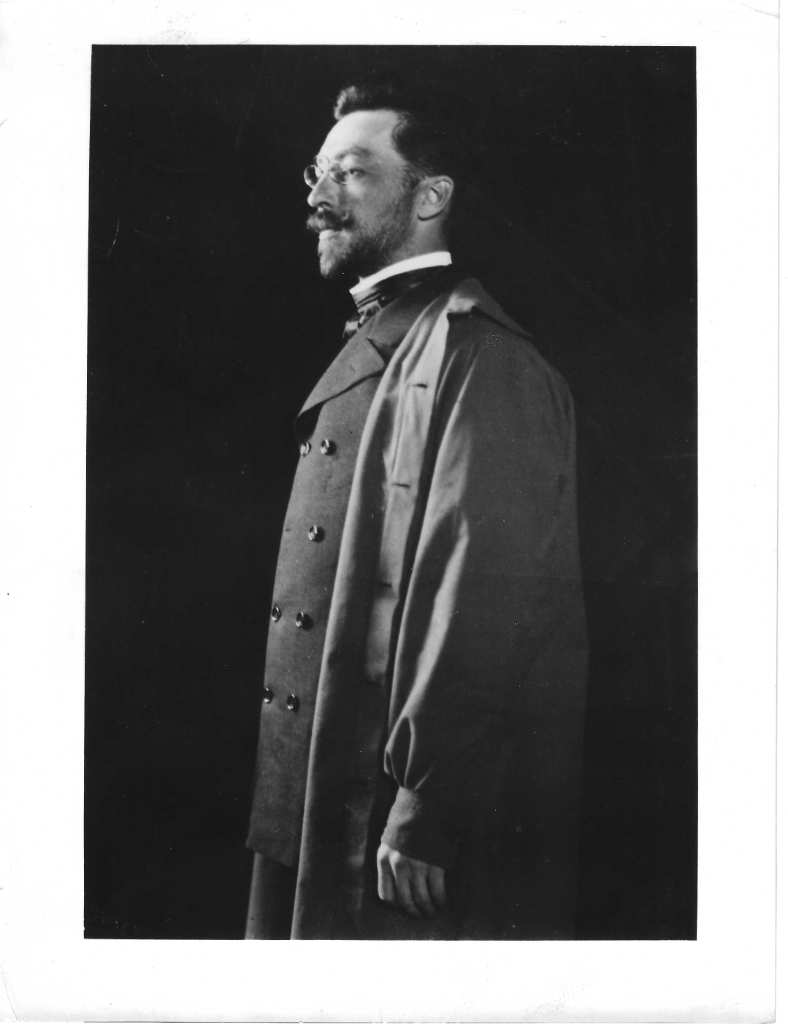
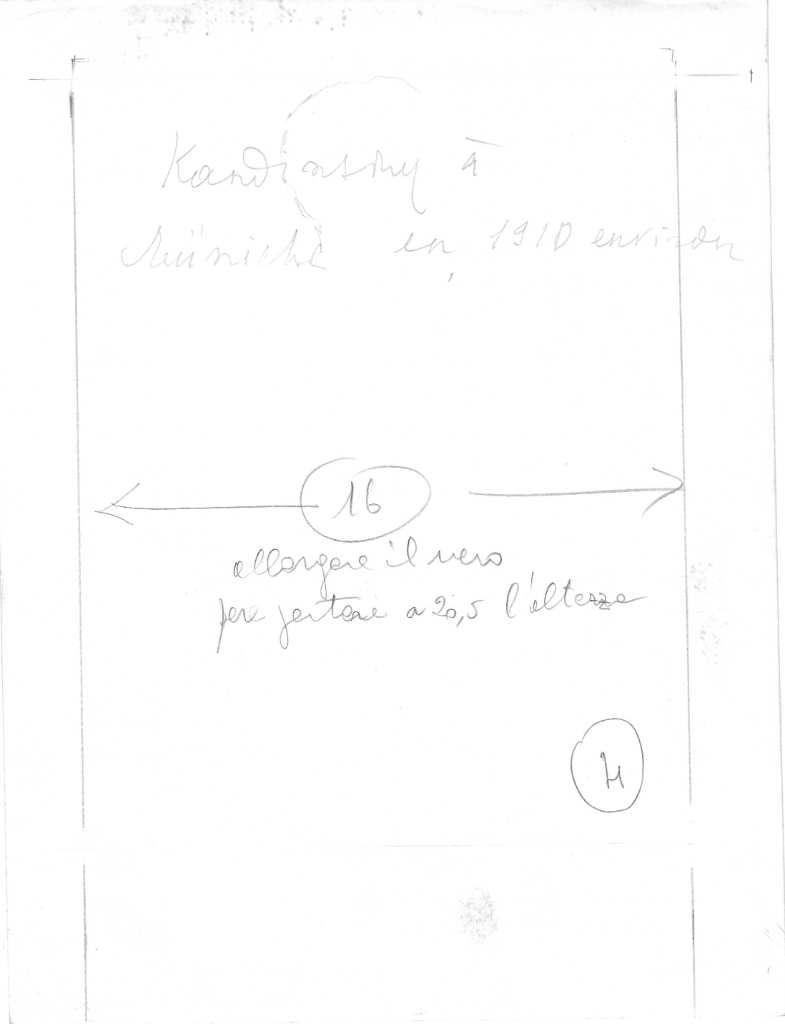
A photograph can capture more than a face: it can crystallise an epoch, a movement, a revolution. This vintage gelatin silver print depicts Wassily Kandinsky around 1910, during the crucial years that witnessed the birth of lyrical abstraction and the Blaue Reiter group. The Russian master appears in profile, wrapped in an elegant double-breasted coat, wearing his iconic pince-nez spectacles and displaying that austere bearing which characterised his presence. The verso carries handwritten annotations in French — 'Kandinsky à München en 1910 environ' — and typographic indications in Italian, unequivocal testimony to the editorial use of the print for an art publication, probably Franco-Italian.
Bibliographic notes
The dating of the subject to circa 1910 places this image at a pivotal moment in modern art history. That year Kandinsky completed his first abstract watercolour and laid the theoretical foundations of 'Über das Geistige in der Kunst' (Concerning the Spiritual in Art), published in 1911. The photograph belongs to the genre of documentary artist portraiture, typical of monographic publications and art journals of the early twentieth century. The absence of the photographer's signature is common for images destined for editorial use of the period, when the subject prevailed over the author of the shot. The bilingual annotations suggest international circulation of the matrix, probably through photographic agencies or editorial archives active between Paris, Milan and Munich.
Provenance and condition
The print presents technical characteristics consistent with vintage production between the 1920s and 1950s: baryta paper, deep silvery tones, soft contrast typical of darkroom techniques of the era. The verso, with its stratified editorial annotations, constitutes a fascinating palimpsest: elegant and precise French handwriting, Italian typographic indications, possible archive stamps or initials. These elements transform the photograph into a document in its own right, witness to the editorial circuits that disseminated Kandinsky's image and thought across post-war Europe. The Italian or Franco-Italian editorial provenance is confirmed by the bilingual annotations, suggesting use for exhibition catalogues, monographs or specialist journals. The state of preservation appears good for its age, with normal traces of use related to editorial handling: possible archive folds, slight marginal oxidation, pencil or ink marks on the verso.
Market value
BookOracle's valuation places this photograph in the €700-1,500 range, with a high rarity index (75/100). The market for vintage photographs of early twentieth-century artists is segmented and sophisticated: images with documented editorial provenance and period annotations achieve significant prices at specialist auction houses such as Lempertz Cologne, Sotheby's Photography, Villa Grisebach and Galerie Bassenge. Analogous photographs of Kandinsky, Klee or Mondrian in vintage prints with annotations have sold for between €600 and €2,000 in recent years, depending on dimensions, condition and iconographic rarity. Kandinsky's Munich period — less photographically documented than his Bauhaus years — confers additional interest on this image. The dual linguistic provenance (French-Italian) broadens the pool of potential collectors, including both the transalpine market and the Italian one, historically attentive to documentation of European modernism.
Why it matters
This photograph is not a simple portrait: it is a window onto Munich 1910, capital of the German avant-garde on the eve of the Great War. Kandinsky had founded the Neue Künstlervereinigung München there (1909) and was about to establish, with Franz Marc, the Blaue Reiter (1911). The image captures the moment when Western painting made the leap towards abstraction, definitively abandoning naturalistic mimesis. The austere profile, the intellectual spectacles, the bourgeois coat: Kandinsky appears here not as a rebellious bohemian, but as a rigorous theorist, a professor of art philosophy disguised as a painter. The editorial annotations on the verso add a layer of meaning: they testify to the reception and dissemination of Kandinsky's image in post-war Europe, when his theories on abstraction became common heritage of the avant-gardes. For the collector of art photography, Kandinsky documents or Blaue Reiter materials, this print represents an acquisition of considerable historical-artistic interest, a tangible piece of the visual revolution of the early twentieth century.
Comments
Loading…
Sign in or register to leave a comment
Sign in or register