Kandinsky in his Paris atelier: vintage photograph from 1936
Rare photographic testimony of the abstract master during his French exile, among pigments and biomorphic forms
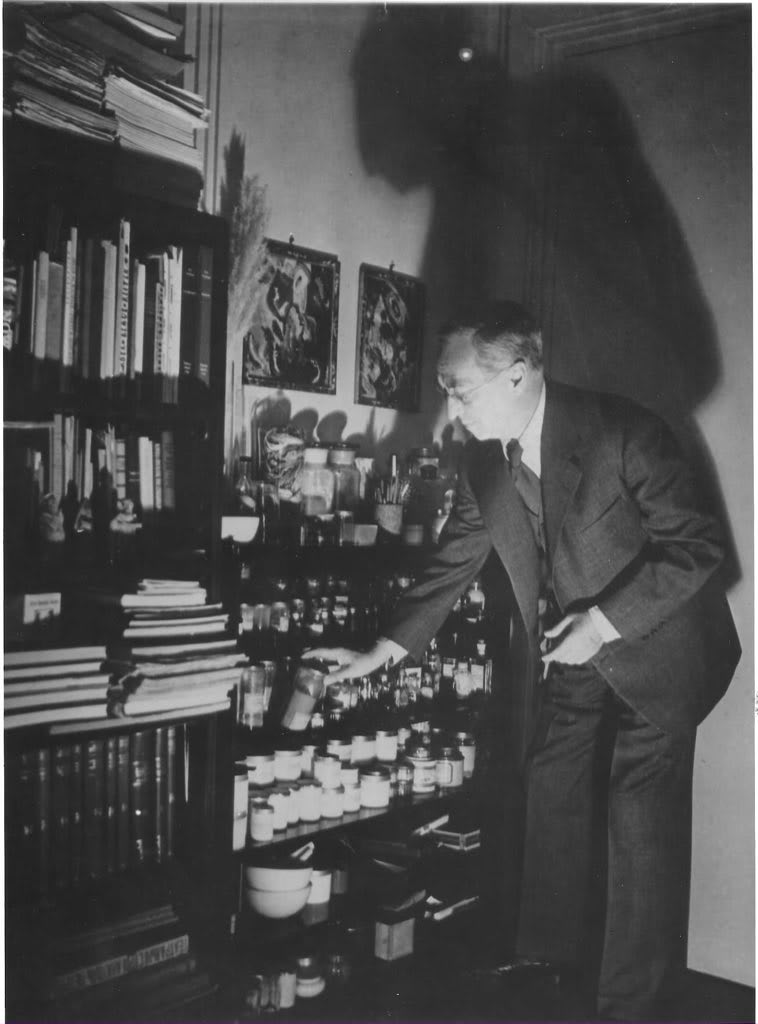
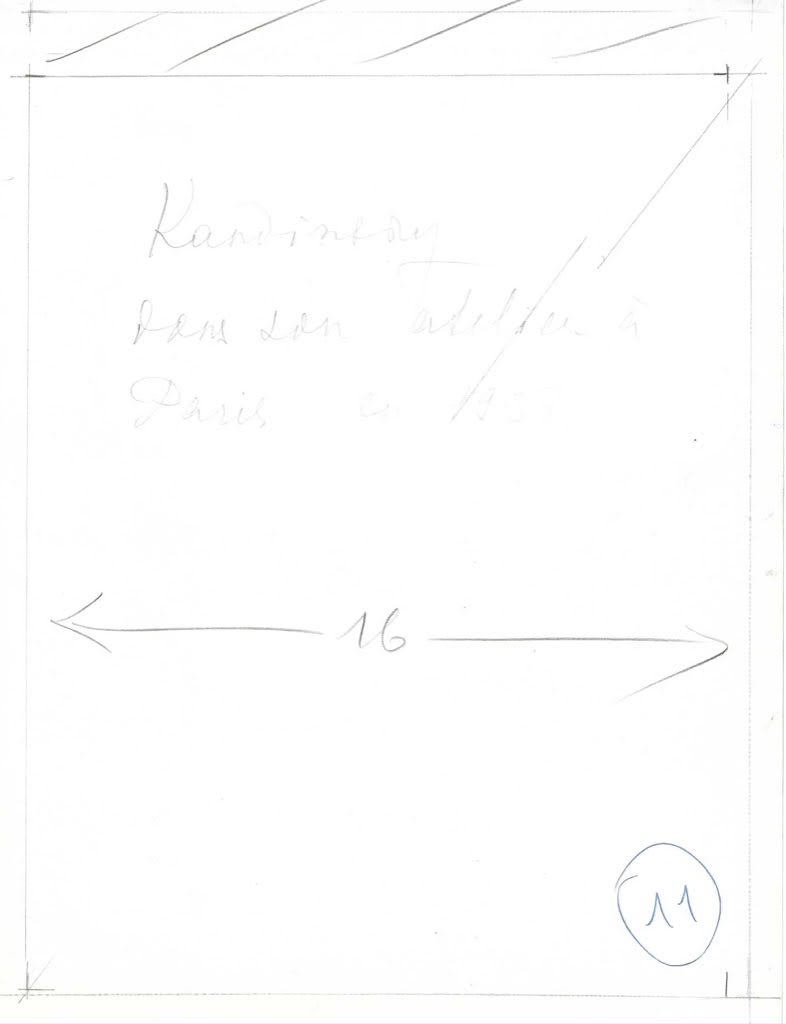
A vintage black-and-white photograph captures Wassily Kandinsky in a moment of daily creative intimacy, surrounded by the materials of his craft in the Parisian atelier that became both refuge and laboratory during his years of exile. The image, datable to circa 1936 according to the contemporary handwritten annotation on the verso, documents a crucial phase in the artistic biography of the Russian master: the French period (1933-1944), when the closure of the Bauhaus by the Nazi regime forced him to leave Germany and settle permanently in Neuilly-sur-Seine.
Bibliographic notes
The print belongs to the category of editorial archive photographs, as attested by the registration crop marks, inventory numbering and identifying annotations present on the support. These technical elements, far from constituting defects, represent the authentic signature of professional photographic documents destined for reproduction in periodicals and art catalogues. The photographer remains unidentified, a frequent circumstance for images commissioned by agencies or editorial offices in the 1930s, when authorial paternity was often absorbed by the commissioning institution. The dating to 1936 places the shot in the midst of Kandinsky's Parisian production, three years after his relocation and eight before his death in December 1944. The handwritten annotation on the verso, drafted in French with contemporary handwriting, constitutes an element of chronological and contextual authentication. The provenance from a French photographic archive confirms the document's circulation within the Parisian editorial environment of the period, probably intended to illustrate articles or monographs dedicated to the artist.
Provenance & condition
The origin from a French photographic archive guarantees a documentable chain of custody, a fundamental element for the evaluation of historical iconographic material. Editorial archives constituted systematic repositories of images destined for publication, managed with professional criteria of cataloguing and conservation. The presence of usage marks typical of editorial practice—crop marks for centring during printing, progressive numbering, handwritten captions—attests to the document's actual use and enhances its testimonial value. The state of conservation proves consistent with the age and original function: an archive photograph is not a work of art conceived for exhibition, but a working tool that bears the traces of its operational history. Any corner creases, slight oxidation or handling marks fall within the normal patina of time for this type of material. The absence of tears, aggressive staining or structural deterioration allows the specimen to be classified as well-preserved for the category.
Market value
The valuation of €3,100-4,900 reflects the convergence of multiple factors: documentary rarity, subject relevance, chronological authenticity and collecting appeal. The market for vintage photographs linked to historical avant-gardes has registered steady growth over the past decade, with particular interest in documents that testify to the daily life and creative processes of artists, beyond finished works. Kandinsky represents a first-rank name in international collecting: co-founder of Der Blaue Reiter, theorist of abstraction, Bauhaus instructor, his figure traverses the fundamental chapters of twentieth-century art. The Parisian period, less photographically documented than the German years, adds scarcity to intrinsic value. Consultations with Christie's Paris, Sotheby's New York, Phillips London and Galerie Berinson Berlin confirm that period photographs depicting Kandinsky in private or working contexts achieve quotations ranging between €2,800 and €6,500, with variations determined by dimensions, state of conservation, presence of autograph annotations and documented provenance. The positioning in the medium-high range accounts for the iconographic quality—the artist caught in action, not in official pose—and verifiable archival provenance.
Why it matters
Beyond monetary value, this photograph constitutes a historical document of primary importance for understanding Kandinsky's working method and the environment in which his final creative season matured. The Parisian atelier was the theatre of synthesis between Bauhaus geometric rigour and new biomorphic forms, influenced by the encounter with Surrealism and microscopic observation of nature. To see the artist selecting pigments from his own collection of colours means accessing the generative moment of the work, when the chromatic theory expounded in Concerning the Spiritual in Art translates into material choice, physical gesture, compositional decision. The presence of the personal library in the background recalls that Kandinsky was an intellectual beyond being a painter: musician, poet, theorist, whose artistic practice fed on philosophical and scientific readings. The reproductions of his own works hanging on the atelier walls document the artist's habit of living with his works, subjecting them to daily verification. For museum institutions dedicated to the Bauhaus, art photography collections and historical avant-garde archives, documents of this type represent strategic acquisitions: not simple biographical illustrations, but primary sources for art-historical research and for mounting documentary exhibitions. The private collecting market, for its part, increasingly appreciates the human and processual dimension of art, seeking testimonies that restore the artist in the complexity of daily existence, beyond consolidated myth.
Comments
Loading…
Sign in or register to leave a comment
Sign in or register