Fontana at the Triennale: Farabola prints document the birth of Spatialism
Pair of 1951 vintage photographs immortalise the revolutionary light ceiling anticipating the famous Cuts
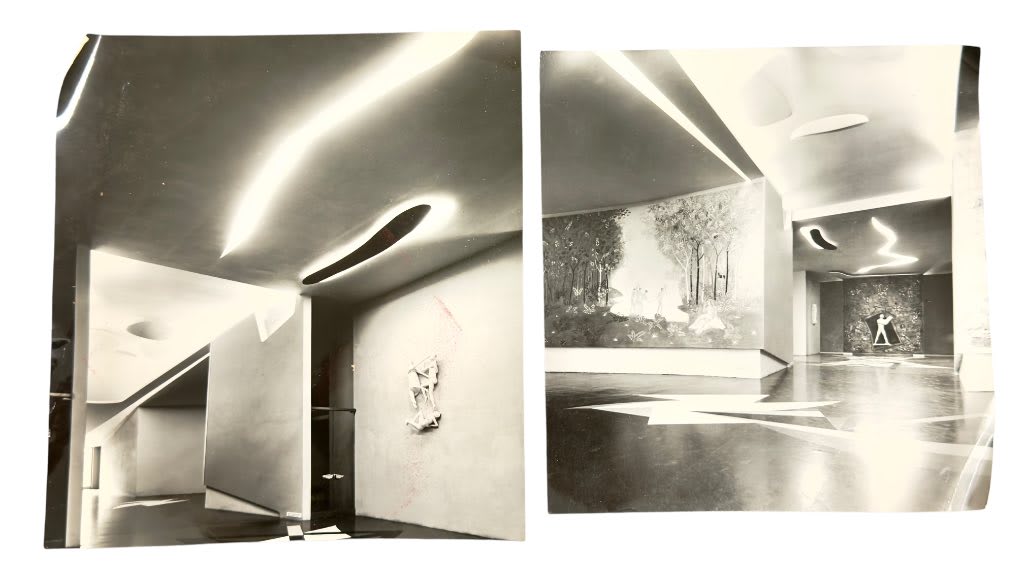
In 1951, when Lucio Fontana created his 'Concetto Spaziale' for the entrance of the IX Milan Triennale, few understood they were witnessing an epochal turning point in twentieth-century art. This pair of vintage gelatin silver photographic prints, executed by the Farabola studio, constitutes visual testimony of primary importance to that foundational event, capturing the moment when Fontana's Spatialism first translated from theory into monumental architectural intervention.
Bibliographic notes
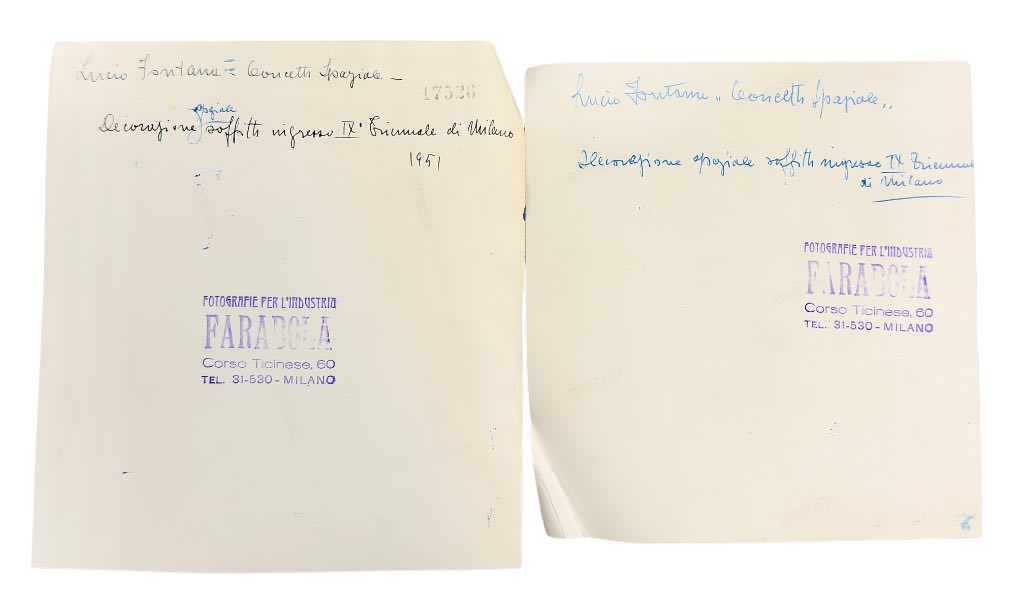
The prints, produced in 1951 by the Farabola photographic studio in Milan, document the environmental installation Fontana conceived for the entrance of the IX Milan Triennale. The studio's stamp on the verso, accompanied by contemporary handwritten inscriptions identifying work, author and occasion, confers immediate authenticity and historical contextualisation. The Farabola studio distinguished itself in the post-war period as a reference point for documenting Italian architecture and design, collaborating with Milan's principal cultural institutions. The gelatin silver technique, the dominant photographic process until the 1970s, guarantees tonal quality and definition that subsequent reproductions have never equalled.
The documented installation represents a direct precedent for the celebrated 'Cuts' on canvas that Fontana would begin producing systematically from 1958. The ceiling with luminous neon cuts translated into architectural form the theoretical principles of the Manifesto Blanco (1946) and the first Manifesto of Spatialism (1947), where the Italian-Argentine artist proclaimed the necessity of surpassing the two-dimensionality of canvas to conquer real space.
Provenance & condition
The photographs presumably derive from the Farabola studio archive or a Milanese private collection connected to Triennale circles. The absence of detailed provenance documentation does not diminish the historical-artistic value, given the presence of direct authentication elements: the photographic studio's stamp and contemporary handwritten annotations on the verso. These elements constitute a form of period certification more reliable than many subsequent documentations.
The state of conservation appears consistent with the prints' age. Vintage gelatin silver photographs from the 1950s typically present a patina testifying to their authenticity, clearly distinguishing them from modern reprints. Any slight marginal oxidation or yellowing falls within the normal evolution of seventy-year-old paper support and does not compromise image legibility or documentary value. The absence of invasive restoration interventions preserves the artefact's historical integrity.
Market value
The valuation of €2,100-4,100 reflects the convergence of multiple factors: documentary rarity, historical-artistic importance, authenticity certified by period elements and conservative condition. The market for vintage photographs documenting artistic events has registered growing interest over the past two decades, particularly when they testify to crucial moments in the careers of masters of Fontana's calibre.
Consultations with Christie's Milan, Wannenes Genoa, Finarte Milan, Phillips London and Maremagnum confirm that period photographs documenting ephemeral installations by second-half twentieth-century artists achieve significant prices, especially when accompanied by direct authentication elements. The Fontana case presents a peculiarity: the 1951 Triennale installation was dismantled at the exhibition's conclusion, rendering these Farabola prints among the few surviving visual testimonies of a lost work.
Direct comparables are difficult to locate on the market, given the subject's specificity. Vintage photographs of Fontana installations from the 1950s appear sporadically at auction, generally within composite lots or broader photographic archives. The presence of the Farabola stamp and handwritten annotations places these prints in the upper range of the valuation bracket.
Why it matters
These photographs transcend the value of simple archival documents to become testimonies of a foundational moment in contemporary art. The 'Concetto Spaziale' of the IX Triennale represents Fontana's first attempt to materialise on architectural scale his vision of an art surpassing traditional painting and sculpture boundaries. The ceiling's luminous neon cuts anticipate by seven years the first 'Cuts' on canvas, demonstrating how the idea of spatial rupture was already fully formed in the artist's mind.
For Fontana scholars, these images constitute primary research material. Criticism has often emphasised the connection between environmental experiences of the 1940s-50s and subsequent canvas production, but visual documentation of those ephemeral installations remains scarce. The Farabola prints fill this gap, offering tangible evidence of conceptual continuity in Fontana's oeuvre.
From a collecting perspective, acquiring these photographs represents a rare opportunity. Fontana's art market concentrates predominantly on canvases, ceramics and works on paper, with prices for 'Cuts' and 'Spatial Concepts' on canvas reaching six or seven figures. These photographic prints offer an alternative access point to the Fontana universe, allowing ownership of direct testimony to a crucial moment at a fraction of the cost of pictorial works.
The IX Triennale of 1951 also marked a moment of cultural rebirth for Milan and Italy in the post-war period. Fontana, returned from Argentina in 1947, positioned himself as a bridge between European avant-gardes and South American ferments, bringing to the Milanese scene a radically innovative vision of artistic space. These photographs document not merely a work, but a cultural climate, an era of experimentation and renewal that would define the face of Italian art in the second half of the twentieth century.
Comments
Loading…
Sign in or register to leave a comment
Sign in or register