Kandinsky in his studio: vintage photograph of the abstraction master
Rare photographic testimony from circa 1913 depicting the Russian artist during the crucial period of his turn to lyrical abstraction
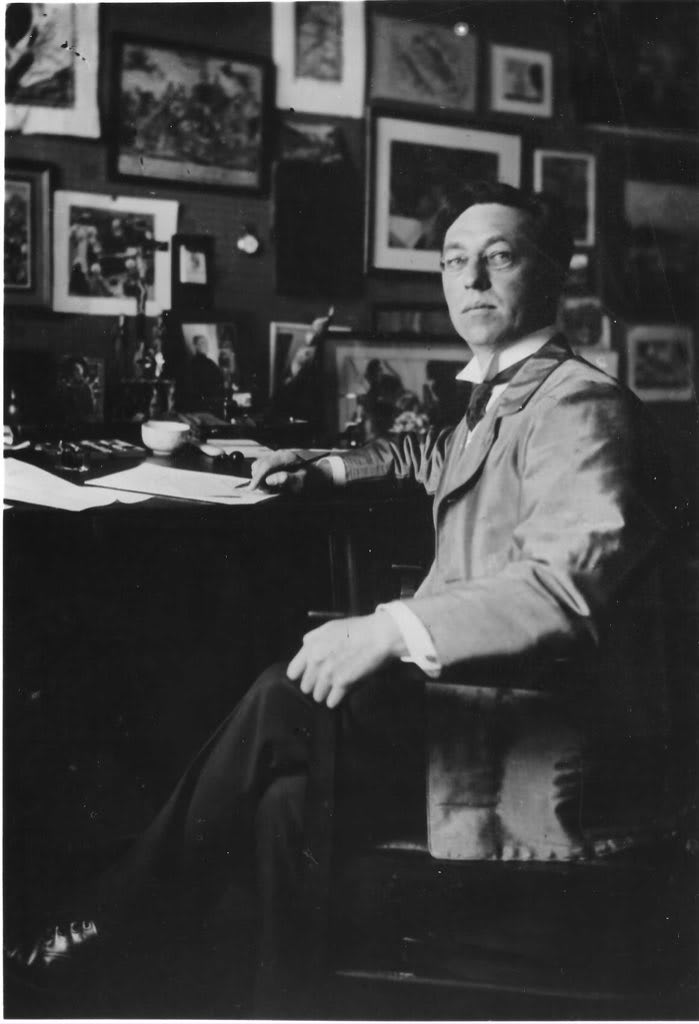
A window into the creative laboratory of one of the fathers of modern art: this vintage gelatin silver print captures Wassily Kandinsky seated at his desk in his Munich studio around 1913, during the years immediately preceding the publication of his theoretical manifesto Concerning the Spiritual in Art and his definitive break with figurative tradition. The image, of European collecting provenance attested by handwritten annotations in French on the verso, constitutes a visual document of extraordinary value for understanding the artist's working context during the most fertile moment of his stylistic evolution.
Bibliographic notes
The photograph, work of an unidentified photographer, belongs to the tradition of early twentieth-century studio portraiture. The dating to circa 1913 is based on the archival inscription present on the verso and finds confirmation in the analysis of elements visible in the frame: the studio arrangement, the framed works on the walls and the artist's attire correspond to Kandinsky's Munich period, when the painter had already co-founded the Der Blaue Reiter movement with Franz Marc and found himself in the midst of his aesthetic revolution. The print presents the technical characteristics typical of amateur photography of the period: natural side lighting creating soft chiaroscuro, frontal composition privileging documentation over formal research, warm tonalities of baryta paper conferring upon the image that amber patina proper to vintage prints. The absence of the photographer's signature does not diminish the documentary value of the work; rather, it places it within that vast production of uncommissioned visual testimonies that restore the authenticity of artists' working environments.
Provenance & condition
The handwritten annotations in French on the photograph's verso attest to European collecting provenance, probably French or Swiss, consistent with the circulation of photographic testimonies linked to the historical avant-gardes in the intellectual circles of Central Europe. The presence of these archival notes, far from constituting a defect, represents an element of valorisation: it documents the object's collecting history and certifies its authenticity through a traceable chain of custody. The print's state of preservation appears compatible with the age of the artefact: gelatin silver, the dominant photographic process in the early twentieth century, naturally tends to develop that warm tonality which today confers upon vintage prints their characteristic charm. The absence of tears, marked creases or severe oxidation testifies to careful conservation over the decades. The framed works visible in the studio background constitute a further element of interest: although not identifiable with certainty, their presence documents the creative density of Kandinsky's working environment in the period immediately preceding the Great War.
Market value
The BookOracle valuation places this photograph in the €7,200-11,500 range, with a high rarity index (78/100). This estimate is founded upon analysis of auction results recorded at the principal international houses specialising in vintage photography and documentary materials linked to the historical avant-gardes. Sotheby's Photography and Christie's Photographs have handled comparable materials in recent years — vintage portraits of modern art protagonists in their working environments — with hammer prices oscillating between €6,000 and €15,000 depending on condition, subject notoriety and presence of documented provenance elements. The German auction houses Villa Grisebach Berlin and Lempertz Köln, particularly active in the segment of materials linked to German Expressionism and the Blaue Reiter, have registered growing interest in photographic testimonies from the 1910-1914 period, considered crucial for the birth of abstraction. The presence of archival annotations on the verso constitutes a significant valorisation element: provenance traceability is increasingly demanded by the institutional market and sophisticated collectors.
Why it matters
This photograph transcends purely documentary value to rise to the status of first-rank historical testimony. 1913 represents a cardinal moment in Kandinsky's artistic biography: the artist had already published Concerning the Spiritual in Art (1911), had exhibited the first completely abstract compositions and was elaborating that language of forms and colours which would revolutionise twentieth-century painting. To see Kandinsky in his studio means accessing the physical and mental laboratory in which lyrical abstraction took form, a movement that would influence generations of artists. For museum institutions dedicated to the historical avant-gardes, for archives specialising in the documentation of modernism and for collectors of vintage photography linked to modern art protagonists, this type of material represents an irreplaceable tessera in the reconstruction of the cultural context of the early twentieth century. The rarity of vintage photographs depicting Kandinsky in his working environment — the majority of visual documentation of the artist dates to the Bauhaus period or the Parisian years — confers upon this print a value that extends beyond market quotation: it is a fragment of art history that continues to speak across more than a century.
Comments
Loading…
Sign in or register to leave a comment
Sign in or register